
News
PPHN Prabowo's green light for Soeharto's ghost
Tenggara Strategics August 31, 2026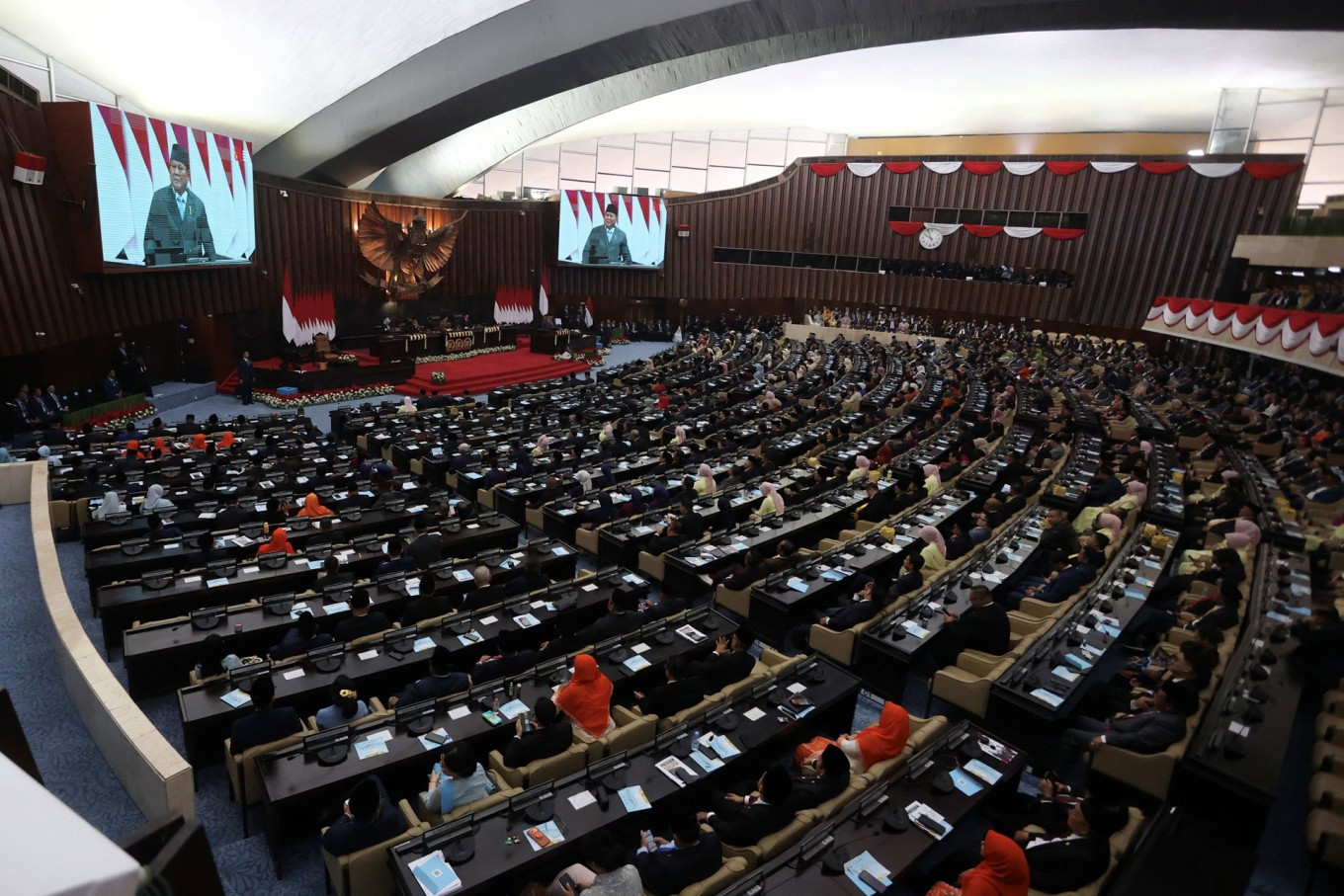 President Prabowo Subianto is displayed on screens as he delivers his annual State of the Nation address ahead of the country's 81st Independence Day anniversary in front of the members of the legislative bodies during the People's Consultative Assembly (MPR) plenary session on Aug. 14 at the Senayan Legislative Complex in Central Jakarta. (Reuters/Stringer)
It is almost a done deal. After a decade of false starts under President Joko "Jokowi" Widodo, the push to revive a binding state roadmap, the Pokok-Pokok Haluan Negara (Principles of State Policy, or PPHN), finally has what it lacked: political consensus and a president willing to back it.
When Ahmad Muzani, chair of the People’s Consultative Assembly (MPR), met President Prabowo Subianto earlier this month, the message was unmistakable. Prabowo endorsed the idea of a PPHN as a long-term national development blueprint and left the mechanism to the MPR. For MPR leaders, that was the signal they had been waiting for.
The politics are ready. The law is not. PPHN did make it to the agenda of this year’s MPR session, which opened Aug. 14. But the proponents aren’t giving up. To make PPHN binding, lawmakers must amend the Constitution. That means clearing the high bar of Article 37 of the Constitution: support from at least one-third of MPR members to propose the amendment, a two-thirds quorum and majority approval of all members.
That is now the last hurdle. If it succeeds, the consequences will be profound. A constitutionalized PPHN would bind future presidents to guidelines set by the MPR. Defying those guidelines would not simply be bad policy. It could become a constitutional violation, and the sitting president could be impeached. In practice, it would shift accountability away from voters and toward the MPR. And that is why critics see PPHN as more than a planning document. This is GBHN by another name.
Indonesia abandoned the Garis-Garis Besar Haluan Negara (Guidelines of State Policy, or GBHN) in 2000 because the Reform Era rejected the idea that the MPR should dictate a single national blueprint. Soeharto, Indonesia’s second president from 1966-1998, showed why. Under the New Order, the MPR issued the GBHN and the president served as the assembly's mandataris, or the mandate carrier. Because Soeharto controlled the MPR, he controlled both the blueprint and the office charged with implementing it. The system repeatedly renewed itself. Soeharto won re-election five times.
Supporters of PPHN argue the comparison is unfair because today's MPR no longer elects the president. Critics argue that that is precisely the problem. A body that does not choose the president cannot logically issue a binding mandate to the president. Restore the mandate, and in due time pressure will build to restore the election mechanism that gives it meaning. That is why opponents see PPHN as a potential first step toward rolling back direct presidential elections.
The test case is already emerging. The House of Representatives is discussing ways to phase out direct regional elections (pilkada) and replace them with appointments or indirect elections through local legislatures. Prabowo has advocated that approach for more than a decade. In 2014, his coalition even succeeded in abolishing direct pilkada before the move was reversed following public protests.
His broader view has been consistent. He has repeatedly criticized Indonesia's democratic system as costly, inefficient and messy. From that perspective, a president constrained by an MPR blueprint and regional leaders chosen through political institutions is not a democratic regression. It is institutional improvement.
Would Prabowo benefit personally? Only up to a point. Like Soeharto, he would need enough control of the DPR and MPR to secure reelection and lock successors into his policy framework. But unlike Soeharto, he lacks time. Soeharto took power at 46 and spent decades consolidating his system. Prabowo will be 78 in 2029.
PPHN is unlikely to produce another Soeharto. What it could produce is Soeharto's architecture without Soeharto: a stronger MPR, a more constrained presidency, appointed regional leaders and a growing skepticism toward direct elections.
The Reform Era dismantled that architecture a quarter-century ago. The debate over PPHN will reveal how much of it Indonesia is prepared to rebuild.
What we've heard
Leadership of the MPR submitted a draft of the PPHN to President Prabowo at the Merdeka Palace on Aug. 3. Although the document remains a work in progress, MPR Speaker Ahmad Muzani stated that the submission was intended to initiate discussions with the President regarding its core substance.
Related Articles