
News
Rosy labor figures conceal deeper cracks
Tenggara Strategics August 31, 2026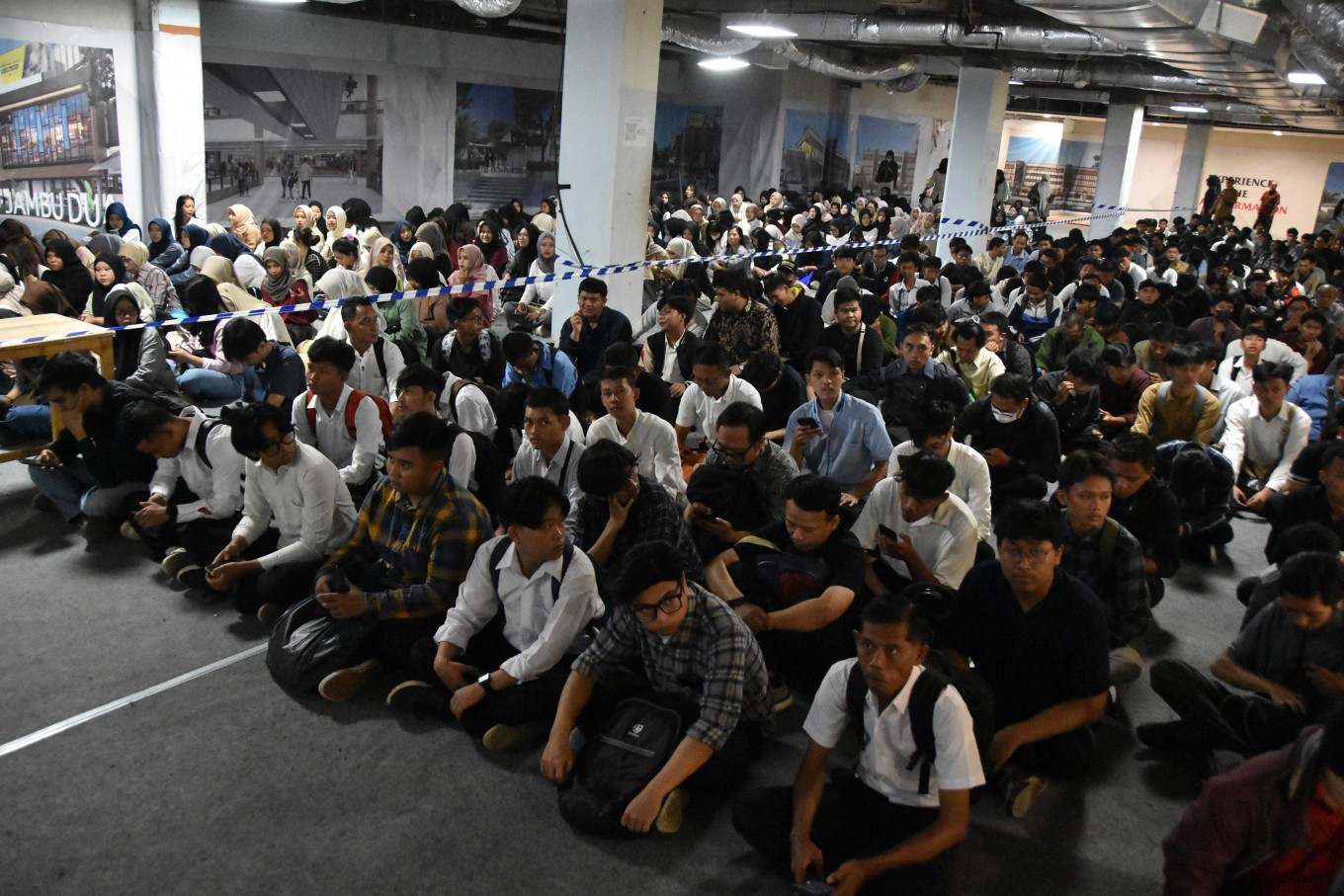 Jobseekers wait in line during the opening of the 2026 Bogor Job Fair at Plaza Jambu Dua in Bogor, West Java, on June 8, 2026.) (Antara/Arif Firmansyah)
Indonesia’s labor market resembles a polished façade concealing deeper cracks. Official figures show headline unemployment falling, yet the recovery has not created enough quality jobs for the country’s growing educated workforce. Education has long been seen as the first step up the social ladder, opening the way to secure employment and a better life. Today, however, more than 1 million university graduates are unemployed, exposing a troubling reality: A degree no longer reliably opens the doors it once promised.
The contrast becomes clearer in the latest data from Statistics Indonesia (BPS). The open unemployment rate edged down to 4.65 percent in May 2026, while the number of unemployed people fell by around 24,000 over three months to 7.22 million. Yet more than 1 million of those without work, or 14.3 percent, held a university degree. Their share has nearly doubled from around 8 percent in August 2022.
The unemployment rate among people with at least a bachelor’s degree has also moved in the opposite direction, rising from 4.80 percent in 2022 to 5.39 percent in 2025. The divergence suggests that Indonesia’s labor market may be improving in aggregate, but it is not creating enough suitable jobs to keep pace with the country’s expanding pool of university-educated workers.
Graduates from some of Indonesia’s largest fields dominate the jobless pool. The Institute for Economic and Social Research at the University of Indonesia (LPEM UI) found that management, law, economics, education, accounting and computer science together accounted for around 40 percent of unemployed university graduates in August 2025. This does not necessarily mean that these fields have the highest unemployment rates, as many of them also produce large numbers of graduates.
Rather, it shows how graduates from broad and popular disciplines are increasingly competing for a limited pool of similar entry-level jobs. Even computer science, long associated with strong employment prospects, is not immune, as rapidly changing industry demands and uneven training quality complicate graduates’ transition into the workforce.
These concerns echo broader complaints from employers about the mismatch between the skills available and those businesses require. Indonesian Employers Association (Apindo) chair Shinta W. Kamdani has cited this mismatch alongside weak formal job creation and the continued dominance of informal employment, while an Apindo survey found that only 26 percent of businesses considered the available workforce suited to their needs.
Graduate unemployment, therefore, reflects both sides of the equation. Universities are not always equipping students with relevant skills, while the economy is not generating enough suitable jobs even for those who possess them.
Yet the skills mismatch tells only part of the story, as the structure of available jobs presents another obstacle. As of May 2026, 59.31 percent of Indonesian workers were in informal employment, which typically offers lower productivity and income, weaker job security and more limited access to protections such as severance pay, workplace accident insurance and old-age security.
Much of the recent increase in employment has also come from people working for themselves. While this may appear to signal growing entrepreneurship, some economists see it instead as necessity-driven self-employment, with workers creating their own livelihoods because stable, salaried positions remain out of reach. In this context, falling unemployment does not necessarily indicate better employment; it may simply mean that more people are accepting precarious work because they have few alternatives.
This limitation matters when assessing the Prabowo-Gibran administration’s campaign pledge to create 19 million jobs. The promise cannot be judged by the unemployment rate alone. Under BPS methodology, anyone who worked for at least one hour during the reference week is classified as employed. In a labor market where nearly six in 10 workers are informal, millions can therefore disappear from the unemployment statistics without securing adequate wages, stable hours or meaningful protection.
A graduate who takes occasional gig work or starts a precarious microbusiness may no longer count as unemployed, even if the work bears little relation to their qualifications or offers no viable career path. The government could thus claim a statistical victory while leaving the underlying employment crisis largely unresolved.
Ultimately, the administration’s employment record should not be judged by numbers on paper, but by whether new jobs are formal, productive, adequately paid and suited to an increasingly educated workforce. Closing skills gaps matters, but training graduates for jobs that barely exist is no solution. The harder task is turning growth and investment into stable employment that uses their qualifications and offers a path out of informality. Without better jobs, the headline numbers may improve while workers’ prospects do not.