
News
When free meals program turns into political battleground
Tenggara Strategics June 29, 2026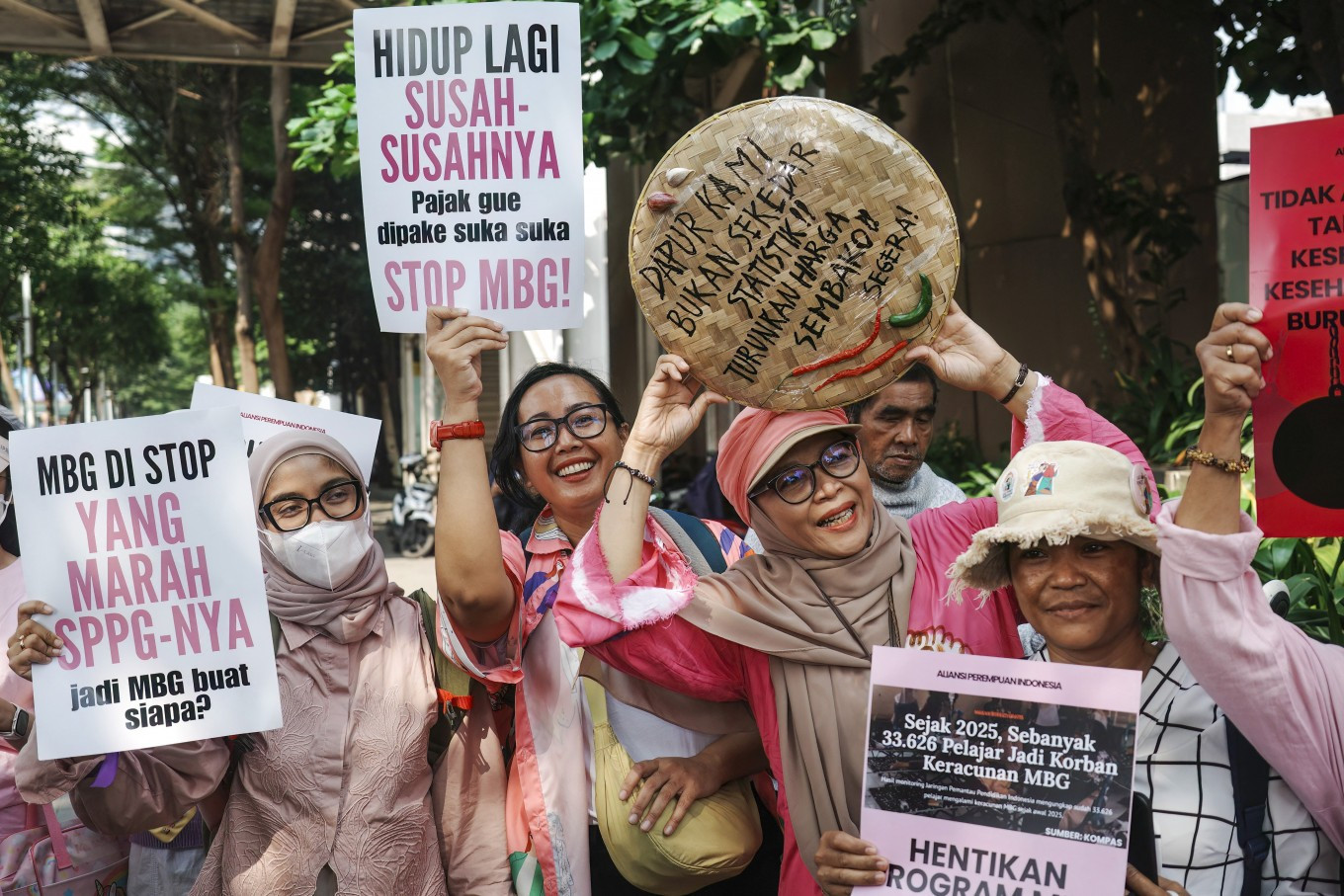 Women carry kitchen utensils and display posters, one of which reads “Life is already hard, taxes are used as they please,“ during a protest demanding the government review the free meal program, lower fuel prices, and open more job opportunities for women, in Jakarta on June 18, 2026. (Photo by BAY ISMOYO / AFP) (AFP/Bay Ismoyo)
The corruption scandal engulfing the National Nutrition Agency (BGN) has significantly amplified public skepticism toward President Prabowo Subianto’s flagship free nutritious meal program. What began as policy criticism has since escalated into street protests.
By late June 2026, the Attorney General’s Office (AGO) had named six suspects in an alleged graft case involving the governance of the program for the 2025–2026 fiscal years. The suspects include three former senior BGN officials, alongside Asep Yusuf Somantri, a close associate of former BGN deputy head Sony Sonjaya; Andri Mulyono, a commissioner at PT Yasa Artha Trimanunggal; and Glory Harimas Sihombing, chairman of the Indonesia Food Security Review Foundation.
The investigation deepened when Sonjaya reportedly disclosed 41 names allegedly involved in the illicit trading of Nutrition Fulfillment Service Unit (SPPG) locations. While Sonjaya sought justice collaborator status, prosecutors rejected the request, arguing that he functioned as a principal actor rather than a secondary participant capable of exposing higher-ranking figures. Meanwhile, the AGO has left open the possibility of questioning the newly appointed BGN head, Naniek S. Deyang. Because Deyang previously served as the agency's deputy head, her promotion has drawn sharp scrutiny from observers who argue that promises of institutional reform ring hollow when leadership changes amount to little more than an internal reshuffle.
Constitutional review petitions challenging the diversion of education funds for the free meals program are currently being examined by the Constitutional Court. Chief Justice Suhartoyo indicated that the court aims to conclude its review of the three petitions by the end of June, with formal rulings expected in July. This judicial process will be pivotal, not only for determining the legitimacy of this specific funding mechanism but also for clarifying the limits of executive discretion over constitutionally protected public resources.
As these legal battles unfold, public opposition on the ground has intensified. Dissatisfaction has manifested in a wave of nationwide demonstrations, accompanied by broader criticism of President Prabowo's governing style, which protesters link to contemporary economic hardships. This unrest has mobilized diverse coalitions of students, women's groups and civil society members across major urban centers, including Makassar, South Sulawesi; Denpasar, Bali; Bandung, West Java; Semarang, Central Java; and Jakarta.
Political researchers argue that this widespread friction cannot be uncoupled from perceptions of an increasingly centralized, top-down governance model. The fact that dissent now extends well beyond traditional student movements suggests that concerns over the program are no longer confined to political activists, but are resonating deeply at the grassroots level.
Conversely, a distinct counter-mobilization has surfaced. Employees and operators of the SPPGs recently rallied near the National Monument in Jakarta to voice their support for the initiative. Teachers, students, kitchen staff and service unit owners participated in the demonstration, emphasizing the program's tangible nutritional benefits and demanding its uninterrupted continuation.
However, political observers caution against interpreting these pro-program rallies as entirely spontaneous expressions of public goodwill. Governments facing crises of legitimacy have historically relied on structured counter-narratives and organized support bases to reshape public perception.
The timing of these pro-free meals demonstrations is also telling, coinciding with the BGN's decision to temporarily suspend the program during the 18-day school vacation period. During this hiatus, SPPG operators forfeit the Rp 6 million (US$335) daily operational incentives typically provided by the government.
Even if support for the continuation of the program is entirely authentic, it is heavily viewed through the lens of economic self-interest. This shifts the broader debate surrounding who truly represents the program’s rightful beneficiaries. While the initiative was originally designed to improve childhood nutrition and elevate educational outcomes, the controversy has increasingly centered on the commercial actors embedded within its implementation chain.
What we've heard
The AGO has named Glory Harimas Sihombing, a suspect in an alleged corruption case involving the free nutritious meal program, chairman of the Indonesia Food Security Review (IFSR) Foundation. According to a source familiar with the investigation, Glory allegedly sold off free meals program kitchen projects allocated to him, including facilities managed under the IFSR Foundation. "The evidence is strong," the source said.