News
The shadow coup within NU: A paradox of power
Tenggara Strategics December 24, 2025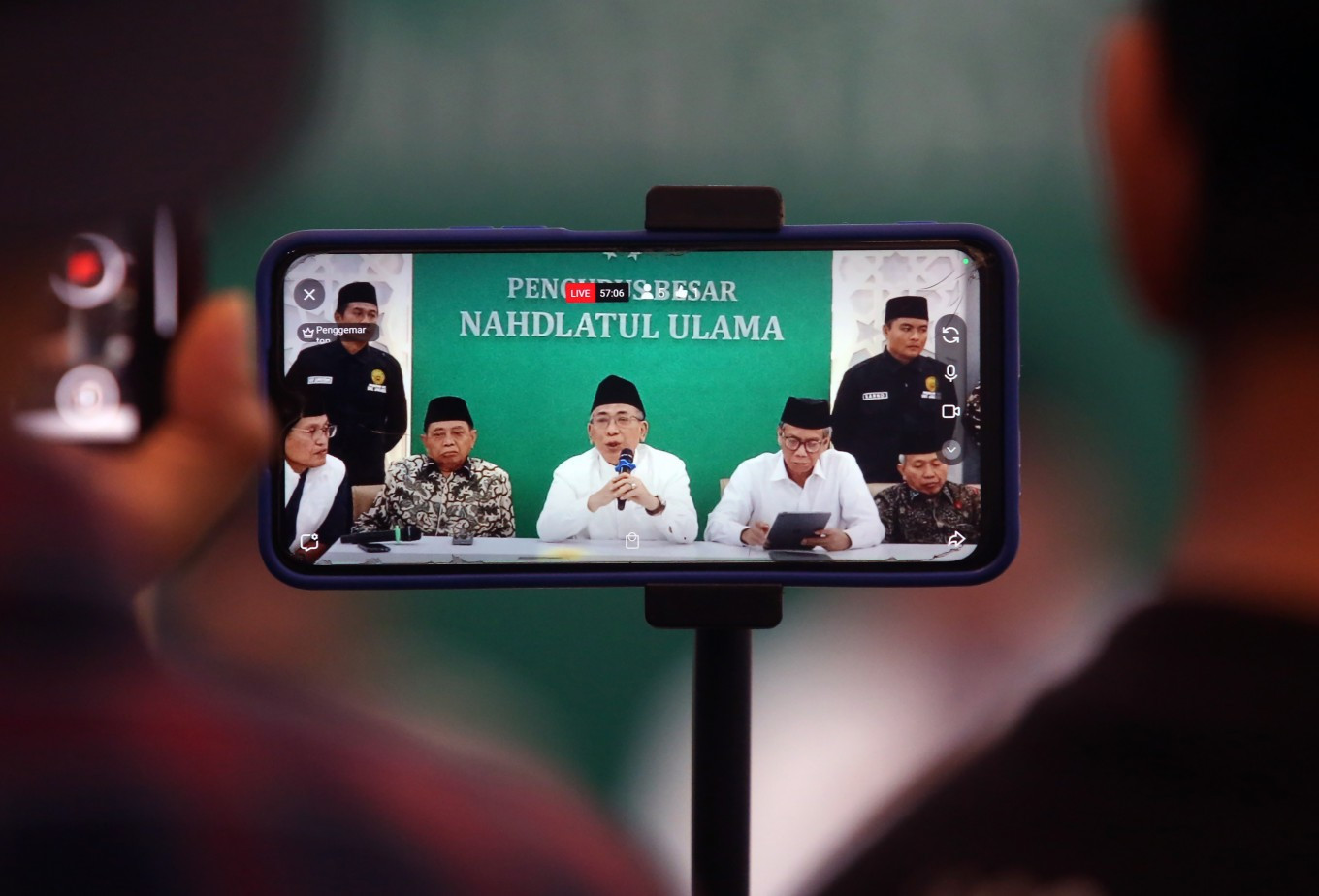 Indonesia’s largest Islamic organization Nahdlatul Ulama (NU) chairman Yahya Cholil Staquf (center), accompanied by the organization’s deputy chairman Masyhuri Malik (second left) and secretary-general Amin Said Husni (second right), gives a press statement on Dec. 3, 2025, regarding the refusal to step down as chairman in Jakarta. (Antara/Muhammad Iqbal)
In a surprising turn of events to cap off the year, Nahdlatul Ulama (NU), Indonesia's largest Muslim organization, has been shaken by turmoil that many observers are calling an internal coup. At the center of the storm is the sudden political ousting of Yahya Cholil Staquf as chairman of NU’s executive body Tanfidziyah.
The catalyst for his removal was Yahya's invitation of Peter Berkowitz, an academic described by critics as having ties to an "international Zionist network", to an internal NU event in August. Yahya, who has a history of engagement with Israel, apologized for the invitation, but it was to no avail.
While Yahya has refused to yield his position, the Syuriah, the organization’s supreme council, moved unilaterally. In an official plenary session held in Jakarta on Dec. 9, the council named senior NU cleric Zulfa Mustofa as the group's acting chairman. The move carried significant political weight, evidenced by the attendance of high-profile government officials and senior NU members: Religious Affairs Minister Nasaruddin Umar, Social Affairs Minister Saifullah Yusuf and East Java Governor Khofifah Indar Parawansa.
At face value, the move against Yahya appears paradoxical. Since his election as chairman of PBNU’s Tanfidziyah in 2021, Yahya has been widely perceived as a staunch ally of the ruling government. Under his leadership, NU has taken pragmatic, some say controversial, steps to align with state policies. Most notably, this included accepting mining concessions under a government scheme allowing mass organizations to manage coal mines.
This concession was formalized through a controversial revision of the Mining Law earlier this year. The law was ratified in just three days without meaningful public or expert consultation, sparking significant backlash. Supporters framed the deal as a path to financial independence for NU, while critics viewed it as a moral compromise that tethered the religious organization too closely to extractive interests and state patronage.
That said, internal power struggles are not new to the current political climate. Late last year, when President Prabowo Subianto was still president-elect, the Indonesian Chamber of Commerce and Industry (Kadin) underwent a similar upheaval. Its then-chairman, Arsjad Rasjid, who had led rival candidate Ganjar Pranowo's campaign, was ousted in favor of the Prabowo-backed Anindya Bakrie. Arsjad initially contested the move as unconstitutional but eventually stepped aside after a compromise was reached.
However, the current NU debacle presents a crucial difference. The Kadin coup was a move against a political rival. Yahya, by contrast, has given no indication of opposing state authority. If Yahya is indeed aligned with the government, why has he become the target of an internal purge?
Observers point towards a proxy war between business factions. One faction within NU is believed to be close to Garibaldi ‘Boy' Thohir, a prominent coal magnate and brother of Youth and Sports Minister Erick Thohir. Another faction is linked to Hashim Djojohadikusumo, a key political financier and Prabowo's brother. Yahya has often been associated with figures close to Hashim, raising the question: why would a faction linked to the President's inner circle allow, or perhaps even orchestrate, his removal?
The contradictions deepen when considering the role of former vice president Ma'ruf Amin. A senior NU cleric, Ma'ruf has long been one of Yahya's most important allies. Yet, Yahya's replacement, Zulfa Mustofa, happens to be Ma'ruf's nephew. Zulfa claims he received his uncle's blessing to assume leadership.
This claim, however, clashes with the former vice president's public stance. Ma'ruf has openly rejected the manner of Zulfa's appointment, declaring Yahya's ousting illegitimate. He argues that under the group's constitution, a change in leadership cannot occur through a mere plenary session; it requires an Extraordinary Muktamar (Congress), reserved for emergency situations.
With NU now effectively split into dual leaderships, and Yahya continuing to assert his legitimacy, the organization is trapped in a stalemate marked by paradoxical power plays. Given the magnitude of the rift, it remains to be seen whether the Prabowo administration will intervene to resolve this quiet coup d'état.
What we've heard
A source said the NU's internal rift was triggered by a struggle over mining control between the two factions. Saifullah's camp pushed Yahya, as a senior executive of the NU-established mining corporation, to sign the Work Plan and Budget, which is due in December 2025. Yahya, however, is reluctant, citing the interest of another businessman seeking to manage NU's mining concession in East Kalimantan. "As long as the contractor remains unclear, this conflict will continue," the source said.
According to the official, both factions are claiming legitimacy over NU leadership because the Tanfidziyah chairman is set to serve as the head of the company managing the mining operations. The signature of the company's chief executive will determine whether the agreement with the contractor proceeds.
There are two parties interested in managing NU's mining concessions. The first is a company affiliated with Boy Thohir, and the second is Hashim.
The government has yet to take an official stance. However, several of Prabowo's close associates attended the Syuriah meeting that appointed Zulfa as acting chairman. Among them were ministers Saifullah and Nasaruddin.
According to sources familiar with NU's internal dynamics, Prabowo has long kept his distance from Yahya's family.
Related Articles