
News
Meikarta to Tanah Abang: Public housing in private hands
Tenggara Strategics April 16, 2026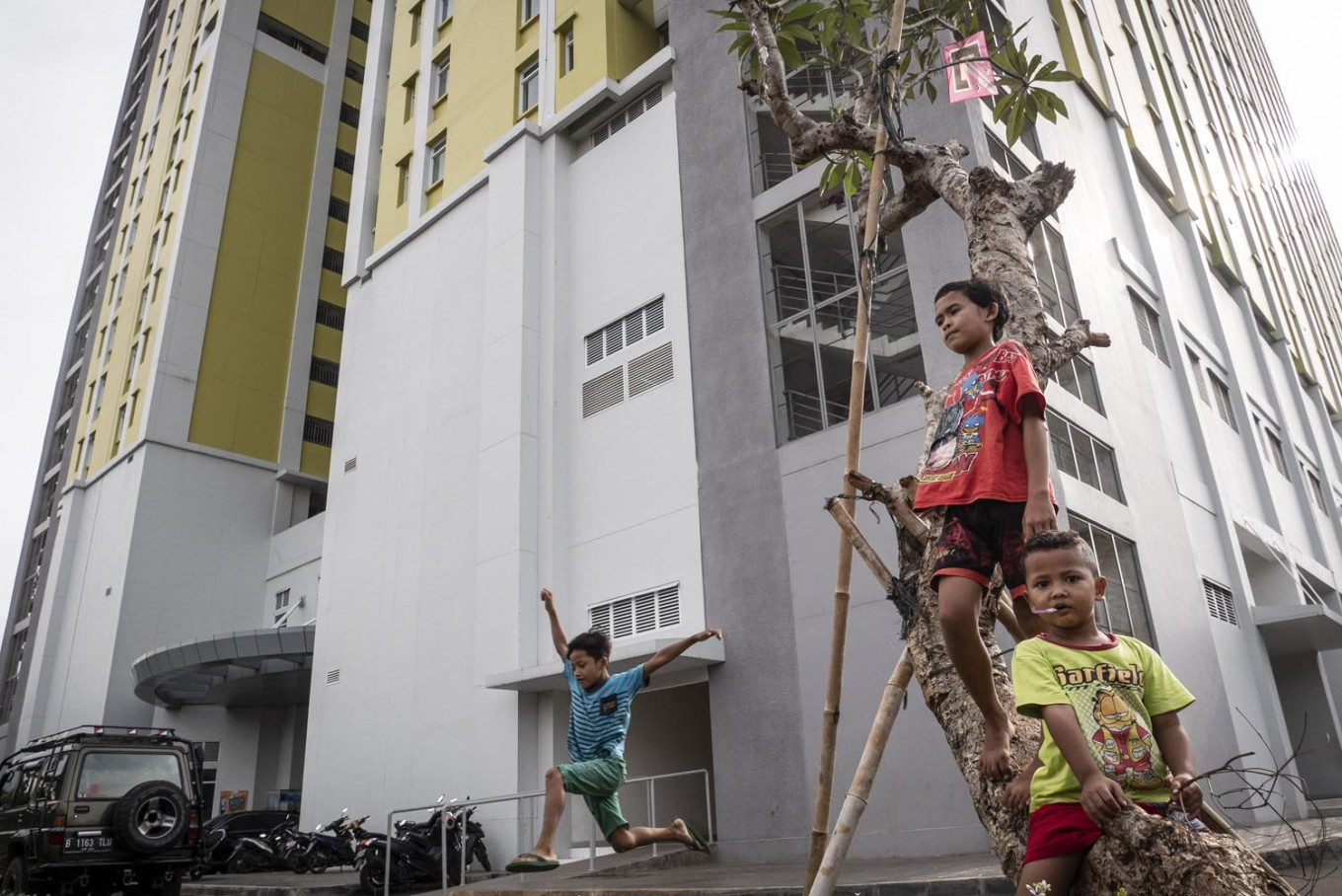 Children play on May 4, 2020, in the yard of the Pasar Rumput Simple low-cost apartment (rusun) in South Jakarta. (Antara/Dhemas Reviyanto)
Of its plan to deliver 3 million homes, the government is partnering with state-owned PT Kereta Api Indonesia (KAI) and PT Astra International to build 1,000 low-cost flats on KAI-owned land in Tanah Abang, Central Jakarta, financed through Astra’s corporate social responsibility (CSR) scheme. While the model appears efficient, it raises a key question: Is this a sustainable solution to Indonesia’s housing shortage, or merely a stopgap that masks deeper structural gaps and potential quid pro quo dynamics?
The 3-million housing program is one of President Prabowo’s flagship initiatives to expand access to affordable housing and reduce regional disparities. Achieving this target requires substantial financing, pushing the government to move beyond the state budget and increasingly rely on private sector participation.
Astra International’s involvement reflects this broader shift toward public–private collaboration. The company plans to develop affordable apartment units on PT KAI’s land in Tanah Abang, a strategically located site with strong long-term residential potential. Each unit will be around 35 square meters with two bedrooms, targeting lower-income households.
Under the arrangement, the government provides the land while Astra handles construction, with the completed units to be handed back to the state. While this project illustrates how private participation can help accelerate housing supply, it also highlights a growing dependence on corporate actors in delivering what is fundamentally a public good.
Housing and Settlements Minister Maruarar “Ara” Sirait has outlined various schemes to accelerate the construction of subsidized flats, with land sourced from state assets, state-owned enterprises (SOEs), ministries and local governments. Development may involve a mix of actors, including SOEs, government institutions and private firms, while financing extends beyond the state budget to include CSR and other alternative mechanisms.
However, the increasing reliance on CSR as a financing instrument raises a more fundamental concern. Public housing is inherently a core state responsibility, and its provision through corporate philanthropy reflects a growing dependence on private actors to deliver what has traditionally been a public mandate. This blurring of roles not only represents a pragmatic response to fiscal constraints but also signals a gradual redefinition of the state’s responsibility in delivering social welfare.
A similar pattern can be seen in the planned repurposing of the Meikarta project in Cikarang, Bekasi, owned by the Lippo Group. Once a high-profile development stalled by regulatory and legal controversies, the site is now being repositioned as part of the government’s subsidized housing strategy.
Reports indicate that around 30 hectares of land from the Meikarta project will be made available for development, with plans to construct up to 141,000 housing units valued at approximately Rp 39 trillion (US$2.36 billion). While framed as a contribution to public housing provision, the notion of “free” land warrants closer scrutiny. In practice, such asset transfers are rarely detached from broader economic considerations.
A similar question can be raised regarding Astra’s involvement in the Tanah Abang project, given the conglomerate’s experience with the revocation and subsequent reinstatement of the mining permit for Agincourt Resources, a unit under its subsidiary PT United Tractors. The housing project could be interpreted as indirectly aligned with the restoration of Agincourt’s license.
While there is no explicit evidence of direct exchanges, the coexistence of regulatory discretion and corporate participation in CSR-funded housing programs raises the possibility of implicit alignment between state priorities and business interests. This dynamic is particularly consequential in the context of public housing, which remains a core state responsibility.
As private actors take on a growing role, the line between voluntary corporate contribution and structurally induced participation becomes increasingly blurred, complicating how such initiatives should be interpreted within Indonesia’s broader welfare framework.
In this light, Indonesia’s housing push reflects not only a question of scale, but also of institutional direction. Leveraging private participation may offer short-term gains in accelerating supply, yet it risks embedding a model in which the fulfillment of basic social needs becomes contingent on corporate alignment rather than guaranteed by the state. Without clearer boundaries and accountability mechanisms, such arrangements may gradually normalize a redistribution of responsibility away from the public sector.
Moving forward, the challenge lies in ensuring that collaboration with private actors complements — rather than substitutes — the state’s central role in delivering affordable housing, so that efficiency gains do not come at the expense of long-term equity and public accountability.