
News
Judicial review surge: A verdict on flawed lawmaking
Tenggara Strategics January 21, 2026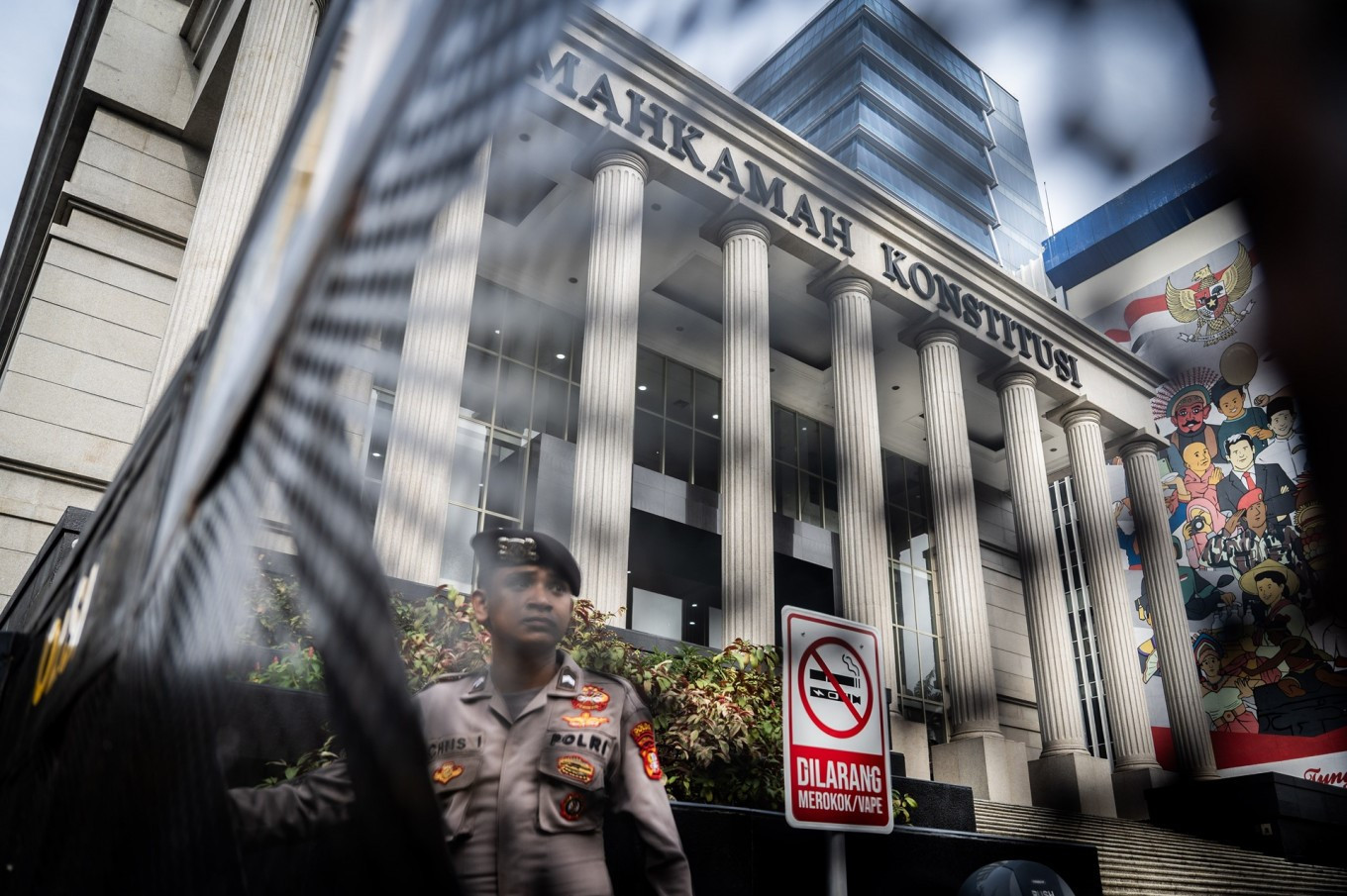 A police officer stands guard in front of the Constitutional Court building on Feb. 4, 2025, in Jakarta. (Antara/Bayu Pratama S)
The quality of Indonesia’s lawmaking is under growing scrutiny. The skyrocketing number of judicial review petitions should serve as a wake-up call to reform the legislative process. Meaningful public participation, in particular, remains a crucial element that must be strengthened to ensure laws are drafted with prudence, accountability and constitutional soundness.
Judicial reviews have long dominated the Constitutional Court’s workload. Over its 22 years of operation, the court has issued 4,644 rulings from 4,747 registered cases, with nearly half involving judicial review motions.
This trend has intensified. In 2025 alone, the court received 284 judicial review petitions, marking a 50.3 percent increase from the previous year. This figure has nearly tripled compared with five years ago. Several major laws account for a large share of these challenges, including the Indonesian Military (TNI) Law, the National Police Law and the Elections Law.
The surge shows no sign of slowing. Between Jan. 1 and Jan. 14 of this year, at least 29 new motions were filed, including high-profile challenges against the amended Criminal Law Procedures Code (KUHAP) and the Criminal Code (KUHP).
This spike carries two important implications. On one hand, it reflects stronger constitutional engagement. Citizens are no longer limiting themselves to political criticism but are increasingly turning to legal avenues to challenge state policies. This shift has been reinforced by simpler filing procedures and the expanded use of digital platforms.
As Constitutional Court Chief Justice Suhartoyo noted earlier this month, the rise in petitions signals growing public awareness of constitutional rights, supported by streamlined procedures and advances in information technology.
On the other hand, the trend exposes a deeper structural rot in how laws are produced by the House of Representatives and the government. Many laws are widely perceived as legally fragile and democratically questionable, largely due to limited public participation and an imbalanced concentration of power.
The House has come under increasing criticism for sidelining meaningful public input during legislative deliberations. Key stakeholders, including academics, research institutions, civil society groups and affected communities, are often excluded or consulted only superficially. Consequently, legislation tends to be more responsive to elite interests than to public needs.
Public frustration has repeatedly spilled into the open. During the revision of the TNI Law in early 2025, for example, draft bills were not made publicly available, while key deliberations were held behind closed doors at a luxury hotel, triggering protests across several regions. Similar concerns surfaced during discussions on the Police Law, KUHAP and KUHP, laws that rank among the most frequently challenged at the Constitutional Court.
Calls have grown for the House to reassert its independence and reclaim its legislative dignity. However, the political reality makes this difficult: seven of the eight parties in the House, controlling approximately 81 percent of the 580 seats, are part of the coalition backing President Prabowo Subianto. Only the Indonesian Democratic Party of Struggle (PDI-P) stands alone outside the governing bloc.
Most troublingly, both the government and lawmakers have at times appeared to treat judicial review as a substitute for proper lawmaking. Senior officials have publicly suggested that citizens dissatisfied with newly enacted laws should simply challenge them at the Constitutional Court.
Late last year, Coordinating Law and Human Rights Minister Yusril Ihza Mahendra invited the public to file judicial reviews against the KUHAP if they were dissatisfied. Similar remarks were made by Deputy House Speaker Cucun Ahmad Syamsurijal and later echoed by Deputy House Speaker Sufmi Dasco Ahmad earlier this year.
While such statements may sound like an endorsement of constitutional rights, they effectively amount to an abdication of legislative responsibility, a tacit acceptance that flawed laws can be “fixed later” by the court rather than properly debated and corrected during the drafting process.
Legal scholars have warned that lawmaking has become target-driven, shaped by short-term political interests rather than substantive deliberation. Public objections are often brushed aside during discussions and redirected downstream to the Constitutional Court.
In effect, the court is being positioned as a corrective mechanism for defective legislation. This arrangement reflects not only rising public awareness but also admission of failure in the legislative process itself.
Unless serious reforms are made at the upstream stage of lawmaking, judicial review petitions will continue to pile up, and the Constitutional Court will remain burdened with repairing problems that should never have existed in the first place.
What we've heard
A source familiar with internal dynamics at the Constitutional Court stated that the surge in petitions reflects deep flaws in the legislative process at the House of Representatives, citing both procedural and substantive failures.
"That is why we see both formal and material challenges brought before the Court," the source explained.
Conversely, a source within the House’s Legislative Body (Baleg) argued that the flood of petitions does not necessarily indicate poor legislative quality. According to this source, the rise in judicial challenges is merely a result of differing public perspectives on newly enacted laws.
Meanwhile, a lawmaker from a ruling coalition party said the House would commit to self-correction by expanding public participation.
"Legislative outreach to regions and university campuses during the lawmaking process will be implemented," the lawmaker promised.
Related Articles