
News
Fear of misuse looms as new Criminal Code takes effect
Tenggara Strategics January 14, 2026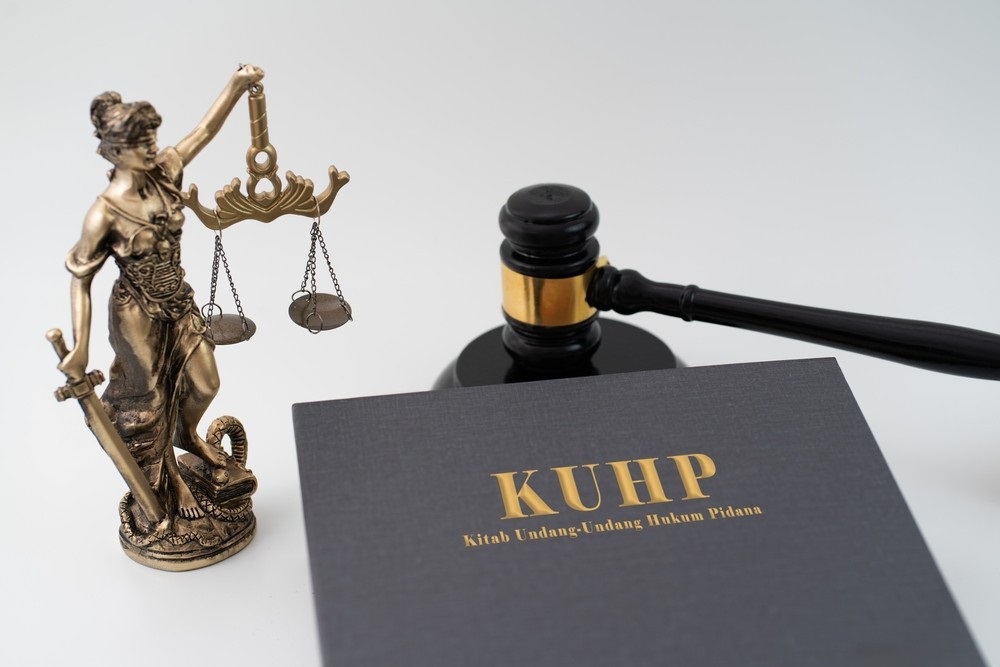 Illustration of a Criminal Code (KUHP) book next to a gavel and a Lady Justice statue. (Shutterstock/La Terase)
After decades of relying on Dutch colonial regulations, Indonesia finally has its own Criminal Code (KUHP), which came into effect on Jan. 2. While the government claims the new KUHP reflects modern legal standards, critics say it retains significant gaps, particularly regarding potential conflict between law enforcement practices and human rights protections.
One article that has drawn intense scrutiny concerns insulting the president and vice president as well as the government and state agencies. Critics fear this provision could shield officials from legitimate criticism, resembling past offenses frequently used to silence opposition against the colonial regime. There is a palpable concern this could create a climate of fear among activists and journalists.
However, the drafters of the new KUHP, primarily the Law Ministry and House of Representatives Commission III, which oversees law enforcement, argue that Article 218 is a substantial improvement over Article 134 in the previous code. The latest KUHP reclassifies this as "delik aduan" (complaint-based offense) rather than an ordinary offense, meaning that legal proceedings can only be initiated upon a formal complaint from the affected party. The maximum penalty has also been reduced from six to three years.
Deputy Law Minister Edward "Eddy" O.S. Hiariej has emphasized that only specific officials could file complaints, such as the president, the vice president and the heads of major state institutions. He also clarified that the offense applied to insults directed at institutions, not individual officeholders.
Further, Article 218(2) explicitly states that criticisms, protests and views intended to evaluate government policies are legitimate forms of expression and may not be criminalized. In a similar vein, the new KUHP treats violations related to public demonstrations as "material offenses", meaning they are punishable only if they result in tangible harm, such as public disorder, rioting or property damage.
The new code also introduces major changes to capital punishment. The death penalty is no longer categorized as a primary punishment but as a sanction of last resort. Article 100 stipulates a 10-year probationary period for death sentences and if a convict demonstrates exemplary conduct during this time, their sentence may be commuted to life imprisonment or a maximum 20 years in prison.
Lawmakers acknowledge that the new KUHP does not formally abolish the death penalty, but say this mechanism moves the judicial system away from the death penalty as a form of criminal punishment.
On offenses related to the state ideology, the KUHP maintains that spreading communism or Marxism-Leninism is incompatible with Pancasila. However, Article 188(6) exempts academic activities such as teaching and research, provided they are not intended to promote these political doctrines and socioeconomic systems. Nevertheless, concerns remain that law enforcement could misinterpret the thin line between "teaching" and "disseminating" ideas.
House Commission III chair Habiburokhman, who hails from the ruling Gerindra Party, has defended the new KUHP. In particular, he has pointed out that concerns about the criminalization of journalists and academics are addressed by a requirement for proof of criminal intent (mens rea). He argues the new code has shifted focus from the content of the information spread to the consequences it generates, reinforcing the principle that criminal law should serve as ultimum remedium (last remedy) and not a primary tool of repression.
Legal scholar Romli Atmasasmita says the true test of the KUHP will be its implementation. The challenge lays in balancing legal certainty with social justice, ensuring that authorities translate the spirit of the new code into practice without neglecting the rights of vulnerable groups, including indigenous communities who have long been marginalized.
Amid the ongoing democratic decline, however, the new KUHP looks set to exacerbate the setback to Indonesian democracy.
What we've heard
A public interest lawyer involved in advocacy on KUHP-related issues noted that several other articles also have the potential to curtail civil liberties. According to the lawyer, members of the public now face a heightened risk of criminal prosecution for criticizing the President. "The criminal penalty could be up to 1.5 years in prison," the source noted.
The same source added that while the government often argues that defamation-related provisions constitute complaint-based offenses, reality suggests otherwise. Various cases indicate that public officials have frequently weaponized criminal laws to counter criticism of their policies. As an example, the source cited the lawsuit filed by Agriculture Minister Amran Sulaiman against Tempo magazine.
"In that case, the reporting clearly criticized ministerial policy, not the individual personally," the source explained.
Beyond civil rights, foreign investors and multinational corporations have also begun assessing the implementation of the new KUHP and its potential impact on the business climate. According to a source familiar with the matter, these businesses have instructed their legal teams to identify critical liabilities arising from the KUHP.
"These matters will be discussed publicly in the near future," the source said.