
News
Disaster response tests government's openness to criticism
Tenggara Strategics January 12, 2026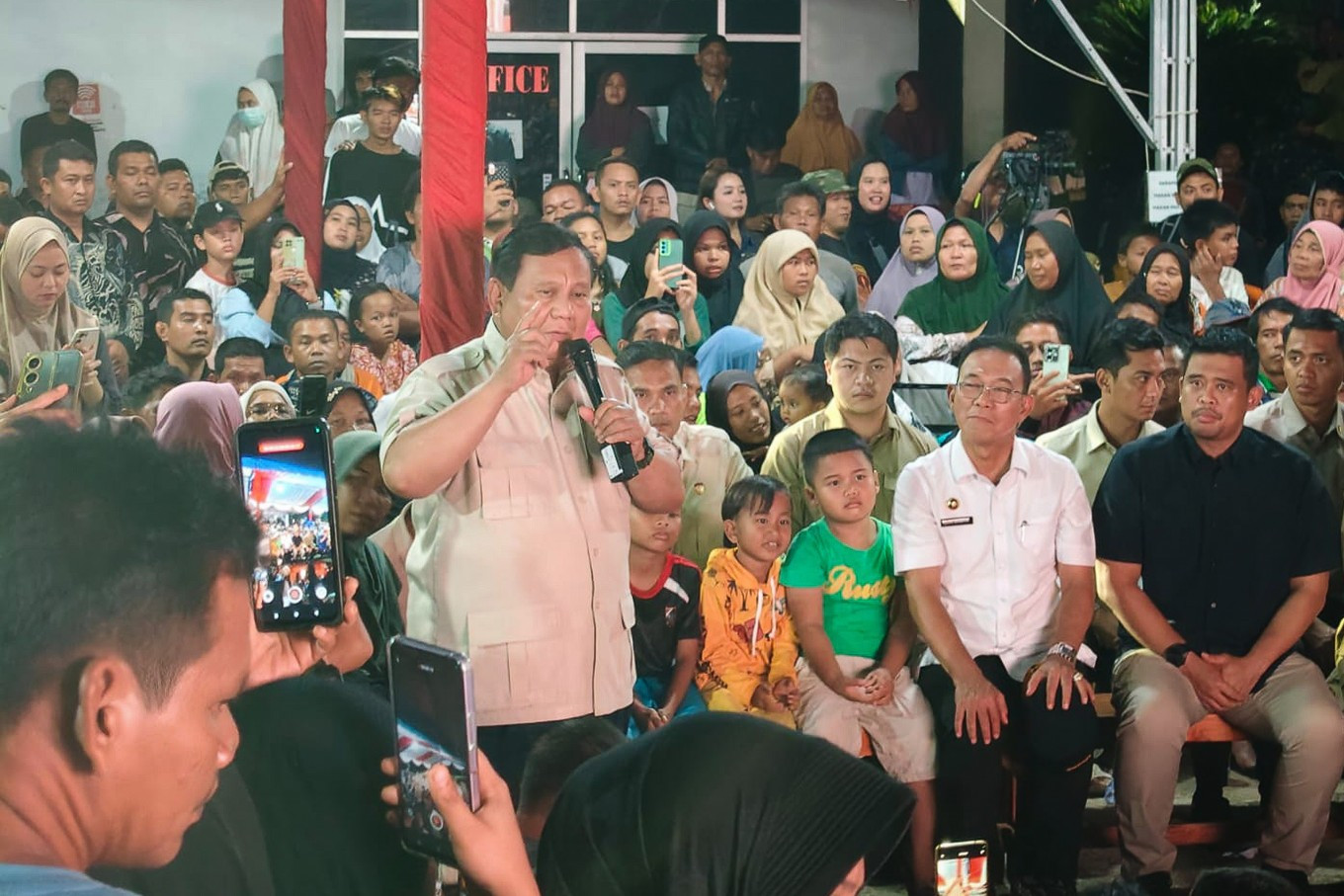 President Prabowo Subianto (center) addresses displaced people during a gathering on Dec. 31, 2025, at an evacuation center in Batu Hula village, South Tapanuli regency, North Sumatra, as North Sumatra Governor Bobby Nasution (right, front row) and South Tapanuli Regent Gus Irawan Pasaribu (second right, front row) look on. (Antara/Father Rochman)
The protracted disaster response in parts of Sumatra has increasingly become a focal point of public criticism, testing not only the state's operational capacity but also its willingness to engage with dissent. Rather than treating criticism as an essential component of democratic accountability, the government has often responded defensively, a posture that risks deepening public distrust at a time when confidence in state institutions is critical.
Flash floods and landslides that struck Aceh, North Sumatra and West Sumatra on Nov. 25, 2025, continue to demand sustained attention. As of Jan. 7, the National Disaster Mitigation Agency (BNPB) recorded 1,178 deaths, with 147 people still missing. A total of 53 regencies and cities have been affected, while more than 242,200 people remain displaced. Aceh accounts for the largest number of evacuees, particularly in Aceh Tamiang and North Aceh.
The government's public communication came under mounting scrutiny as the emergency dragged on. Disappointment has grown over what many perceive as a slow, insufficient and poorly coordinated response, compounded by messaging that appears detached from conditions on the ground.
Between Nov. 25 and 29, 2025, 35 percent of online discussions related to the Sumatra disaster carried a negative sentiment according to data from consultancy Drone Emprit, largely directed at government performance and the ecological factors contributing to the disaster.
Negative sentiment surged to 58 percent between Nov. 24 and Dec. 7, 2025, and remained high at 57 percent through Dec. 8–15, 2025. Public discourse moved toward anger, driven by perceptions of officials' lack of empathy, delays in emergency measures and the government's reluctance to declare the disaster a national emergency.
Online discussions highlighted discrepancies between official claims of electricity restoration and conditions reported by residents, as well as frustration over restrictions on foreign humanitarian assistance. In Aceh, public disappointment also took a symbolic form, with residents raising white flags as distress signals and appeals for help.
At its core, public criticism functions as a mechanism of oversight. Yet government responses have often suggested an aversion to scrutiny, evident in how senior officials addressed growing dissatisfaction.
In a Dec. 19, 2025, press statement, Cabinet Secretary Teddy Indra Wijaya emphasized that the government had been working tirelessly since the earliest stages of the disaster, even in the absence of media attention, and urged influential figures not to "complicate" the situation. Army Chief of Staff Gen. Maruli Simanjuntak similarly called on the public to show greater appreciation for personnel deployed in disaster areas.
President Prabowo Subianto echoed this sentiment during a coordination meeting on Jan. 1, expressing frustration over negative public commentary on the government's handling of the crisis.
Such reactions risk overlooking a basic democratic principle: Criticism is not an attack on the state, but a legitimate demand for accountability. While efforts by responders on the ground deserve recognition, it is also true that disasters can become stages for political image-building. In this context, public scrutiny is not only inevitable but necessary.
Criticism does not arise in a vacuum. It often reflects substantive concerns that warrant attention. This dynamic is evident in the growing use of the term "disaster tourism" to describe official visits perceived as performative and lacking empathetic engagement with affected communities.
Public backlash followed, for example, the circulation of images showing Coordinating Food Minister Zulkifli Hasan carrying sacks of rice during a site visit, or legislator Verrell Bramasta appearing in a bulletproof vest. Such imagery, rather than conveying solidarity, risk widening the emotional distance between officials and disaster survivors.
More concerning is the emergence of pressure on and intimidation of critical voices. Several public figures and influencers who spoke out about the disaster response reported acts of intimidation, including Greenpeace activist Iqbal Damanik, actor Yama Carlos and influencers DJ Donny, Sherly Annavita Rahmi and Virdian Aurellio. Reported incidents included anonymous threats, the delivery of animal carcasses and even Molotov cocktail attacks.
Journalists have also faced intimidation. In one case, a reporter was pressured to delete footage documenting clashes during a peaceful protest by residents demanding national disaster status in North Aceh.
State Secretary Prasetyo Hadi and Human Rights Minister Natalius Pigai have said such cases must be investigated by the police to prevent speculation, with Pigai emphasizing that intimidation does not reflect government policy.
Amid an ongoing humanitarian crisis, public expectations remain simple: that the state is present, responsive and willing to listen. When criticism is met with defensiveness or silence, disasters risk claiming not only lives and livelihoods, but also public trust.
What we've heard
Some public figures who reported a series of intimidation incidents against them toward the end of 2025 also claimed their homes had been targeted with Molotov cocktails. One victim said the pattern of intimidation appeared systematic. According to the source, attempts to hack the victims' social media accounts preceded the physical threats. The targets, the source added, were individuals who had been openly critical of the government's performance.
The acts of intimidation were suspected to be linked to criticism of the disaster response, particularly allegations that the government had been slow to respond to flooding and landslides. "That narrative puts the government in a corner," the source said.
Several activists said the victims had yet to identify those behind the attacks. However, they noted similarities in the methods used by those who delivered the threatening packages to the homes of activists and influencers.
According to the source, the people alleged to have carried out these acts shared similar physical characteristics, described as solidly built, and seen to be questioning neighbors beforehand. "The profiles of the perpetrators were strikingly similar," the source said.