
News
Indonesia plays it safe in response to US attack on Venezuela
Tenggara Strategics January 15, 2026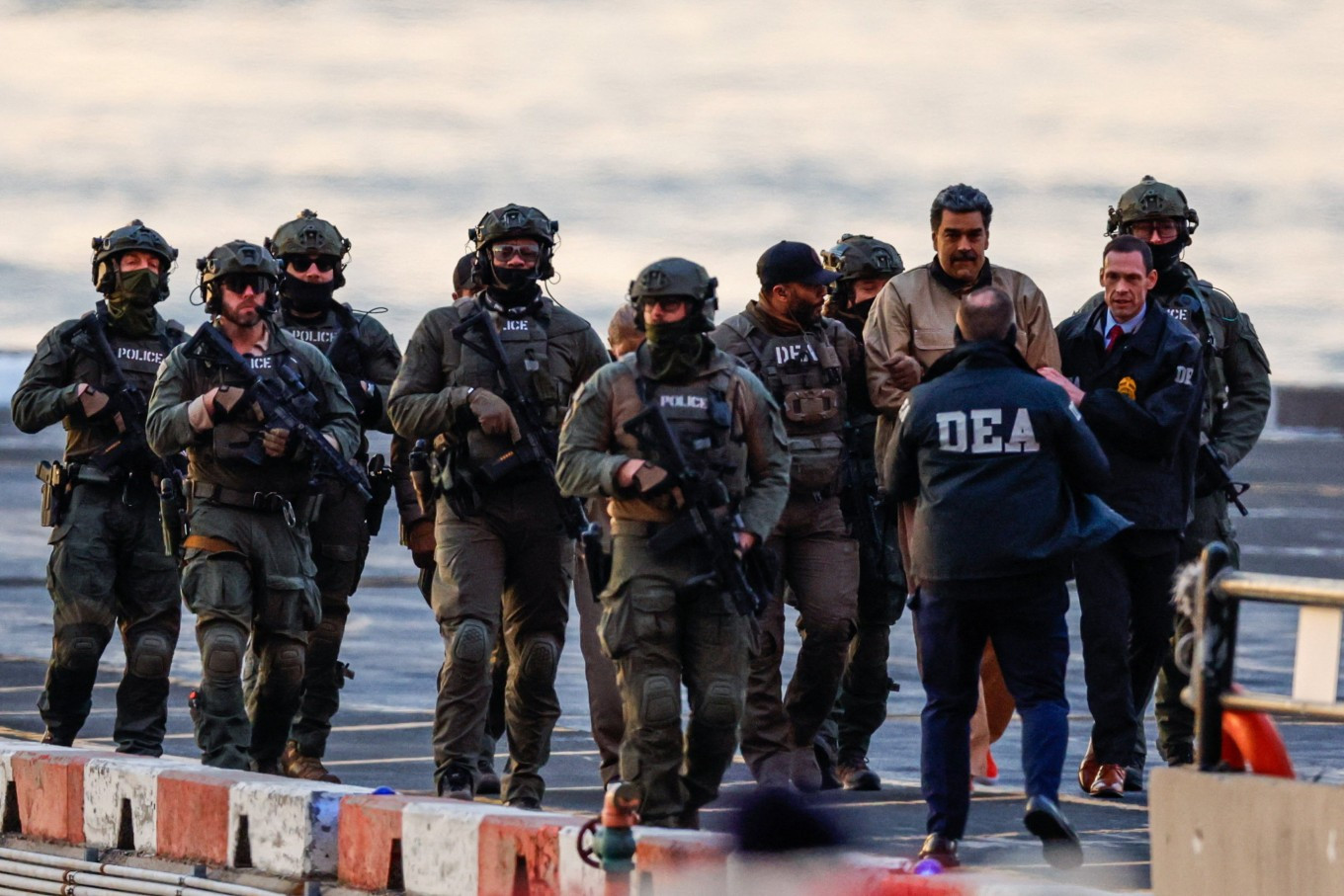 Bold operation: Captured Venezuelan President Nicolas Maduro arrives on Jan. 05, at the Downtown Manhattan Heliport as he heads toward the Daniel Patrick Manhattan United States Courthouse for an initial appearance to face US federal charges including narco-terrorism, conspiracy, drug trafficking, money laundering and others in New York City, the US. (Reuters/Eduardo Munoz)
It should have been a no-brainer for Indonesia to condemn the United States for bombing Caracas and then seizing Venezuelan President Nicolás Maduro and First Lady Cilia Flores, flying them to New York to face drug trafficking charges. This was clearly an act of aggression against a sovereign country and a violation of international laws.
The statement from the Foreign Ministry not only fell short of condemnation but also refrained from naming the US as the aggressor.
The statement, posted on Dec. 3 on the ministry’s X and Instagram accounts in both English and Indonesian but not on its website kemlu.go.id, reads: “The Government of Indonesia is closely monitoring the latest developments in Venezuela. Indonesia expresses its grave concern over any actions involving the use or threat of force, which is setting a dangerous precedent in international relations and could undermine regional stability, peace and the principles of sovereignty and diplomacy. […]
“Indonesia urges all parties to exercise dialogue and self-restraint and to fully respect international law.”
The official response has baffled Dino Patti Djalal, founding chair of the Foreign Policy Community of Indonesia (FPCI), who took to social media to ask, “Since when have we become reluctant/afraid in criticizing a friend for violating international laws?”
Dino, a career diplomat and a former ambassador to the US who is now a staunch critic of the government’s foreign policy, continued: “Why hasn’t Foreign Minister Sugiono weighed in? The world is waiting for the view of Indonesia, an important member of the Global South.”
The short answer to these questions is that Indonesia is putting national interests before ideological principles, and fear or reluctance has little to do with its stance.
Since taking office in October 2024, President Prabowo Subianto has taken foreign policy in his hand, appointing fellow Gerindra Party member Sugiono as foreign minister despite his limited exposure to international affairs.
President Prabowo has traveled the globe extensively but has not visited US President Donald Trump at the White House. Though the two leaders have met on the sidelines of a few summits they attended last year, including at the United Nations General Assembly (UNGA) in New York, they have yet to arrange a formal meeting in Washington, D.C.
Meanwhile, the two countries are in a delicate state of relations after concluding negotiations on a trade agreement, including US tariffs, which Prabowo and Trump are expected to sign sometime this month.
The President has also been campaigning hard to carve out a role for Indonesia in the Middle East peace process. He has offered to provide medical treatment for 2,000 Palestinians from war-torn Gaza and has readied as many as 20,000 Indonesian troops to join the planned International Stabilization Force under the US-brokered Gaza peace plan. In the absence of diplomatic ties between Indonesia and Israel, Trump is in a position to help fulfill Prabowo’s peacemaker ambitions.
In September, Prabowo was among the eight leaders from Arab and Muslim-majority countries who were invited to meet Trump alongside the UNGA in New York, during which the US president discussed his Gaza peace plan.
Prabowo might also have a personal interest in building ties with Trump, as indicated when he attended the announcement of Trump’s Gaza peace plan in Egypt last October and was caught asking the US president in a hot mic moment: “Can I meet Eric [Trump]?” Jakarta provided no clarification as to why the President wanted to meet Trump’s second son, who is executive vice president of The Trump Organization.
In criticizing the government’s response to the US strike on Venezuela, Dino drew up a comparison with the way Indonesia categorically condemned the US invasion of Iraq in 2003. This was the foreign policy standard of the regime at the time, which put principles before interests, especially regarding something as serious as a unilateral act of aggression against a sovereign nation.
It seems that “condemn”, “deplore” and “denounce” are no longer part of Indonesia’s diplomatic lexicon when the aggressor is a big power, and we might have to wait for the next act of aggression by a big power to determine whether this is the new foreign policy standard.
Looking at the geopolitical trend, however, this might not be a long wait.
What we've heard
A source familiar with the internal dynamics at the Foreign Ministry said its response to the Venezuela crisis reflected the leadership style of Foreign Minister Sugiono, whose policy direction was heavily shaped by instructions from President Prabowo. “The statement is a reflection of foreign policy rooted in command and loyalty,” the source said.
According to the same source, Indonesia’s cautious language regarding the US is influenced by the ongoing trade deal process as well as the consideration that Maduro was not widely recognized by the international community as Venezuela’s legitimate leader. Jakarta is apparently concerned that openly condemning Washington’s action against Caracas could be interpreted as supporting an authoritarian regime.
The source added that many diplomats had struggled to read Indonesia’s foreign policy direction under Sugiono, as the President was directing key decisions. This lack of clarity was not limited to the Venezuela crisis, the source said, and was also evident in the government’s position on the war in Ukraine and territorial disputes in the South China Sea.
According to the source, the minister is aware of and is listening to criticism from foreign policy observers and analysts, frequently referring to external notes and critiques in regular internal meetings. “But there has been no shift in policy despite the barrage of criticism,” the source said.