News
Iran peace deal brings respite for President Prabowo at home
Tenggara Strategics July 2, 2026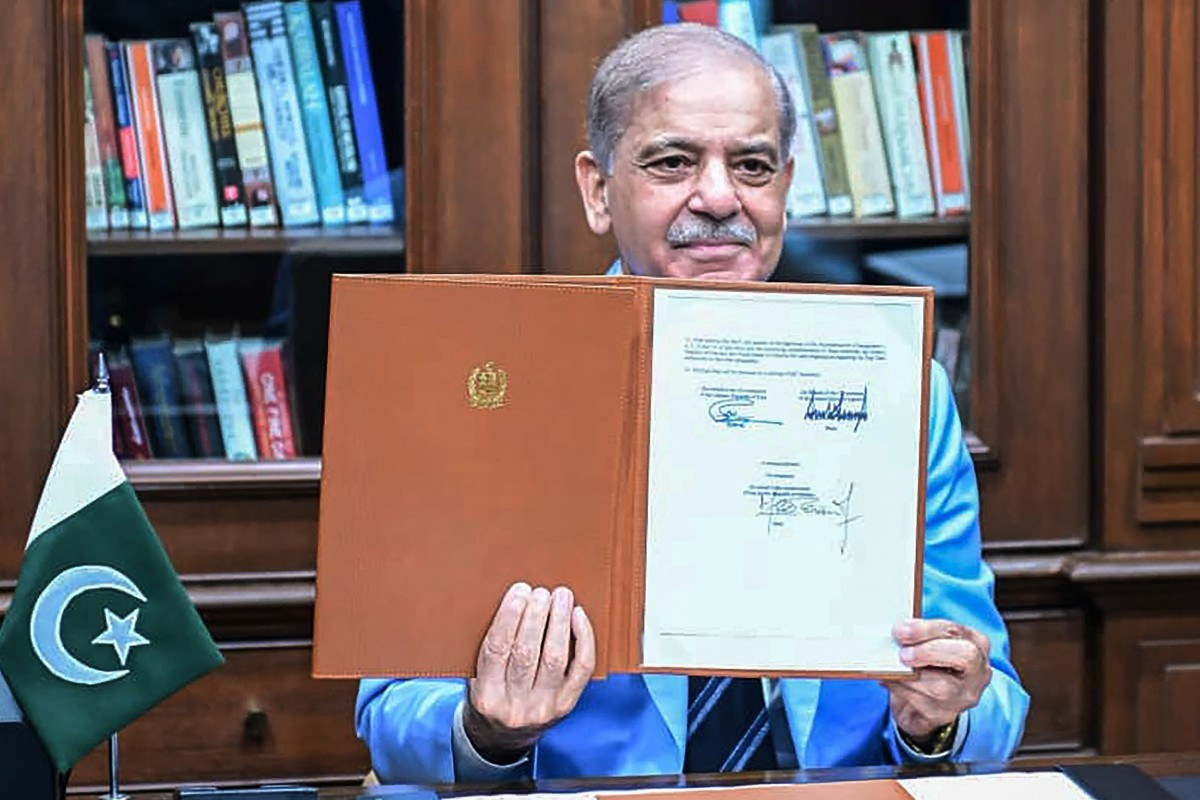 This handout photograph taken and released by Pakistan's Prime Minister's Office on June 18, 2026, shows Pakistan's Prime Minister Shehbaz Sharif holding the memorandum of understanding after signing it as a peace mediator to end the Middle East war, in Islamabad. (AFP/Pakistan's Prime Minister Office)
The peace treaty between the United States and Iran, no matter how fragile, offers a measure of relief to President Prabowo Subianto, who is grappling with mounting economic and political pressures at home.
As leader of Southeast Asia’s largest economy, Prabowo has been contending with the ripple effects of the prolonged conflict in the Middle East, which has strained global markets and compounded domestic challenges. Indonesia’s economic growth remained relatively resilient at around 5.1 percent in 2025, with a projected 5.2 percent in 2026, but risks have risen sharply amid global instability.
The President has maintained subsidies for the widely used Pertalite gasoline and pressed ahead with his signature free nutritious meal program. But both policies have come at a steep cost. The meals program alone is expected to require more than Rp 300 trillion (US$18 billion) annually, while energy subsidies could exceed Rp 380 trillion, straining fiscal space. The government’s 2026 budget projects a deficit of about 2.6–2.7 percent of GDP, already close to the legal ceiling, with risks of widening further if oil prices remain elevated.
His insistence on sustaining these programs has begun to erode market confidence. The rupiah has fallen to record lows, weakening toward 18,000 per US dollar, while the Indonesia Stock Exchange (IDX) Composite index has dropped to multi-year lows and is among the worst-performing markets globally this year. Rising oil prices, at times approaching $100 per barrel, have further amplified concerns over Indonesia’s fiscal and external balances.
Investor sentiment has weakened sharply, with billions of dollars flowing out of Indonesian equities, while public discontent has grown. Students have taken to the streets in large protests against both his economic policies and broader leadership, while also questioning his commitment to democratic norms amid concerns over the rising role of the military in government. Some fear his administration could resort to coercive measures to deal with critics.
These policies are increasingly seen as unsustainable, raising expectations that Prabowo will eventually have to scale back his populist agenda. Early signs of policy adjustment have already begun to emerge, including efforts to rein in spending and improve efficiency.
Just prior to the June 17 peace deal, Prabowo took a number of measures widely seen as necessary, though not far-reaching enough. Bank Indonesia raised interest rates twice to shore up the rupiah, while the government increased prices for non-subsidized Pertamax gasoline.
He also moved to overhaul the National Nutrition Agency (BGN) that oversees the free meals program after much of its previous leadership was arrested on corruption charges. The new team has begun scaling back the program, shifting from a universal rollout toward a more targeted approach.
The June 17 peace agreement signed by US President Donald Trump and Iranian President Masoud Pezeshkian has since eased some of the pressure, particularly by calming energy markets and reducing the immediate risk of further oil price spikes.
The initial market reaction in Indonesia was positive. The rupiah strengthened back below 18,000 per dollar, and the Composite index surged about 4 percent in a single session, reflecting relief over easing oil prices and improved global sentiment.
But the gains proved short-lived. The rupiah soon softened again and equity markets struggled to sustain momentum as investor focus shifted back to Indonesia’s domestic challenges, particularly fiscal risks and policy credibility.
Investor flows may stabilize or partially return in the short term. However, a sustained recovery will depend on whether Prabowo uses this breathing space to address deeper fiscal and governance concerns.
The peace deal buys Prabowo time, but not trust.
What we've heard
The government is closely monitoring the negotiations between the United States and Iran to end their conflict, as the regional warfare has driven global energy prices sharply higher. A senior government official stated that a peace agreement would significantly benefit the energy sector by gradually easing supply chain disruptions.