
News
Indonesia-US trade deal undermines halal certification
Tenggara Strategics March 10, 2026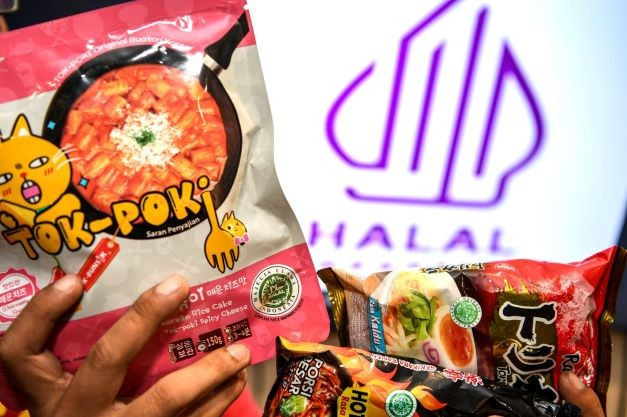 A person holds up imported food products with halal certification against the halal logo in this illustration created on March 14, 2022. (Antara)
The provisions in the Indonesia-United States Agreement on Reciprocal Trade (ART) have once again drawn public scrutiny. This time, the debate extends beyond tariff reductions to a more sensitive issue: the possible easing of halal certification requirements for US products entering the Indonesian market.
As stipulated in the ART, several US products such as cosmetics and medical devices are recorded as receiving certain facilities related to halal certification. The agreement also mentions recognition of US slaughtering standards and food safety supervision systems for food and agricultural products.
Specifically, the ART stipulates that Indonesia will allow any US halal certifier recognized by Indonesia’s halal authority, such as the Halal Transactions of Omaha (HTO) and the Islamic Food and Nutrition Council of America (IFANCA), to certify products for importation without additional requirements or restrictions. In addition, Indonesia will streamline and accelerate recognition of US halal certifiers.
For the world’s largest Muslim-majority country, however, halal certification is not merely an administrative requirement but a central pillar of consumer protection. Under Law No. 33/2014 on halal product assurance, goods entering and distributed in Indonesia must be halal certified unless they are explicitly declared non-halal. In theory, imported US products could simply be labeled and sold as non-halal.
However, the more pressing concern is the lack of clarity on how the policy would be implemented. Without detailed guidelines from the government, the uncertainty surrounding this issue has fueled speculation about whether this would amount to a limited administrative adjustment or a broader relaxation of the national halal assurance framework.
At present, domestically distributed products are generally expected to be halal certified. Retail outlets specializing in non-halal goods remain the exception rather than the norm. In practice, businesses seeking broad market access must obtain halal certification through the Halal Certification Agency (BPJPH), meaning that this is not just a formal requirement but effectively a gateway for mass-market domestic distribution.
In essence, the debate now centers on two fundamental concerns. The first is consumer protection. From the perspective of foreign exporters, mandatory halal certification is often framed as a nontariff barrier that discriminates against imported goods. Yet in the domestic context, halal assurance is less about trade restrictions and more about safeguarding the religious freedoms of Indonesia’s Muslim majority.
In a country where the overwhelming share of consumers requires halal products for daily consumption, consumer protection cannot be treated as religiously neutral. It is inherently tied to ensuring that Muslim consumers can participate in the market without doubts or ambiguities regarding what they consume. Removing or diluting halal certification requirements, even selectively, risks shifting the burden of product assurance from the state to individual consumers.
The second issue is regulatory sovereignty. Halal certification is embedded in Indonesia’s legal and institutional frameworks. Accepting foreign standards in lieu of domestic certification would not simply streamline procedures; it could also signal a partial transfer of regulatory authority. Recognition of US slaughtering or food safety standards without full alignment with Indonesia’s halal assurance mechanisms may be interpreted as subordinating domestic rules to external systems. Over time, this could weaken the state’s control over how religious compliance is defined, audited and enforced within its own territory.
Taken together, these concerns illustrate why the ART provisions have generated sensitivity beyond typical trade negotiations. The issue is not solely about tariffs or technical facilitation but also about how Indonesia balances trade liberalization with its responsibility to protect consumers and maintain regulatory autonomy. In a matter as closely tied to religion, identity and public trust as halal certification, even incremental policy adjustments can carry implications that extend well beyond commerce.
What we've heard
The tariff agreement between Indonesia and the US includes provisions concerning halal certification for products from the US. A source familiar with the discussion said that the trade tariff agreement does not eliminate the requirement for halal certification and labeling for products entering and circulating in Indonesia.