
News
Five centuries of Semana Santa in Larantuka
WINDONESIA April 28, 2026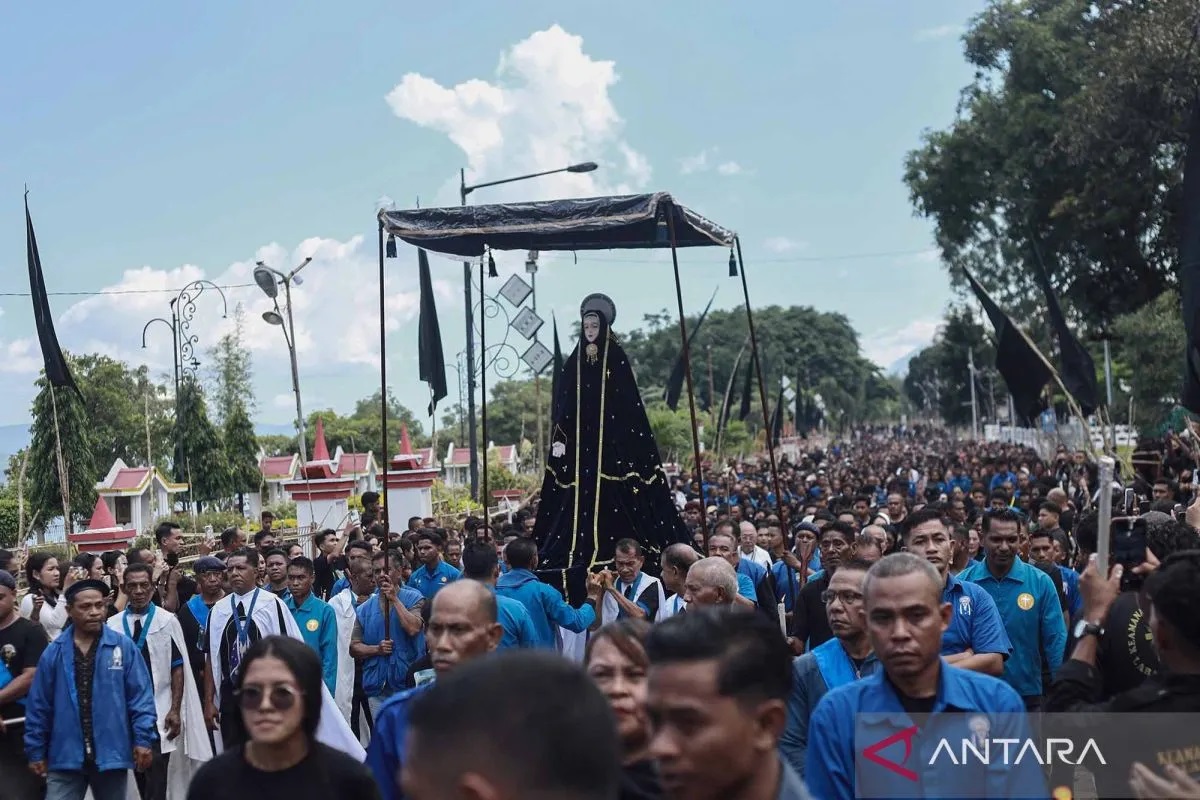 Several youths from the Tuan Ma Chapel congegration and pilgrims participated in the Tuan Ma Statue procession in Larantuka District, East Flores Regency, East Nusa Tenggara Province as part of Semana Santa on Apr. 3, 2026. (Antara/Mega Tokan/wsj)
On the eastern tip of Flores, as the sun slowly sets into the Sawu Sea, the small town of Larantuka in East Flores Regency, East Nusa Tenggara Province transformed into a silent, moving stage on Apr. 3, 2026.
Candles are lit along the streets, and bells toll softly. Thousands of people walk silently, following two venerable statues of Tuan Ma (the Virgin Mary) and Tuan Ana (Jesus Christ), paraded in a slow rhythm, as if time had been pulled back five centuries.
The Semana Santa in Larantuka District, which means Holy Week in Portuguese was born out of long transoceanic journeys, the politics of faith, and global trade in the 16th century. Its roots lie in Catholic Europe, particularly Spain and Portugal.
In the 16th century, after the Protestant Reformation shook Europe, the Catholic Church responded with the Counter-Reformation. Amid the difficulty of the general public in comprehending Catholic teaching, which was caused by low literacy and limited access to scripture, the Church changed its approach.
The street procession became a communication tool, with statues made to resemble real people, music, and a sequence of events arranged like a visual narrative. Each element serves a function; teaching, inspiring, and binding the congregation in a collective experience.
This model is particularly well-established in regions like Andalusia, southern Spain. The basic structure remains the same to this day: brotherhoods, statues, a night procession, and a predetermined route.
East Flores has a majority Catholic population with a strong concentration in Larantuka, the regency capital. The celebration of Semana Santa in the town is observed as a series of religious activities in the week preceding Good Friday.
Beginning on Ash Wednesday, the congregation observes a 40-day fast. Commemorating this period are communal prayers, the Stations of the Cross, and bible reading at the Tuan Ma Chapel every weekend.
During Good Friday, a procession of Catholics departs from the Tuan Ma Chapel and heads to the Katedral Reinha Rosari (Cathedral of the Queen of the Rosary Larantuka). In the evening, the procession returns along the same route.
There are eight designated waystations or armida along the route and follows the sequence of the Passion of Jesus. Each armida is managed by a local tribe of Larantuka. The Mulawato in Pantai Besar Subdistrict opens the procession. Ama Kelen, Kapten Jentera, Riberu, Sau (Diaz), and the Diaz Viera de Godinho family take part in subsequent phases. The final stop is at the Tuan Ana Chapel, guarded by the Amaleken Lewonama Tribe.
Each time the procession stops, lamentations from the Book of Jeremiah, popule meus, and o vos omnes are sung in Latin and ancient Portuguese. The rhythm of the lamentation is languid, maintaining a calm atmosphere despite the thousands of people present. In the front row, the symbols of the passion are carried in a fixed order: cross, nails, crown of thorns, spear, and lantern.
According to local history, a young man named Resiona found a statue of a woman on the coast of Larantuka. The statue was then kept in a korke, a traditional house, and treated as a sacred object. When missionaries arrived, the statue was symbolically identified as the Virgin Mary. Early records of the procession date back to around 1617. The details of the statue's arrival have never been fully disclosed.
Today, the Semana Santa in Larantuka District stands as one of the most unique Catholic traditions in the world. It brings together traces of medieval Europe, the Asian spice trade route, and the local cosmology of Flores Island in one space.
Related Articles