
News
Indonesia’s IFC ambitions face credibility test
Tenggara Strategics July 8, 2026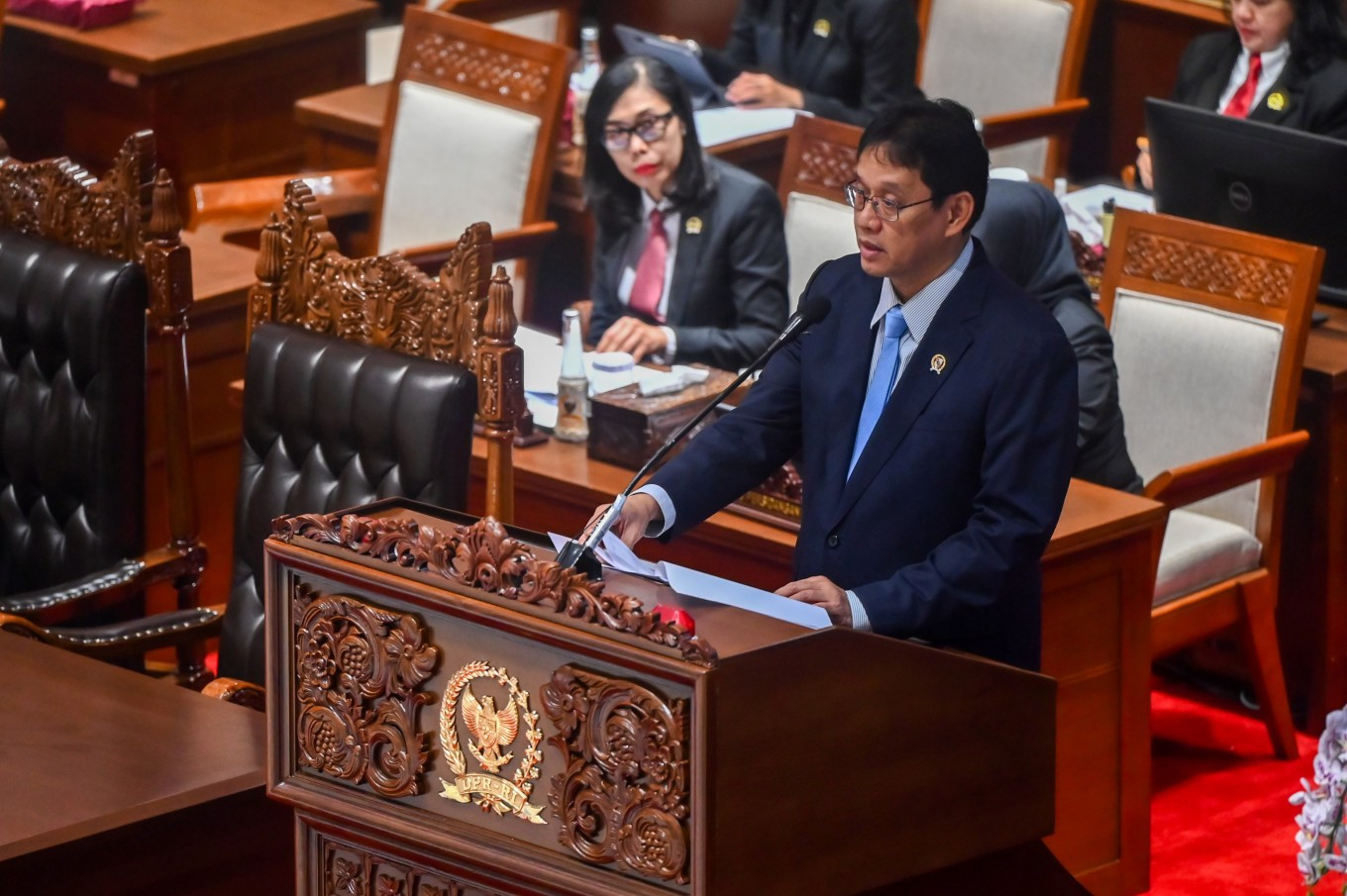 Finance Minister Purbaya Yudhi Sadewa delivers the government's final statement on behalf of President Prabowo Subianto on June 4, 2026, during a plenary session on amendments to the 2023 Financial Sector Development and Strengthening (P2SK) Law at the Senayan Legislative Complex in Central Jakarta. (Antara/Rivan Awal Lingga)
The establishment of the Indonesia International Financial Center (IFC), introduced through the revised Financial Sector Development and Strengthening (P2SK) Law, has raised concerns that it could become a channel for illicit funds. The concern stems from the law's simultaneous introduction of legal protections for buyers of special government bonds, shielding them from criminal, civil and tax investigations while prohibiting the bonds from being used for tax assessments or as evidence in court proceedings.
The IFC represents an ambitious effort to position Indonesia as an international financial hub. However, the legal protections afforded to buyers of Danantara's special bonds, including the Patriot Bonds and Red and White Bonds, risk undermining the credibility the IFC needs to attract sophisticated institutional investors, including family offices. Moreover, the government's three-month deadline to complete the IFC Law may leave insufficient time to develop the robust institutional framework such a financial center requires.
Article 248A of the P2SK Law defines the IFC as a zone primarily dedicated to financial sector activities with financial and administrative autonomy, as well as a special legal jurisdiction based on "international principles and/or standards".
The zone will be governed by an IFC Council, and more than one IFC may be established. Businesses operating within the IFC will be subject to special taxation procedures and enjoy tax incentives and other facilities. The article also mandates that the IFC Law be enacted within three months of the P2SK Law coming into force on June 17, 2026.
As for the incentives, Coordinating Economy Minister Airlangga Hartarto signaled that the IFC could become a tax haven, noting that international financial centers such as Dubai and Singapore provide tax incentives of up to zero percent to remain globally competitive. He argued that Indonesia also needs to offer an attractive fiscal regime if it wants to compete for international capital.
Policymakers see the possibility of Indonesia becoming a tax-friendly jurisdiction, similar to Singapore, Hong Kong, and the United Arab Emirates, as an acceptable trade-off for attracting significantly higher investment. For comparison, Indonesia attracts an average of Rp 2.2 quadrillion in investment annually, compared with around Rp 5 quadrillion in Singapore. Meanwhile, Dubai attracted around US$800 billion in foreign direct investment and capital inflows associated with its financial center ecosystem.
However, Finance Minister Purbaya Yudhi Sadewa rejected suggestions that the IFC would turn Indonesia into a tax haven. He explained that the IFC would be established as a new special economic zone in Bali covering around 100 hectares, with tax incentives applying only to funds held within the zone, while investments made outside the IFC would remain subject to Indonesia's normal tax regime. Purbaya also said the IFC could adopt a common law system separate from Indonesia's civil law framework, potentially giving effect to the "special legal jurisdiction according to international principles and/or standards" stipulated in the P2SK Law.
The Dubai International Financial Centre (DIFC), one of the main benchmarks for Indonesia's IFC, is one of the UAE's Financial Free Zones (FFZ). It is exempt from the UAE's federal civil and commercial laws but remains subject to federal criminal laws, including anti-money laundering legislation. Analysts argue that the DIFC's institutional autonomy is one of the key features Indonesia's IFC should emulate. However, they caution that Indonesia must first develop strong financial infrastructure, data security, and regulatory oversight to establish credible safeguards against money laundering and terrorism financing
What we've heard
Several financial industry practitioners believe the proposed IFC is likely to function as a tax haven. They argue that the initiative is deliberately designed to accommodate "dark" or undisclosed funds that were effectively legitimized through Article 50A of the revised UU P2SK.