
News
Government going after ‘unpatriotic’ critics, by almost any means
Tenggara Strategics April 22, 2026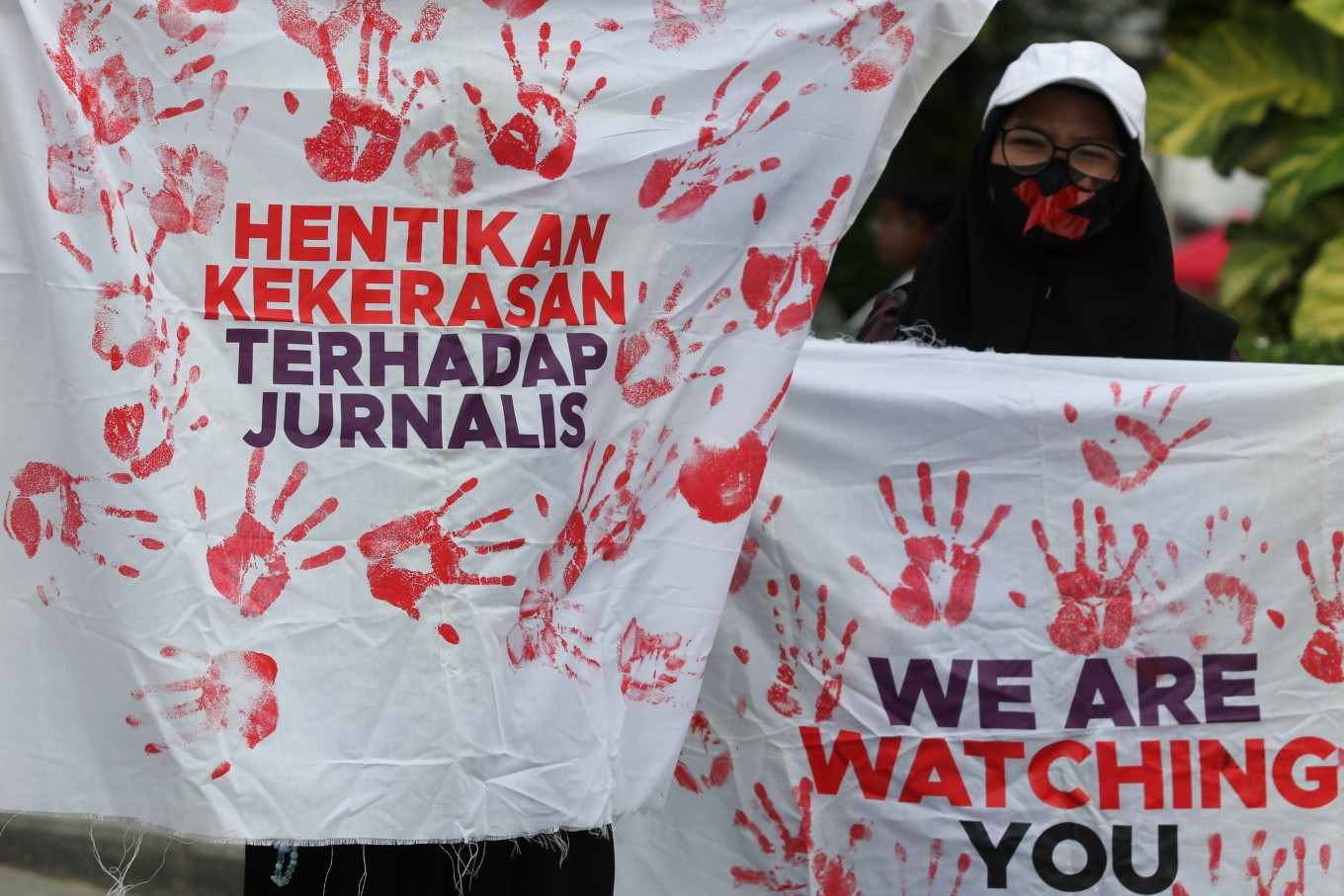 Journalists hold banners during a protest to commemorate World Press Freedom Day in Surabaya, East Java on May 2, 2025. The protest, organized by the Surabaya chapter of the Alliance of Independent Journalists (AJI Surabaya) and other civic groups, condemned intimidation and violent acts against journalists. (Antara/Didik Suhartono)
Three government critics have been reported to the police for something they said in public while an online magazine has seen the circulation of an Instagram article restricted, further evidence of Indonesia’s shrinking civic space. These incidents happened not long after the March 12 acid attack against a human rights activist, an attack which the military and police have blamed on members of the Indonesian Military (TNI) intelligence agency.
The Military Police have yet to disclose the identity of the perpetrators or the motive for the acid attack against Andrie Yunus of the Commission for the Disappeared and Victims of Violence (Kontras), more than one month after the attack. The Military Police took over the investigation from the police’s hands the moment the latter found links to the TNI.
The public remains in the dark about the incident other than that four members of the TNI’s Strategic Intelligence Agency (BAIS) are under investigation, and that BAIS chief Lt. Gen. Yudi Abrimantyo resigned because of the attack but without disclosing his own role.
Civil society organizations are pressing for an independent investigation to be credible and for the perpetrators to be tried in a civilian court rather than a military tribunal.
Magdalene.co, an online feminist magazine, fell prey to official censorship when its Instagram article reporting on an independent investigation into Andrie’s attack was blocked to Indonesian users. The investigation, by a group of civil society organizations and also published in other news outlets, indicate a larger and sinister operation by the military, certainly involving more than the four alleged perpetrators.
The Communications and Digital Ministry restored the content after public protests, but not before stating that Magdalene is not a verified new media and therefore did not enjoy the protection accorded news media outlets and journalists under the 1999 Press Law.
The ministry invoked a degree issued in March by Minister Meutia Hafid, who is a former journalist, that allowed members of the public to call on the government to request social media platforms take down content that incited public unrest, within four hours of notification. Platforms risk losing their operating license if they fail to comply.
Meanwhile, Saiful Mujani, a political scholar and founding director of leading surveying agency Saiful Mujani Research and Consulting (SMRC), has endured widespread attacks on social media since his call for a people’s power movement to impeach President Prabowo Subianto.
Muhammad Qodari, a staff member of the Presidential Office, said that as a political scholar Saiful should have known better that his remarks for impeachment would fall outside the Constitution, and netizens quickly raised the ante to describe it as treason.
Soon enough, several private individuals and groups filed a criminal complaint with the Jakarta Police against Saiful, not for treason, which is punishable by 15 years in prison, but for inciting violence and insurrection, punishable by four years’ jail time. They also named Islah Bahrawi, an activist of the Nahdlatul Ulama Islamic mass organization and a long-time critic of the government, in the same dossier.
Ubedilah Badrun, a political scholar at University Negeri Jakarta, has also been reported to the police by private groups for questioning the legality of the 2024 election of Prabowo and running mate Gibran Rakabuming Raka, and for describing the pair as “burden on the state”.
The government is not short of friends and supporters who would do its bidding to counter government critics. This week, a group of drivers of app-based transportation services, staged a protest outside the SMRC office, demanding Saiful publicly apologize for his remarks about impeaching Prabowo.
These moves against critical voices followed President Prabowo’s March 13 remarks in a Cabinet meeting in which he threatened “to put in order” critics for being unpatriotic. Cabinet Secretary Teddy Indra Wijaya later followed this up with his claim that Indonesia is suffering from an ‘inflation” in the number of experts who choose to ignore the government’s many achievements and surveys that show the President enjoying high approval ratings.
Whether or not the instigators of the crackdown against government critics took their cue from the President, these episodes show the breadth of methods to silence them, from the use of terrorism as in the acid attack, the law as in the criminal reports filed with the police, to finding administrative/technical faults as in the case of censoring the magazine.
Usually, or historically at least, moves against government critics have chilling effects on other critics and media. In the absence of the government denouncing this online and offline harassment and even terrorism against government critics, these incidents are likely to increase.
What we've heard
A source within the State Palace stated that the "foreign stooge" (antek asing) narrative was orchestrated as a response to President Prabowo’s warnings regarding foreign powers attempting to undermine the government. Prabowo has repeatedly asserted that these forces exert influence through funding, disinformation and propaganda. "Prabowo believes that analysts who graduated from overseas could serve as a gateway for foreign interests," the source noted.