
News
For the sake of public safety, MBG should be put on hold
Tenggara Strategics September 28, 2026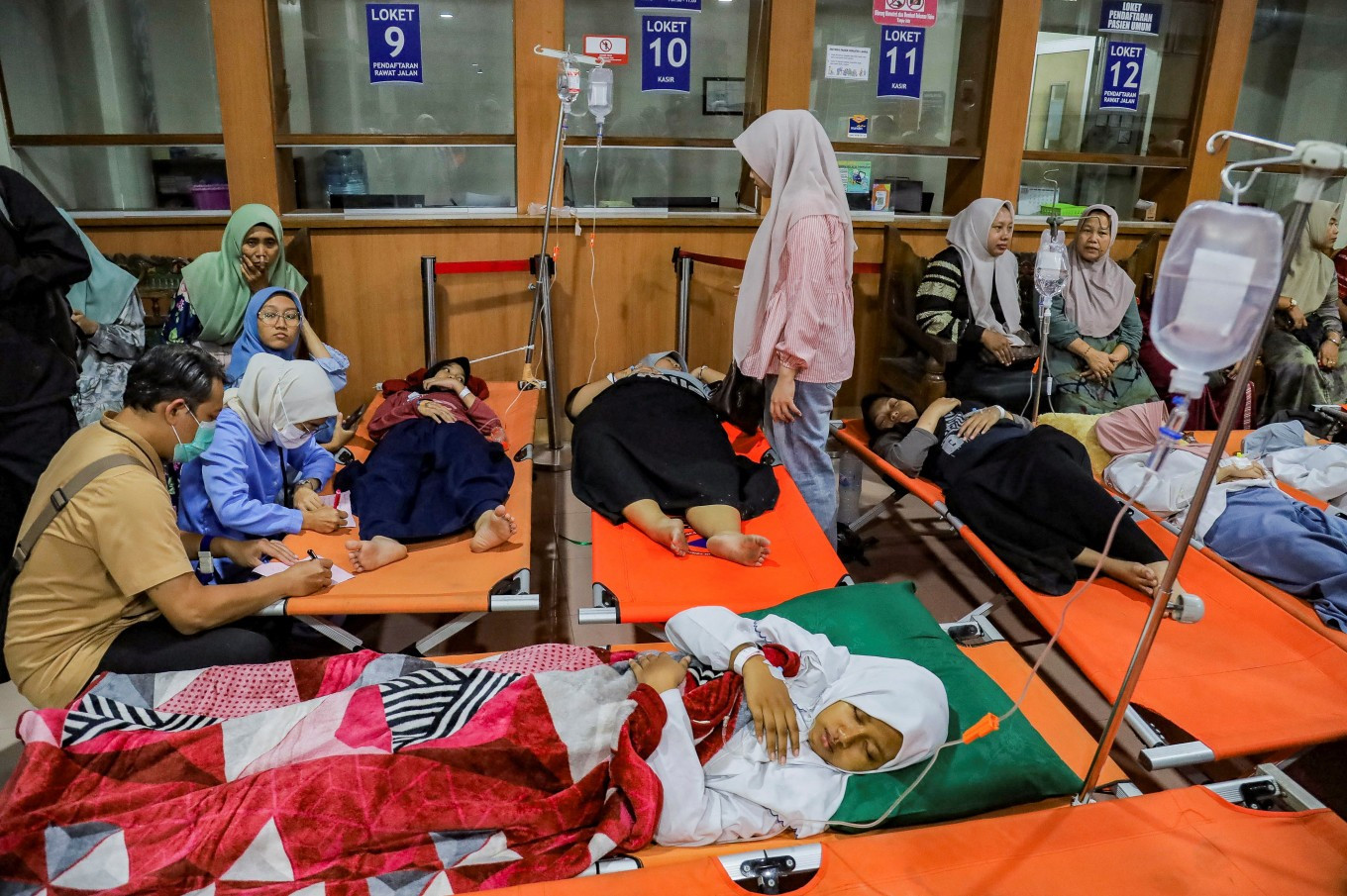 Students rest while receiving treatment for food poisoning at the regional general hospital after eating government-sponsored free school meals in Sidoarjo, East Java province, Indonesia, September 2, 2026. (Reuters/Suryanto)
The government’s flagship free nutritious meal program is facing an escalating crisis of public confidence as recurring food-poisoning outbreaks sweep the country. Yet despite mounting casualties, growing demands for accountability and urgent calls for a moratorium, the government has shown no intention of pausing the rollout.
Launched on Jan. 6, 2025, the free meal program was designed to improve nutrition for tens of millions of Indonesians, particularly schoolchildren and vulnerable communities. Since its debut, however, repeated mass food-poisoning incidents have raised urgent questions about basic food hygiene, institutional oversight and the state's capacity to manage such an operation at scale. This latest wave forces a fundamental question: Why does the free meals program press forward despite flaws that officials repeatedly acknowledge yet fail to fix?
The sheer scale of the fallout makes it impossible to dismiss these cases as isolated slip-ups. According to Health Ministry surveillance, 240 food-poisoning incidents linked to the free meals program had sickened 21,262 people across 32 provinces by Nov. 29, 2025. By Sept. 2, 2026, those figures had surged to 560 outbreaks affecting 50,059 people across 36 provinces and 245 regencies and cities, according to data presented to House of Representatives Commission IX.
An independent tally by the Indonesian Education Monitoring Network (JPPI) counted 43,838 victims between January 2025 and August 2026. While the numbers diverge due to differing methodologies and reporting cutoffs, both datasets point to the same grim reality: Food-safety breakdowns have persisted long past the program's teething phase. And the toll keeps mounting.
In early September alone, suspected food poisoning related to the free meals program was reported in Sidoarjo and Nganjuk in East Java; Rembang in Central Java; Bengkulu and Agam in West Sumatra; and Tana Toraja in South Sulawesi. More than 2,000 people fell ill within the first few days of the month. In Tana Toraja alone, 196 students and teachers were stricken by Sept. 9. This geographical spread is telling. Because these outbreaks span disparate provinces, local administrations and Meal Provision Service Units (SPPGs), the crisis can no longer be chalked up to a few negligent kitchens.
In Sidoarjo, the National Nutrition Agency (BGN) dismissed the head of the Kalitengah SPPG and shuttered the kitchen after an outbreak. Other regions have followed a similar playbook: swift investigations, temporary closures and administrative reprimands. But these reactive measures raise obvious doubts about whether authorities are tackling systemic flaws or simply playing whack-a-mole with individual contractors.
JPPI national coordinator Ubaid Matraji has warned that the absence of strict legal enforcement allows reckless SPPG operators to walk away without consequence. Legal scholars have echoed this concern, urging prosecutors to pursue criminal negligence charges where evidence warrants, rather than letting operators off with bureaucratic slaps on the wrist. Predictably, calls for a decisive pause are intensifying.
On Sept. 8, demonstrators in Yogyakarta rallied to demand a halt to the program. The Save Indonesian Education Coalition and MBG Watch, backed by organizations including the Jakarta Legal Aid Institute (LBH Jakarta) and Indonesia Corruption Watch (ICW), served formal legal notices to President Prabowo Subianto, the head of BGN, the finance minister and the House speaker, demanding a root-and-branch review alongside victim restitution. Meanwhile, the Indonesian Legal Aid Foundation (YLBHI) has demanded an immediate nationwide moratorium on all MBG operations and expansion until an independent safety and human rights audit is completed and published.
Pausing the program does not mean abandoning its nutritional goals. Proponents argue that a temporary halt provides the necessary circuit breaker to stress-test safety protocols before any further rollout. Even senior officials have conceded the severity of the situation. On Sept. 4, Coordinating Food Affairs Minister Zulkifli Hasan candidly admitted that the free meal program’s execution had failed, citing chronic food-poisoning cases. Yet in the same breath, he insisted the program would push on.
For President Prabowo, the free meal program is far more than a public health scheme. It was the centerpiece of his campaign and remains the signature policy of his presidency. Halting it would trigger profound political and bureaucratic ripples. At the same time, the program has spawned a vast commercial ecosystem of caterers, food suppliers, logistics networks and local intermediaries. As the free meal program expands, so do the financial interests embedded in its supply chain. This makes complete transparency around vendor selection, supplier contracts and oversight mechanisms non-negotiable. While these economic stakes do not prove why the state refuses to pause, they explain the sheer institutional momentum keeping it alive.
The challenge facing the government is no longer about managing PR after the latest outbreak. It must prove that the operational framework itself can prevent the next one. A temporary moratorium, as civil society demands, offers one way to step back and reengineer the machinery. Pushing forward while overhauling standards on the fly is another. But either route requires something the public has yet to see: undeniable proof that the system is growing safer, rather than assurances that officials will clean up the mess after children fall sick.
What we've heard
President Prabowo Subianto has tapped Sudaryono to overhaul the governance of the flagship free nutritious meal program, according to a government insider. Moving quickly to clean house, Sudaryono has already reshuffled key officials and dismissed over 100 National Nutrition Agency (BGN) staff allegedly tied to the illicit buying and selling of free meals kitchens (SPPG).