
News
200 million accounts: Financial inclusion or fiscal excess?
Tenggara Strategics September 28, 2026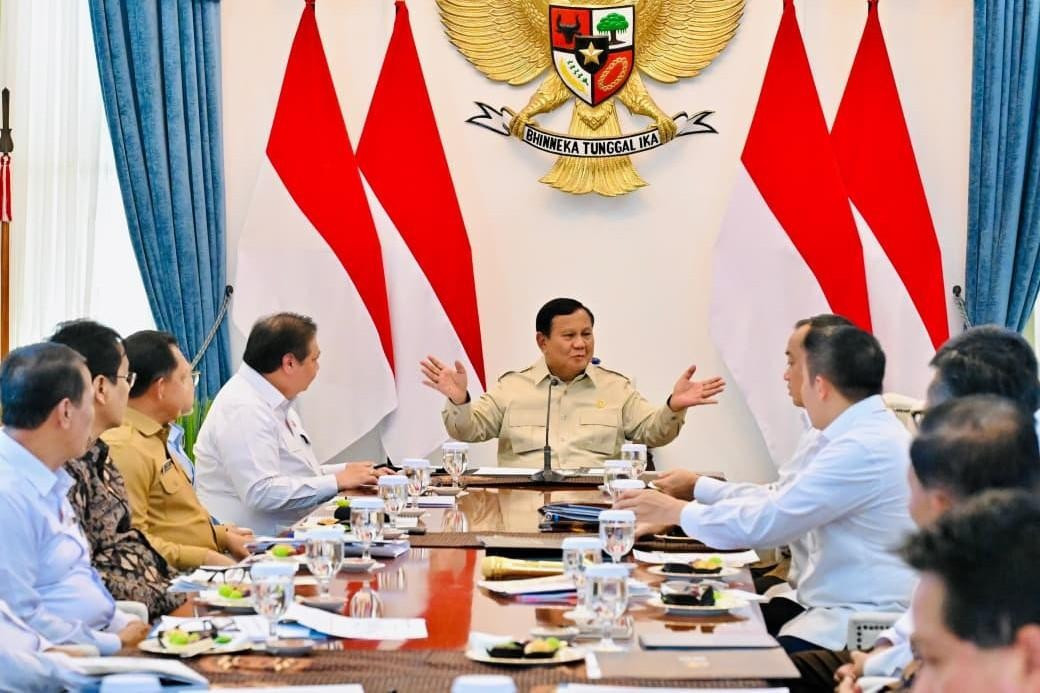 President Prabowo Subianto chairs a limited cabinet meeting to discuss economic issues on Sept. 7, 2026, at the Presidential Palace Complex in Central Jakarta. (BPMI Setpres/-)
The government’s plan to spend an estimated Rp 11 trillion (US$619 million) opening bank accounts for more than 200 million Indonesians aged 17 and above is difficult to justify when fiscal space is already tight and financial inclusion has reached 93.61 percent. If the objective is to reach the unbanked or improve the delivery of social assistance, there is little reason to give new accounts to almost every adult, including those already banked. Scarce public funds should be targeted at people who actually need them.
The program will be implemented through two state-owned banks: Bank Rakyat Indonesia (BRI) nationwide and Bank Syariah Indonesia (BSI) specifically in Aceh. Accounts are to be opened automatically, without recipients having to visit a branch, by matching population identification numbers (NIK) held by the civil registry with Bank Indonesia’s payment system, with QRIS serving as the gateway. Accounts belonging to people who are already banked would be consolidated and used for government programs, including cash social assistance.
The Rp 11 trillion figure remains an estimate, with no budget year yet determined and the scheme still being worked out with Bank Indonesia and the Financial Services Authority (OJK).
The program’s stated basis is the 2026 National Survey of Financial Literacy and Inclusion (SNLIK), released jointly by OJK, Statistics Indonesia (BPS) and the Deposit Insurance Corporation (LPS) on Aug. 10. The survey put financial literacy at 69.57 percent and financial inclusion at 93.61 percent, with the latter already exceeding the 2029 target under the 2025-2029 National Medium-Term Development Plan (RPJMN).
Coordinating Minister of Economic Affairs Airlangga Hartarto presented the results favorably, comparing Indonesia’s 69.57 percent financial literacy index with the OECD benchmark of 63 percent, while saying the government would continue working to improve it. The problem is that these figures provide a justification for doing less, not more. Moreover, LPS reported that 46.5 million Indonesians remain unbanked, of whom roughly 15.3 million are of working age.
This raises a further question, as the figure is far below the proposed target of 200 million people. Even providing Rp 50,000 to all 46.5 million unbanked Indonesians would cost only around Rp 2.33 trillion (US$126 million), roughly one-fifth of the estimated Rp 11 trillion being prepared for the program. The 200 million estimate therefore appears to have been derived from the number of people who could receive an account rather than those who actually need one.
Moreover, access to bank accounts has not been the main constraint on social-assistance distribution. The effectiveness of such programs depends more on the quality of the National Socioeconomic Single Data (DTSEN), the validity of national identification number (NIK) records and the integration of data across government agencies. If the objective is to improve the delivery of social assistance, strengthening these systems and ensuring that intended beneficiaries have access to accounts would be a more targeted approach.
A member of House of Representatives Commission VIII has raised a similar concern, warning that creating duplicate accounts for people who are already banked could simply add to the stock of dormant accounts. Such accounts became a controversy in 2025, when the Financial Transaction Reports and Analysis Centre (PPATK) temporarily suspended transactions involving 122 million inactive accounts across 105 banks for screening. It subsequently found around 180,000 accounts linked to online gambling networks that moved Rp 28 trillion in the first half of that year.
The proposed program could therefore create more dormant accounts rather than reduce their number. Airlangga has said that people who are already banked will still receive an account, making duplication a feature of the program’s design rather than merely a risk that needs to be managed.
Finally, the basis for selecting the two participating banks has not been clearly explained. Asked why BRI and BSI were chosen, Airlangga said only that they were retail banks within the Association of State-Owned Banks (Himbara), an explanation that does not distinguish them from other state-owned banks.
No competitive selection process has been reported, nor have the terms of any cost-sharing arrangement been published. What is clear so far is that the program would hand the two banks potentially hundreds of millions of new customer relationships at state expense, while accounts holding only Rp 50,000 and potentially remaining largely inactive could impose administrative costs without generating meaningful deposits. Neither side of that ledger has been publicly quantified.
Nearly everything else about the program also remains unsettled. The budget allocation has yet to be decided, and newly-installed Finance Minister Suahasil Nazara inherits the proposed commitment. The implementing regulation has yet to be drafted, while neither BRI nor BSI has publicly disclosed what share of the operating costs it would bear.
Opening 200 million accounts may be technically achievable. The more important question is whether that number will survive the policy-design process intact or be narrowed toward the population the program is ostensibly intended to reach: the unbanked.