
News
Purbaya’s contentious tenure ends in internal clash
Tenggara Strategics September 22, 2026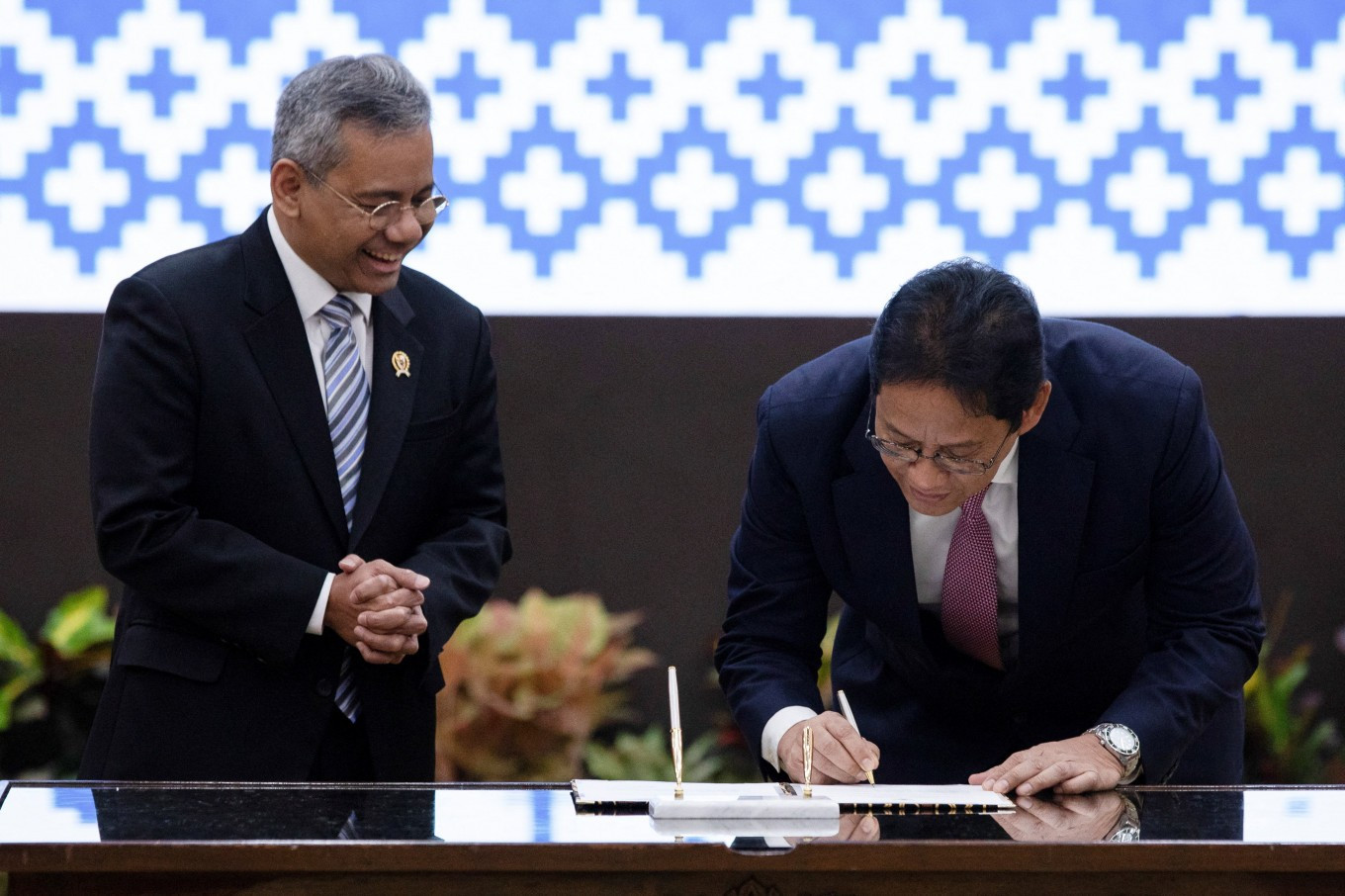 Indonesia's newly appointed Finance Minister Suahasil Nazara reacts as outgoing Finance Minister Purbaya Yudhi Sadewa signs a document, during a handover ceremony at the Finance Ministry in Jakarta, September 15, 2026. (Reuters/Garry Lotulung)
Purbaya Yudhi Sadewa was removed as finance minister after just over a year in office, marking the second time President Prabowo Subianto has replaced the country’s finance minister in less than two years. Prabowo appointed former deputy finance minister Suahasil Nazara to replace him, making Suahasil the third person to hold the position since Prabowo took office. The abrupt change followed months of contentious reforms, fiscal policies and plans that increasingly brought Purbaya into conflict with officials within the Finance Ministry and with other institutions.
On Sept. 10, four days before his removal, Purbaya carried out a major personnel reshuffle affecting around 400 officials, including echelon-II and echelon-III officials, non-echelon officials, agency heads and directors of Special Mission Vehicles (SMVs). Most of those affected were from the Directorate General of Taxes and the Directorate General of Customs and Excise. Purbaya reportedly faced resistance from both directorates over the changes.
The dispute subsequently escalated after Customs and Excise Director General Djaka Budhi Utama and Tax Director General Bimo Wijayanto opposed the changes. Both were appointed to their current positions under then-finance minister Sri Mulyani Indrawati and had met with Prabowo before their appointments in 2025. Djaka, a retired three-star Army general, had previously served in the military alongside Prabowo, while Bimo is an alumnus of Taruna Nusantara, whose alumni network has gained prominence in the current administration.
According to reports, Djaka and Bimo subsequently met with Prabowo on Sept. 11, shortly before the President departed for India. The meeting reportedly followed an earlier attempt by Purbaya to obtain Prabowo’s approval to replace the two directors general, which the President rejected. Reuters, citing sources, reported that the dispute with Djaka ultimately became the decisive factor in Purbaya’s removal. Three days later, on Sept. 14, Prabowo dismissed Purbaya and appointed Suahasil as his replacement.
One of the most recent controversies involved Purbaya’s plan for Danantara to transfer Rp 120 trillion (US$6.76 billion) in profits to the state to help finance the government’s budget. Purbaya announced the planned transfer in late August, saying the funds would be recorded as non-tax state revenue (PNBP). Danantara’s leadership subsequently indicated that no such plan had been discussed, creating a public dispute between the Finance Ministry and the institution managing the government’s state-owned assets. Purbaya nevertheless maintained that the funds would be recorded as PNBP despite Danantara’s objections.
This followed an earlier and more prolonged dispute over the government’s use of its excess budget balance (SAL). In September 2025, the Finance Ministry began moving SAL funds from Bank Indonesia (BI) to state-owned banks (Himbara) under Finance Ministerial Decree No. 276/2025, initially placing Rp 200 trillion with the banks to increase liquidity and encourage lending. The policy was subsequently expanded, with hundreds of trillions of rupiah in government funds placed in Himbara as the banks used the additional liquidity to extend credit.
By June 2026, the Finance Ministry had temporarily withdrawn Rp 110 trillion from the Rp 281 trillion placed in Himbara and returned it to BI amid pressure to support monetary and exchange-rate management. The withdrawal, however, exposed a complication: some of the funds had already been disbursed by Himbara as loans, including financing for government-supported programs such as the Red and White Cooperatives.
Himbara subsequently raised concerns about tighter liquidity, giving Purbaya grounds to reverse the withdrawal. He announced that the Rp 110 trillion would be returned, restoring the placement to Rp 281 trillion. The government also prepared another Rp 100 trillion as standby funds at BI, bringing the amount potentially available for placement to Rp 381 trillion. By August, it planned further injections that could bring total government funds in the banking system to nearly Rp 400 trillion. The repeated changes in the SAL policy added to concerns about the consistency of the government’s liquidity strategy, highlighting tensions between the government's growth objectives and BI's monetary policy.
The market’s reaction to his removal was mixed. The Indonesia Stock Exchange (IDX) Composite index initially fell by more than 2 percent on Sept. 14 before recovering sharply after Suahasil was announced as his replacement, although it still closed below its opening level. Given Suahasil’s long tenure under Sri Mulyani, his appointment could signal a return to a more institutionally familiar and technocratic style at the Finance Ministry. It also leaves questions over the future of policies pursued under Purbaya, including the Danantara profit transfer and the government’s strategy for placing state funds in banks.
What we've heard
There had long been reports that Purbaya did not get along with the customs and tax directors general, Djaka and Bimo. The rift came to a head when Purbaya sought to reshuffle hundreds of echelon II and III officials at the two directorates. The reshuffle was reportedly carried out without discussion with or the knowledge of Djaka or Bimo. Both opposed the reshuffle and were reportedly believed to have instructed their subordinates to turn around and not attend their inauguration ceremonies. Tensions also emerged between Djaka and Finance Ministry secretary-general Robert Leonard Marbun over the reshuffle. Robert was reportedly seen as Purbaya's representative within the Finance Ministry.