
News
Wanted: The best candidates to tame the stock market
Tenggara Strategics February 23, 2026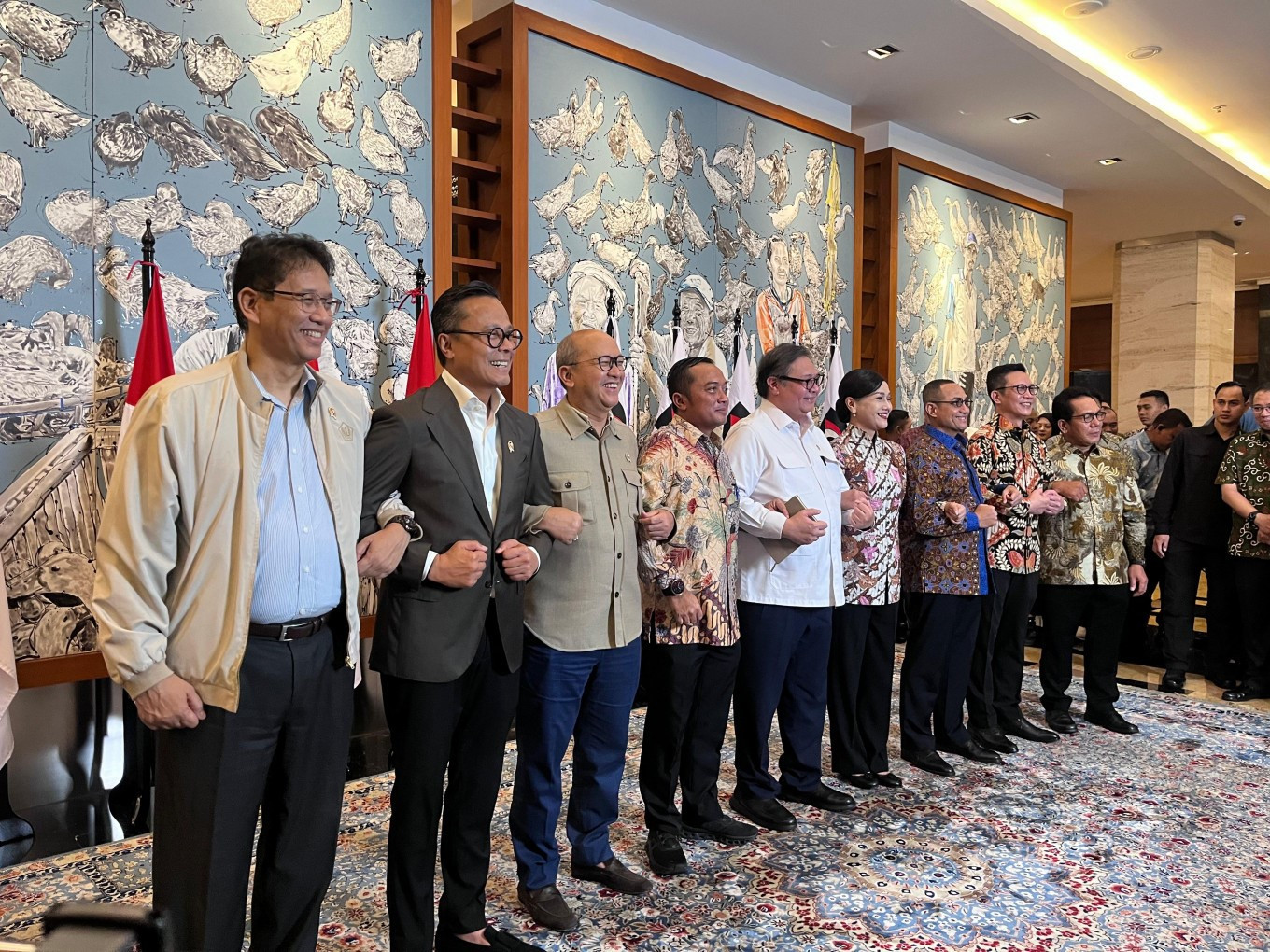 Financial Services Authority (OJK) acting head Friderica Widyasari Dewi (fourth right), and another newly appointed OJK leader, Hasan Fawzi (third right), brief the press after taking on their new roles on Jan. 31, a day after previous leaders announced their resignations. Jeffrey Hendrik (second from right), meanwhile, is expected to assume ad-interim the role of Indonesia Stock Exchange (IDX) president director. (The Jakarta Post/Ni Made Tasyarani))
Following the resignation of the Financial Services Authority (OJK) chairman and deputy chairman, the government has formed a selection committee to seek the best candidates to lead the OJK and restore investor confidence after market turmoil triggered by Morgan Stanley Capital International (MSCI)’s interim freeze of its February review of Indonesian stocks. The pressing question is whether any candidate will be capable of rebuilding market trust.
The selection committee, established on Feb. 9, is chaired by Finance Minister Purbaya Yudhi Sadewa and comprises eight members, including Bank Indonesia (BI) Governor Perry Warjiyo, Deputy Finance Minister Suahasil Nazara and several senior officials and experts. The committee has set relatively lenient eligibility criteria, requiring at least 10 years of experience in the financial sector and no criminal record. Politicians are eligible provided they resign from their political parties.
Several figures were rumored to be entering the race, including House of Representatives Commission XI chairman Muhammad Misbakhun and Suahasil Nazara, though both denied their involvement. While applications remain open until March 2, Purbaya has publicly expressed dissatisfaction with the quality of the applicants, noting that many have fallen short of expectations.
The selection process unfolds at a critical juncture. The stock market has slumped after MSCI temporarily froze Indonesia’s February market classification review and warned that the country could be downgraded from emerging market to frontier market status if governance concerns persist through May 2026. Such a downgrade could trigger capital outflows of up to Rp150 trillion (US$8.88 billion), according to one estimate.
At the heart of MSCI’s concerns is weak market governance, particularly the limited disclosure of ultimate beneficial ownership (UBO) because of complex corporate structures, especially among conglomerate-linked stocks. These stocks have long been suspected of engaging in market manipulation practices, commonly known as “pump-and-dump” schemes, which propelled the Jakarta Composite Index (JCI) toward the 9,000 level within a short span.
These concerns are reflected in unusually high price-to-earnings (P/E) ratios, signaling excessive valuations and elevated risk. For instance, shares of PT Chandra Daya Investasi - linked to conglomerate Prajogo Pangestu - reached a P/E ratio of 401 times. Following MSCI’s announcement, the JCI fell sharply from nearly 9,000 in late January to 7,922 on Feb. 2.
MSCI’s warning did not emerge overnight. Discussions over governance weaknesses have been ongoing since October 2025. Earlier this year, MSCI even offered the OJK a revised free-float calculation methodology tailored to Indonesia. In response, the OJK and the self-regulatory organizations (SROs) prepared measures to strengthen equity market governance, including improving UBO transparency.
Beyond MSCI’s warning, Purbaya had repeatedly urged the Indonesia Stock Exchange (IDX) and the OJK to tighten market discipline, curb manipulative practices and strengthen investor protection. In December 2025, he gave the OJK a six-month deadline to enforce discipline and sanction violators, later criticizing the IDX for responding too slowly to MSCI’s recommendations.
MSCI’s decision triggered a snowball effect. Shortly after the announcement, Goldman Sachs downgraded Indonesian equities to “underweight”, while UBS cut its rating from “overweight” to “neutral”. Soon after, Moody’s Investors Service revised Indonesia’s sovereign outlook from stable to negative, citing policy unpredictability and governance risks.
Domestically, political pressure intensified. Deputy House Speaker Sufmi Dasco Ahmad from President Prabowo Subianto’s Gerindra Party reportedly summoned OJK commissioners and urged them to take responsibility. Dasco was said to have suggested that several commissioners step down. Meanwhile, Defense Minister Sjafrie Sjamsoeddin, another close Prabowo ally, proposed legal action against OJK and IDX leaders. OJK and IDX leaders eventually chose to resign.
The OJK, now led by Friderica Widyasari Dewi as interim chair, serves as a pillar of Indonesia’s financial system stability, supervising banks, capital markets and nonbank financial institutions. Its independence is crucial to ensuring objective supervision aligned with stringent banking standards, including international benchmarks such as the Basel Framework. Political interference risks eroding regulatory credibility and further undermining investor confidence.
History offers a sobering lesson. Weak governance and financial oversight were among the factors that worsened the 1997–1998 Asian Financial Crisis, which ultimately toppled strongman Soeharto, then Prabowo’s father-in-law. A recurrence of such instability would carry severe economic consequences.
Given the erosion of investor trust, the OJK leadership selection process must be transparent, merit-based and free from political interference to produce candidates capable of restoring confidence among investors, MSCI and rating agencies. Failure to do so could deepen market skepticism, accelerate capital outflows and ultimately threaten financial system stability.
What we've heard
A pro-government politician in the House of Representatives said several candidates have emerged, including Misbakhun of the Golkar Party. However, the source said Misbakhun is still weighing his chances and the level of support from his party before deciding to run as a candidate. The source noted that Misbakhun had previously sought to become one of the leaders of the Supreme Audit Agency (BPK), but internal transitions within Golkar at the time pushed him out of contention.