News
How Prabowo controls criticism in Indonesia’s democracy
Tenggara Strategics February 19, 2026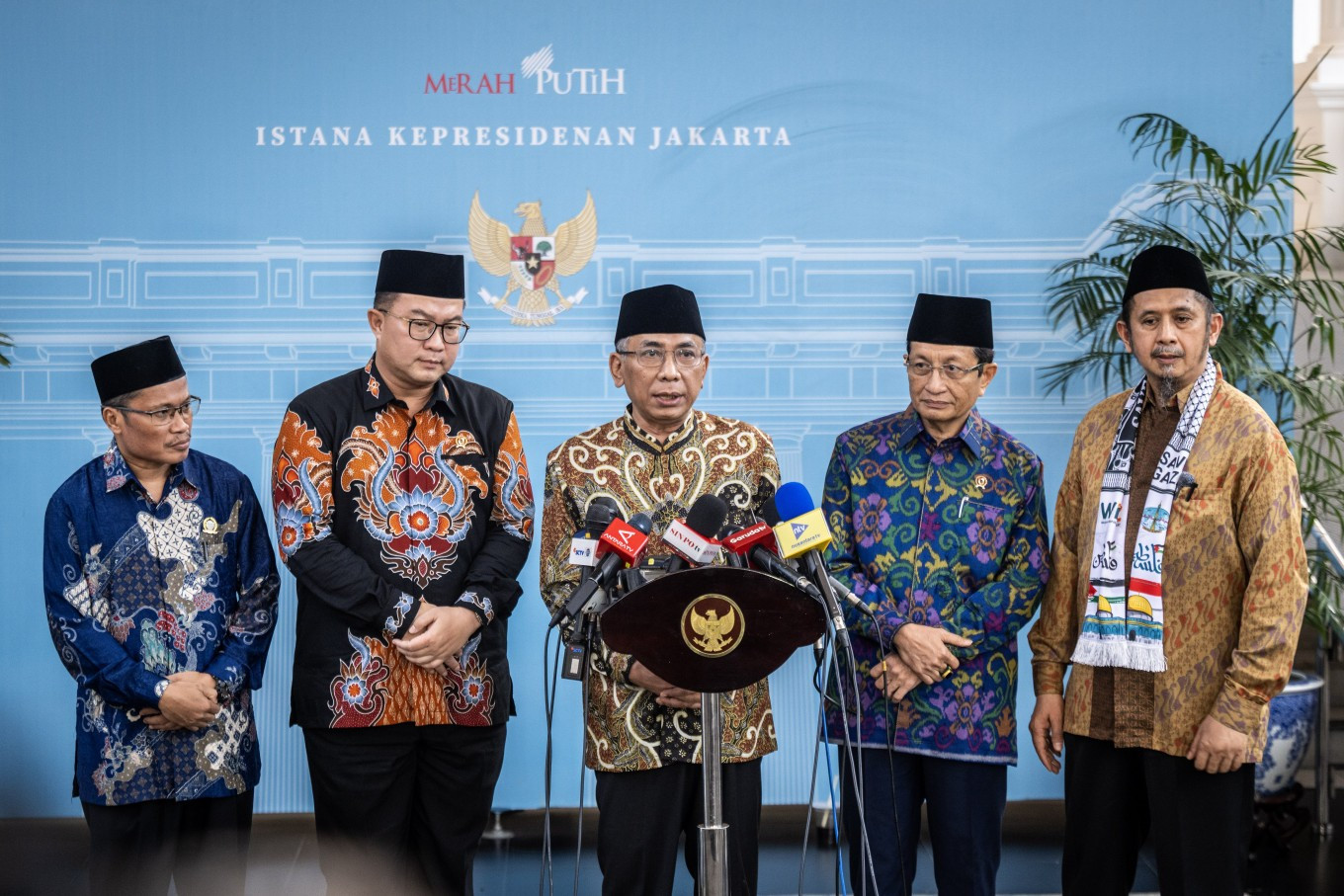 Religious Affairs Minister Nasaruddin Umar (second right) alongside religious leaders attend a press conference on Feb. 3, 2026, after a meeting with President Prabowo Subianto at the State Palace in Central Jakarta. The meeting discussed Indonesian participation in the Board of Peace. (Antara/Bayu Pratama S)
On many occasions, President Prabowo Subianto has publicly stated that he welcomes criticism of his administration, emphasizing that governments require critical feedback, even when it is uncomfortable. Yet the situation on the ground suggests a paradoxical reality: criticism may be welcomed in rhetoric, but its public expression appears increasingly constrained.
In recent weeks, the President has intensified a series of closed-door engagements with prominent figures, a move widely framed as an effort to obtain diverse perspectives on national priorities.
On Jan. 30 at his private residence on Jl. Kertanegara in South Jakarta, Prabowo received several public figures including Siti Zuhro, Abraham Samad, Said Didu and Susno Duadji. Their discussions reportedly covered eradicating graft, regional elections, the Corruption Eradication Commission (KPK), police reform and Indonesia’s involvement in the Gaza Board of Peace (BoP). The meeting generated mixed responses ranging from praise for the President’s openness to speculation that vocal critics were being symbolically repositioned within the administration’s orbit.
The pattern was repeated on several other occasions. On Feb. 3, the President convened a closed meeting with leaders from at least 19 Muslim organizations at Merdeka Palace in Central Jakarta. A day later, he welcomed former foreign ministers, deputy foreign ministers, lawmakers and academics. Both meetings focused primarily on Indonesia’s prospective participation in the BoP spearheaded by United States President Donald Trump.
Despite initial differences, the attendees publicly converged on the view that joining the BoP aligned with Indonesia’s constitutional commitment to Palestinian independence.
This type of engagement also extended to the business community. On Feb. 9, Prabowo hosted 22 business leaders from the Indonesian Employers Association (Apindo) at his Hambalang residence in Bogor, West Java. During that meeting, he encouraged the private sector to expand job creation, particularly in the real economy, while supporting poverty alleviation through improved nutrition and education alongside industrialization.
Taken together, these forums project an image of consultative governance. However, critics argue that those consultations have occurred largely within controlled, closed settings: spaces where dissent can be managed rather than addressed openly.
Beyond these curated forums, public criticism has faced growing pressure. Analysts note that escalation in crackdowns on critical voices have occurred in parallel with the ruling coalition’s consolidation of power in the legislature. Seven of the eight factions in the House of Representatives, which account for 81 percent of 580 legislative seats, are now aligned with the Prabowo administration, effectively positioning civil society as the primary opposition.
Tensions were particularly visible during the August-September 2025 protests and ensuing violence, which were triggered by economic grievances including unemployment and declining purchasing power. While the protests highlighted socioeconomic anxieties, authorities responded with mass arrests netting more than 950 individuals, who were charged with offenses ranging from incitement and disinformation to the recruitment of minors for fomenting unrest. In addition, the President labeled certain protest actions as “treason” and “terrorism”, reinforcing perceptions of a rigorous security response to dissent.
Concerns have also surfaced over press freedom. Public scrutiny followed the takedown of a video report on the flooding in Aceh, in which a journalist was seen breaking down while describing the suffering of affected communities. Although an official explanation was provided, the video’s removal fueled suspicions over political sensitivity surrounding coverage of the Sumatra disaster.
Cultural expression has not been immune either. Police summoned comedian Panji Pragiwaksono for questioning on Feb. 6 following complaints that material in his Netflix stand-up special contained insults, including satirical commentary on Indonesian politics and the 2024 elections.
More broadly, the President has denounced what he calls “foreign intervention” aimed at dividing the nation and warned of “foreign lackeys”, allegedly backed by external powers seeking to undermine Indonesia’s prosperity. In parallel, the government has proposed legislation targeting disinformation and foreign propaganda.
The dual posture of inviting selected figures to private consultations while taking a hardhanded approach to public dissent has shaped public perceptions on Prabowo’s governing style. Critics argue that rather than expanding democratic space, curated engagements risk narrowing the room for free expression, concentrating dialogue within elite circles while marginalizing critiques voiced in the public square.
What we've heard
According to three sources familiar with the matter, a meeting between President Prabowo and several prominent critics was orchestrated by Said, with the backing of Defense Minister Sjafrie Sjamsoeddin. Said’s close ties to Sjafrie date back to their 2008 collaboration on restructuring military business interests; sources added that their shared roots in South Sulawesi further cement the relationship.