
News
Skipping G20, a costly foreign policy blunder for Prabowo
Tenggara Strategics December 9, 2025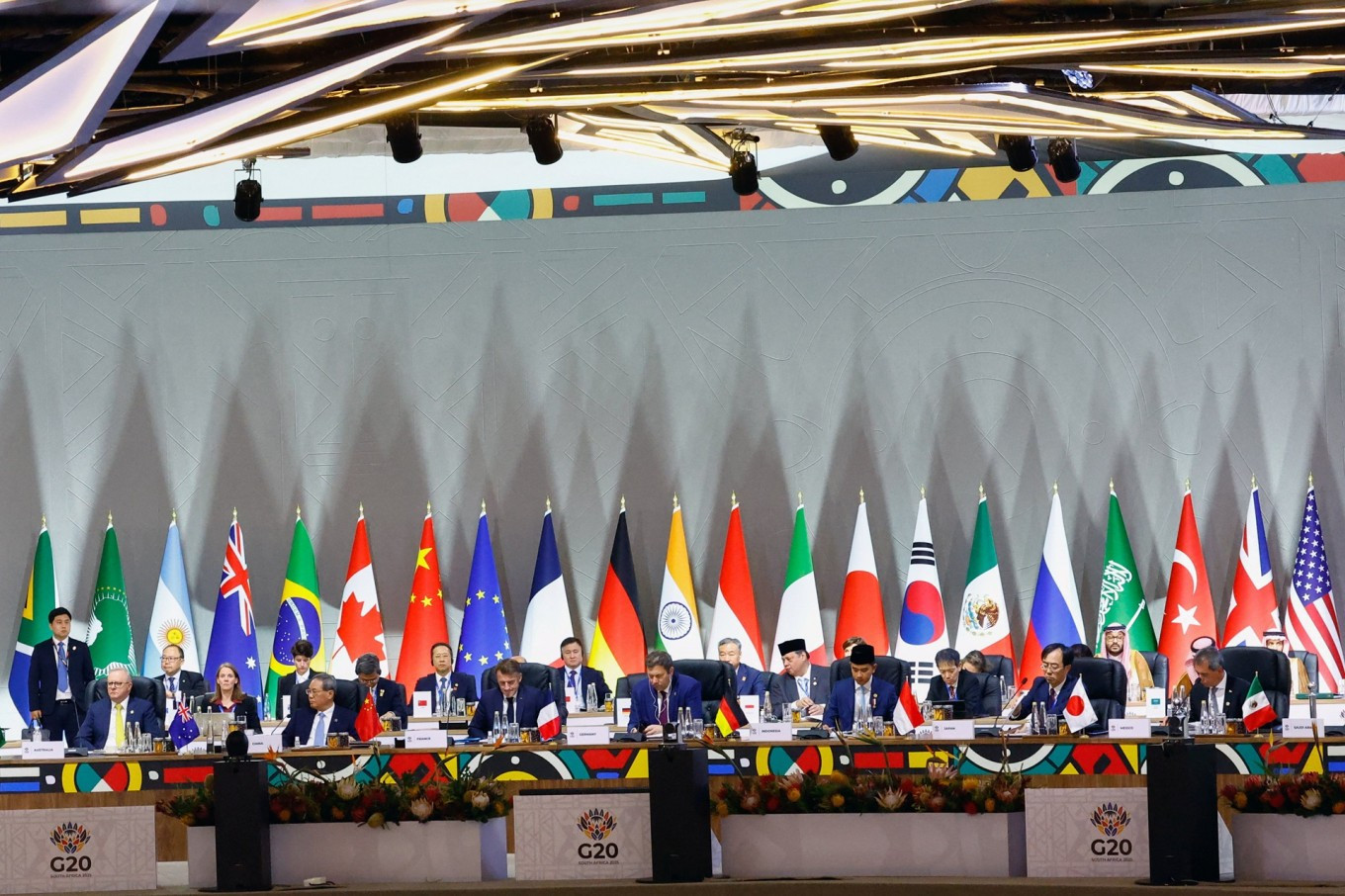 Leaders attend a plenary session on the opening day of the G20 leaders' summit on Nov. 22 at the Nasrec Expo Centre in Johannesburg, South Africa. (Reuters/Pool/Thomas Mukoya)
Last month, President Prabowo Subianto skipped the G20 summit in Johannesburg, South Africa, undermining his claim to be a champion of multilateralism as well as his chances of assuming the vacant leadership of the Global South.
Earlier, Prabowo told South Africa President Cyril Ramaphosa that he would attend when the latter came to Jakarta in October to extend the invitation to the summit personally.
In diplomacy, this is an absolute no-no. South Africa, Brazil, India and Indonesia are the representatives of the Global South in the gathering of leaders from the world's wealthiest nations. Prabowo should have gone there with the other leaders to show solidarity. This episode hardly caused a political ripple at home, other than that people noticed that Vice President Gibran Rakabuming Raka made his international summit debut to take Prabowo's place in Johannesburg. But the president's absence is a major foreign policy blunder that would hurt Indonesia's standing in the world.
The Presidential Palace's explanation that Prabowo had been skipping the G20 summit due to a tight domestic agenda is hard to accept, given that there were no major crises at home to stop him from leaving the country. In comparison, he left for Beijing in September to attend the sizable military parade amid widespread violent riots. The deadly floods in Sumatra occurred days after the G20 summit finished, and even then, he was widely criticized for the tardy response to the disaster that had killed more than 600 people.
Prabowo has traveled overseas extensively since his October 2024 inauguration, more so than any past Indonesian president, and these include attending several summits and the United Nations (UN) General Assembly in September. In many speeches, Indonesia's "foreign policy" president championed multilateralism as the best way of solving global problems and of stopping the world from becoming bipolar. He was living up to Indonesia's foreign policy main principles of being active, independent and nonaligned.
The G20 is not something a true multilateralist would want to miss, so when Prabowo decided at the last minute to delegate the job to Gibran, inevitably, speculations became rampant about the real reason for his decision.
One popular theory that has circulated is that Prabowo was playing to the drumbeat of United States President Donald Trump. If he wasn't following Trump's instruction, he certainly looked like he was trying to appease the US President. Trump boycotted the Johannesburg summit, claiming that South Africa's white minority had been the target of large-scale killings and land grabbing.
South Africa had also led the campaign to get the International Court of Justice to declare that Israel had committed genocide in the war in Gaza, which has killed more than 70,000 people, including many women and children, and displaced almost the entire 3 million population.
Prabowo has been trying very hard for Indonesia to take a more active role in the Israel-Palestine conflict, some say too hard that it looks like on the verge of abandoning its long-held policy of not recognizing Israel until Palestinians gain their independent homeland. One way of doing this, in the absence of direct communication with Israel, is to appease Trump, the biggest supporter of Israel.
In his UN General Assembly speech, Prabowo said Indonesia is prepared not only to recognize the state of Israel, but also to guarantee its security, after Palestinians gain their independence under the two-state solution. He has gone further than all past Indonesian leaders on relations with Israel.
The Indonesian leader has offered to take up to 2,000 Gazans who desperately need medical assistance, and now said Indonesia has prepared up to 20,000 soldiers to take part in the international stabilization force to be deployed in Gaza to enforce Trump's Gaza peace plan.
Prabowo's Middle East initiatives earned him a seat in the September meeting that Trump called in New York with 10 Arab and Muslim-majority countries to discuss his Gaza peace plan before it was announced to the world.
In October, he was invited to a summit in Egypt to launch Trump's Gaza peace plan. In one bizarre moment at the summit, Prabowo was caught on an open mic asking Trump if he could meet with his sons Eric or Don Jr. The only explanation from the Indonesian government is that this was an informal chat, and the docile public let this slide with some laughter.
In the absence of any other more rational explanation for missing Johannesburg, appeasement of Trump is the one that has made the rounds the most in diplomatic circles at home and abroad.
Meanwhile, some Indonesians were impressed by Gibran's first appearance at an international summit. He spoke well, calmly and with clarity in delivering the speech in Johannesburg. But this was hardly sufficient to repair the damage Prabowo has caused to Indonesia's global reputation by staying away from the G-20 summit without any convincing explanation.
Instead, now people are questioning Indonesia's, or perhaps more fittingly, Prabowo's commitments to multilateralism, nonalignment, solidarity with the Global South, and supporting the Palestinian cause.
What we've heard
A source within the Palace circle said that Prabowo assigned Gibran to the South African trip only four days before his departure. According to this source, Prabowo also paid attention to which delegations would attend the G20 summit.
Related Articles