
News
Prabowo targets electoral reforms to consolidate power
Tenggara Strategics December 29, 2025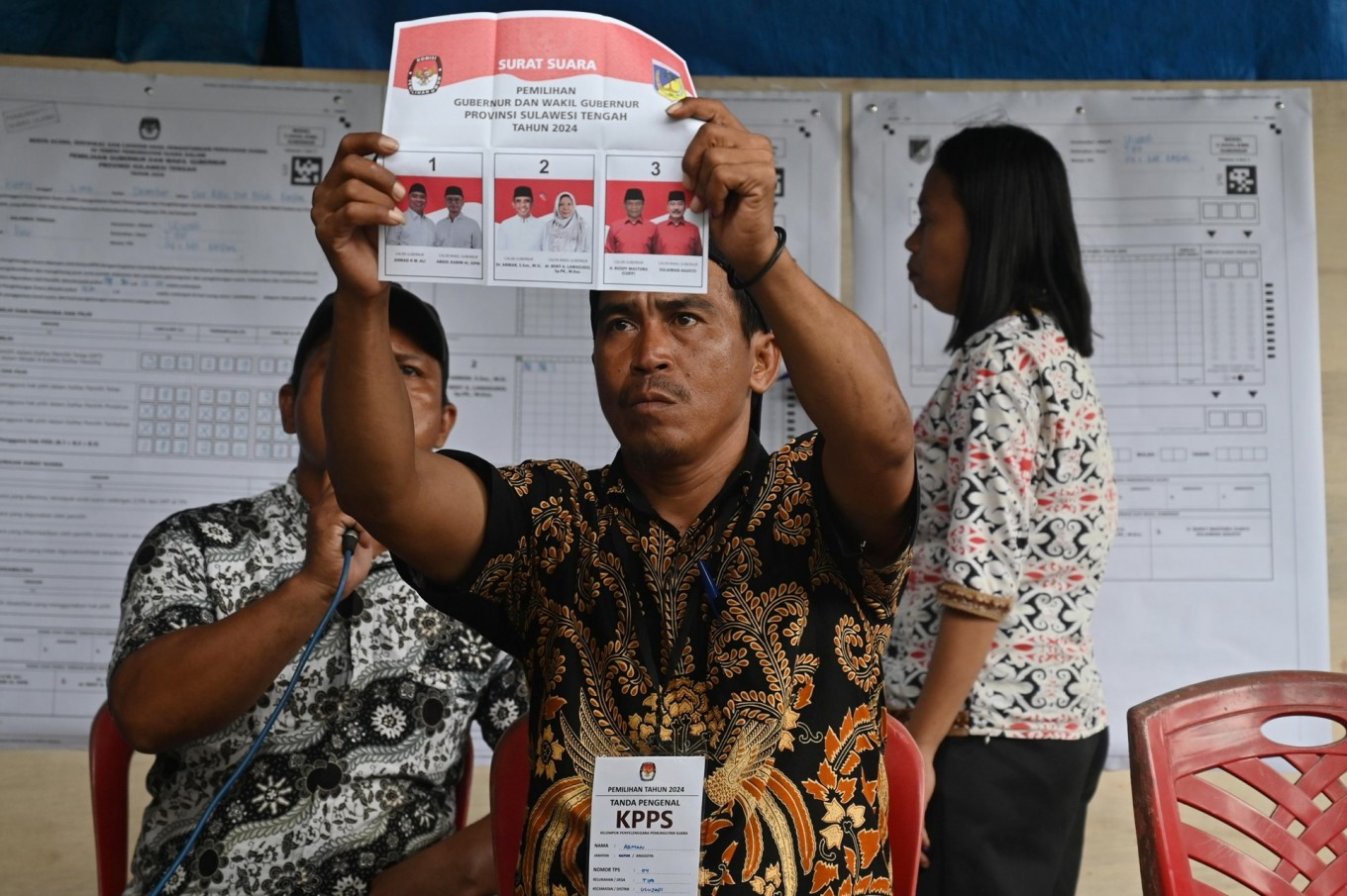 A local poll administrator (KPPS) shows a ballot to witnesses on Dec. 5, 2024, during the vote tabulation of the revote for the Central Sulawesi gubernatorial election in Palu. (Antara/Basri Marzuki)
The direct election mechanism as a way of choosing political leaders could become a thing of the past in Indonesia, starting with the election of the heads of regional administrations, but it could go all the way up to the election of the head of state.
The greatest beneficiary of this indirect system is the President, at least going by the history of how Soeharto had ruled Indonesia for over three decades. A return to the old system would help incumbent President Prabowo Subianto consolidate power and rule longer than the maximum of two five-year cycles currently allowed by the constitution.
The combination of the Functional Groups (Golkar) and Great Indonesia Movement (Gerindra) parties, the two largest parties in Prabowo's coalition government, should be enough to ensure changes in the way local elections will be run in 2029. The coalition controls over 80 percent of the seats in the House of Representatives.
The issue was broached during Golkar's 61st anniversary in Jakarta on Dec. 5 when Prabowo, chair and founder of Gerindra, in a speech, welcomed Golkar's proposal to change the regional electoral system, citing the huge costs of the direct mechanism, estimated at Rp 37 trillion (US$2.2 billion) for the regional elections last year.
Golkar chair Bahlil Lahadalia said his party has helped draft the bill on the new law governing the regional electoral system, and it is now ready to be presented to the House for deliberation.
With Prabowo's ruling coalition controlling more than 80 percent of the 580 seats in the House, the bill will likely be given a swift passage, never mind what the Indonesian Democratic Party of Struggle (PDIP), the lone opposition, think.
This means that in 2029, all the heads of the regional governments, at provincial, regency and city levels, would be elected by the local legislative councils and no longer by the people as has been the practice in post-Soeharto Indonesia since the turn of the millennium.
Critics say this indirect system will take power out of people's hands and put it to elected politicians in the local legislative councils. Real power then rests in the hands of the chairs of the highly centralized political parties who control the legislators.
Going by the experience of the Soeharto regime, the incumbent president, using carrots and sticks, would have no trouble controlling the political parties in Jakarta to ensure favorable outcomes in most, if not all the local elections.
The direct election mechanism was introduced, for both regional and national elections, as part of the political reforms after the collapse of the corrupt Soeharto regime in 1999.
The direct mechanism is also seen as part and parcel of the political consensus to decentralize power out of Jakarta and give it to the region, including their people.
Reforming the presidential electoral system may be a tougher nut to crack, however, since the direct mechanism was written into the constitution during a series of amendments immediately after Soeharto stepped down, again for the reason to reduce some of the political power which had been concentrated in the hands of the president.
Soeharto, president from 1966 to 1998, was re-elected six times by the People's Consultative Assembly (MPR), which he controlled. He also reduced the number of political parties to three, with his own Golkar in the lead, and guaranteed automatic MPR seats for the military. In all the six elections he went through, he ran unopposed.
Amending the constitution may be tough but not at all impossible. There are already discussions about amending the constitution to restore much of the loss power into the hands of the president. One campaign is led by retired members of the Indonesian Military (TNI), including many of Prabowo's peers from his Army years.
In April, the Forum of Retired TNI Members (FPPT) issued a document entitled "TNI for the return to the 1945 Constitution", calling for the nation to go back to the system of government mandated in the original basic law introduced in 1945, the year Indonesia became an independent nation.
Prabowo's predecessor Joko Widodo tried to amend the constitution that would have allowed him to extend his rule for a third five-year term and more beyond 2024. But his coalition of multiple political parties failed to garner enough support in the MPR to launch the amendment process. Now it is Prabowo's turn to take a crack, starting with the easier one of reforming the regional electoral law.
What we've heard
A politician close to President Prabowo said the idea of restoring indirect regional elections has been circulating for some time. The government, the source explained, wants greater control over the appointment of regional leaders to ensure alignment with national programs. "It would make it easier for the central government to control regional heads," the source said.
According to the source, electing regional heads through the Regional House of Representatives would serve as an entry point for the Gerindra Party's broader agenda. As outlined in the party's vision and mission, Gerindra seeks to restore the Constitution to its original 1945 version.
The original 1945 Constitution includes provisions for the president to be elected by the People's Consultative Assembly (MPR), without a term limit. "That is the ultimate goal of the electoral system currently under discussion," the source said.