News
Pope Francis' legacy lives on in Indonesia
Tenggara Strategics May 7, 2025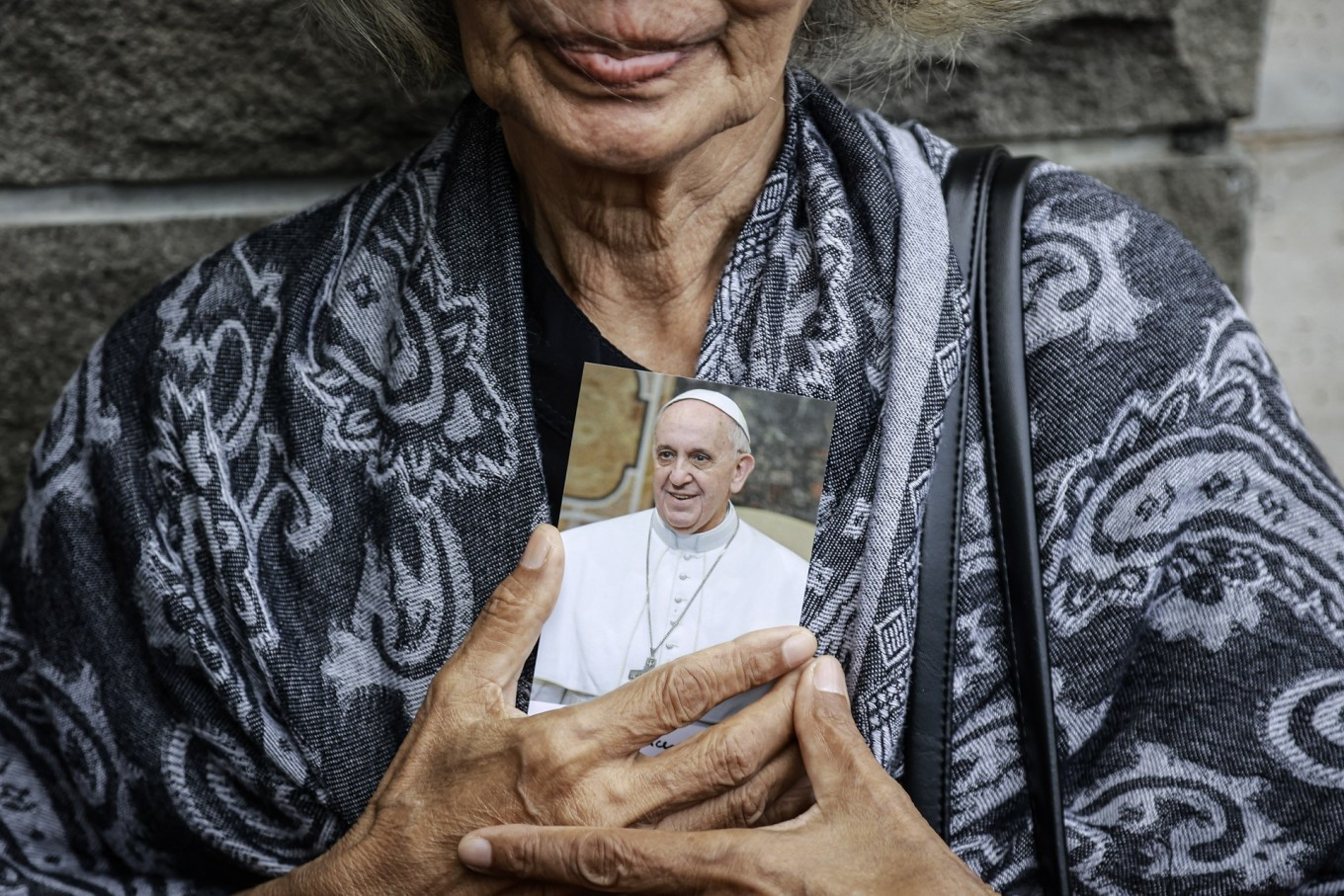 Cradled icon: A woman holds a picture of Pope Francis on Tuesday after visiting the Vatican Embassy in Jakarta. Catholics visited the embassy to pray for Pope Francis, who died at 88 on Monday, following a stroke after months of declining health. (Antara/
The passing of Pope Francis on April 21 has struck the global community to its core. From the outset of his papacy, Francis made a difference. He was a man of many firsts: the first Jesuit pontiff, the first Latin American pope, and the first pope born outside of Europe since the 8th century. Born Jorge Mario Bergoglio, he chose the Latin name Francis for his pontificate in honor of Saint Francis of Assisi, the 13th-century Italian friar who, in his words, was a man of poverty and peace “who loves and protects creation”.
He lived up to these values throughout his papacy in his commitment to building bridges, not walls. Pope Francis championed the marginalized and strongly advocated for the environment, urging global collective action against climate change. In his final public address on Easter Sunday, Francis called for greater humanitarian attention to the Palestinian people as well as the Christian community in the Gaza Strip and a long-standing ceasefire in Gaza, denouncing the bloodshed he once described bluntly as “cruelty”, not war.
With his passing, 135 cardinals are set to enter into a conclave on May 7 to elect a new pope as the next face of the Church, representing 1.4 billion followers worldwide. Indonesian cardinal Ignatius Suharyo Hardjoatmodjo is among those eligible to join the papal election, where a candidate needs a two-thirds supermajority to become the next head of the Holy See.
Many citizens of the world’s largest Muslim-majority country have expressed delight at the prospect of Suharyo leading the Church. However, the Indonesian cardinal has dispelled any talk of personal ambition, saying it was “foolish” for anyone to aspire to the papacy.
Meanwhile, his Southeast Asian counterpart, Philippine cardinal Luis Antonio Tagle, is being touted as a front-runner in the upcoming conclave. Known as an excellent communicator with great charisma, if elected, Tagle would become not only the first Asian pope but also Francis’s ideological successor. The Philippine cardinal holds progressive values similar to those of Francis, emphasizing inclusion in the Church, social justice, and a strong ecological stance.
Even if Suharyo has minimal odds of being elected pope, Francis’s teachings continue to live on through the Bishops' Conference of Indonesia (KWI), which represents more than 8 million Catholics in the country. Suharyo was himself appointed cardinal by Pope Francis in 2019, making him one of the most visible proponents of Francis’ legacy.
The Indonesian church’s commitment to values similar to Francis’s is best seen in its stance on the infamous mining law passed early this year, which granted non-state institutions, including universities and religious organizations, the right to mine resources and profit from mining activities. The KWI was among the several faith-based institutions to reject the new mining law, arguing that the mining sector does not fall within the Church’s domain.
On the other hand, the country’s two largest Muslim organizations, Muhammadiyah and Nahdlatul Ulama (NU), have notoriously supported the new mining law. Early this year, Energy and Natural Resources Minister Bahlil Lahadalia announced that Muhammadiyah would be taking over the former operations of private mining firm Adaro, whereas NU was reported to have taken over concessions of PT Kaltim Prima Coal, the mining arm of Bakrie Group.
Critics said at the time that the mining concessions would only enable the government to silence its critics. According to them, the government hoped to garner the support of religious groups and their congregations through mining concessions, thereby suppressing potential unrest from the ensuing environmental damage and social harm.
In a similar vein, President Prabowo Subianto extended an offer to religious organizations to join the advisory board of the new sovereign wealth fund Danantara, which manages US$982 billion in the consolidated assets of 844 state-owned enterprises. The KWI has again declined this move.
With growing concerns over a shrinking civic space, the Indonesian church has also emerged as a bastion of freedom of speech. In an interview with online Catholic newspaper Crux, Suharyo called for the release of Rata Thalisa, a transgender woman who was sentenced in March to two years and 10 months in prison for hate speech against Christianity after a social media post that mocked Jesus’s hair. “Not everything is to be taken very seriously. Jesus would laugh if he heard the suggestion to cut his hair,” Suharyo remarked.
He also called for a review of the controversial blasphemy provision under the 2024 Electronic Information and Transactions Law, describing it as “fundamentally” dangerous for granting authority to the state in theological matters.
The KWI serves as a heartfelt reminder that Francis’s teachings of compassion and care for humankind and the planet continue to live on through his followers. In a country increasingly marked by unbridled pragmatism and right-wing populism, idealism is needed more than ever to remind us of what is at stake when development abandons ethics.
What we've heard
An official close to Prabowo said he chose former president Joko “Jokowi” Widodo to represent Indonesia in the burial ceremony of the pope due to their past relationship. Pope Francis visited Indonesia when Jokowi was president.