
News
Free land? Public housing and reviving Meikarta
Tenggara Strategics February 21, 2026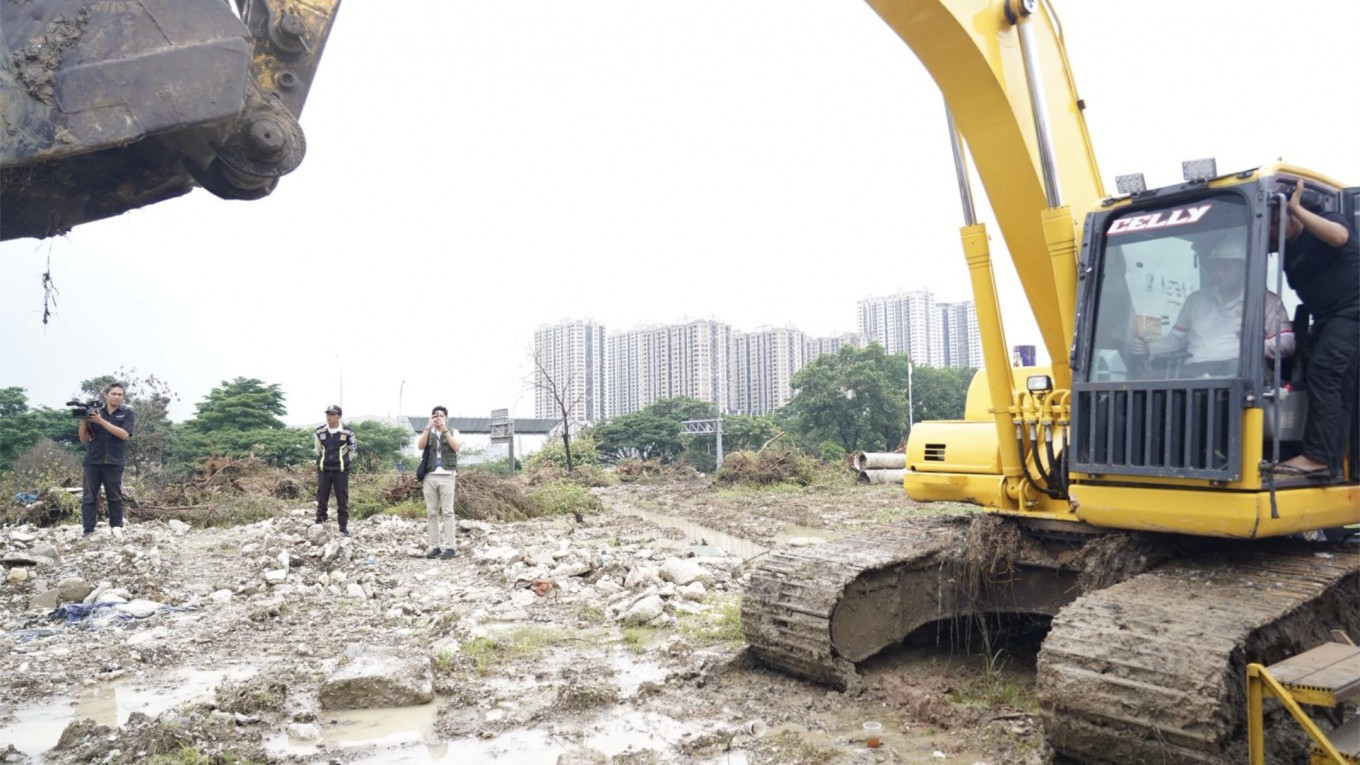 Breaking good: Public Housing and Settlement Areas Minister Maruarar “Ara“ Sirait on Jan. 29, 2026, symbolically kicks off the land-clearing phase for the construction of subsidized apartment housing at the Meikarta site in Bekasi regency, West Java. (Public Housing and Settlement Ministry/-)
Once synonymous with controversy and stagnation, Meikarta has resurfaced on Indonesia’s national housing agenda. The government plans to repurpose the site for subsidized vertical housing for low-income households, with around 30 hectares (ha) of Lippo Group-owned land reportedly provided “for free”. The arrangement raises broader questions about transparency and whose interests the policy ultimately serves.
Housing and Settlements Minister Maruarar “Ara” Sirait announced plans to redevelop the 30-ha site into subsidized apartment towers under the government’s 2026 strategy, part of President Prabowo Subianto Prabowo Subianto Djojohadikusumo, 72, is a retired Army lieutenant general, a businessman and the incumbent Defense Minister (2019-present). Due to his proximity to power throughout his military career, he entered politics in 2004 to pursue his dream of becoming the nation’s president. ’s pledge to deliver 3 million homes annually. The initiative responds to a sizable housing deficit, with an estimated 9.9 million additional units still required nationwide.
Minister Ara has indicated that the Meikarta subsidized apartment project represents an investment of approximately Rp 39 trillion (US$2.3 billion). The plan includes the construction of 18 towers, each rising 30 floors, with a total of around 141,000 units. According to Pahala Nainggolan, a ministry official, unit prices are expected to start at about Rp 350 million.
Under the government’s subsidized housing programs, eligible households can access home ownership through mortgage financing (KPR) with a 1 percent down payment and a fixed 5 percent interest rate. Within this framework, repurposing Meikarta is presented as one mechanism to expand supply while preserving affordability through state-backed financing schemes.
However, the historical uptake of subsidized vertical housing has been relatively modest. Financing through the Housing Finance Liquidity Facility (FLPP) scheme supported only three apartment units in 2025 and approximately 638 units cumulatively since 2011. This pattern reflects structural challenges, including hesitation among low-income households toward vertical living arrangements, limited developer participation due to pricing caps and recurring costs such as maintenance fees.
These dynamics suggest that expanding supply alone may not guarantee effective access. Addressing behavioral preferences, affordability structures and ongoing cost burdens will be as important as physical construction in determining whether the project meets its social objectives.
Despite these demand-side constraints, the project is scheduled to commence in early March. Institutional reassurance has been strengthened by legal clarification from the Corruption Eradication Commission (KPK), which confirmed that the land designated for development is clean and free from legal encumbrances. No assets on the site have been confiscated in connection with previous cases.
The KPK’s confirmation is particularly significant given the project’s controversial history. Meikarta was previously implicated in a bribery scandal related to building permit approvals for 53 towers, which led to the arrest of then Bekasi, West Java, regent Neneng Hasanah Yasin in October 2018. Several senior local officials and Lippo Group operations director Billy Sindoro were also implicated following a KPK operation. Legal clarity now reduces regulatory uncertainty and facilitates redevelopment.
Yet questions remain over the political economics of the “free” land. Minister Ara has stated that the 30 ha is being provided without cost. While framed as a corporate contribution to support public housing, transfers of strategic urban land are rarely neutral in economic terms. Such arrangements warrant scrutiny, not only in terms of transparency and governance, but also regarding whether public housing policy may inadvertently support private asset recovery rather than maximizing public value.
Contributions of strategically located land by large corporate actors are seldom detached from broader commercial considerations. They may relate to asset repositioning, future development leverage or the restoration of market confidence following a period of reputational or financial strain. In this context, the central question concerns how benefits are distributed and what safeguards ensure that the primary outcome is expanded access to affordable housing.
Examining contractual transparency, valuation mechanisms, monitoring arrangements and long-term development rights becomes essential. Without clear disclosure of how the land is valued and how responsibilities are allocated, the perception of “free” contributions risks obscuring more complex exchanges embedded within the partnership.
Beyond its housing policy framing, the redevelopment of Meikarta highlights the broader political-economic tensions inherent in state-business collaboration. With the original project having lost market momentum, government intervention may simultaneously advance social housing goals and reactivate previously stalled private assets. This overlap raises concerns about the potential socialization of risk alongside the restoration of private value. As fiscal pressures increase and reliance on private participation deepens, framing asset contributions as costless intensifies questions about transparency, valuation and accountability.
Ultimately, evaluating the Meikarta initiative requires looking beyond headline housing targets. The more fundamental assessment lies in how institutional transparency shapes the distribution of costs, risks and benefits between public and private actors, and whether the revival of a troubled mega-project can genuinely serve the broader objective of equitable housing provision.