News
Freeport divestment deal anchors Indonesia-US tariff negotiations
Tenggara Strategics March 3, 2026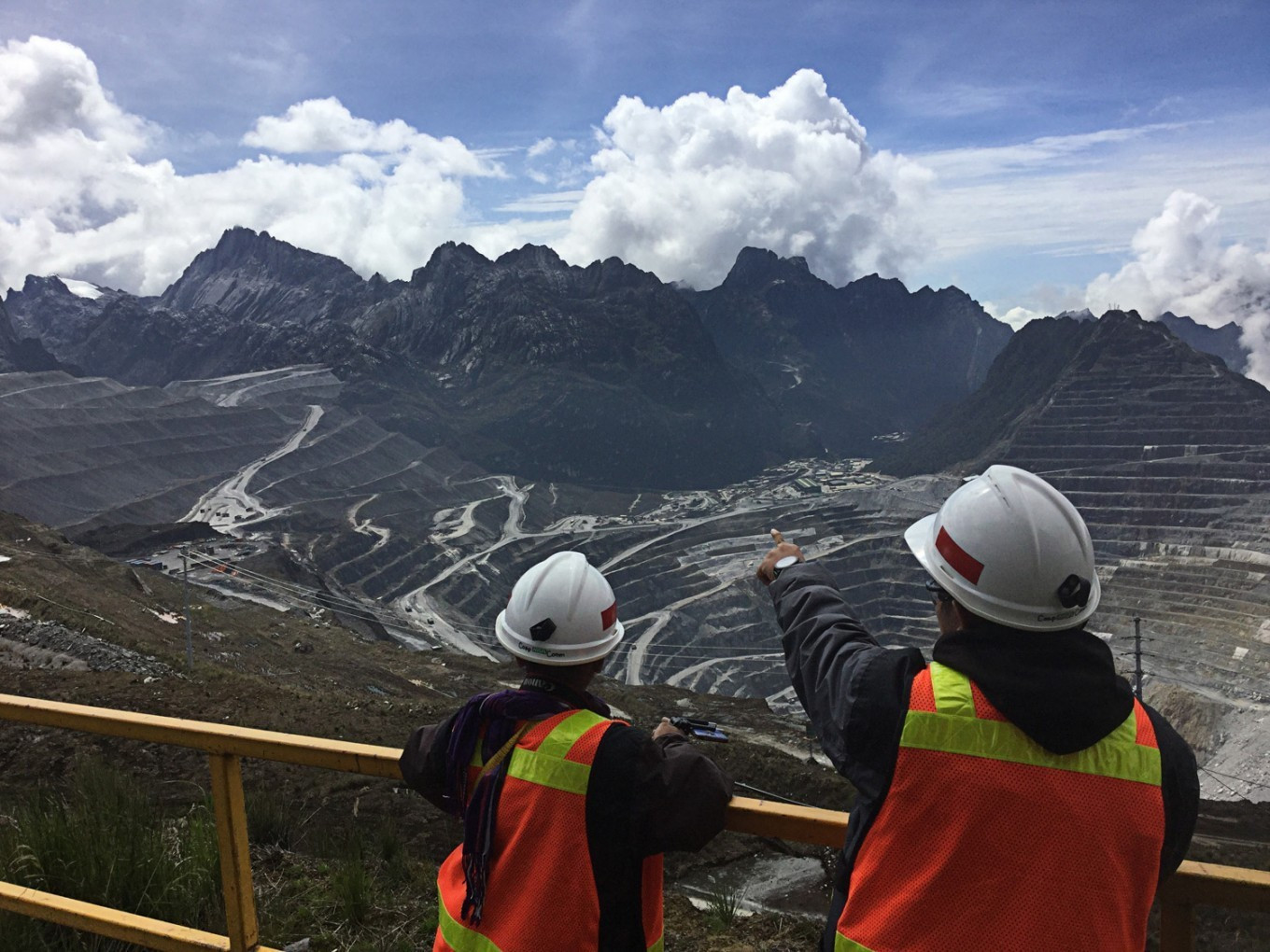 Workers at a mining site of PT Freeport Indonesia look at the Carstensz Pyramid in this undated photograph. (thejakartapost.com/Nethy Dharma Somba)
The administration of President Prabowo Subianto has reached a deal with Freeport-McMoRan as part of Indonesia’s broader negotiations to reduce punitive tariffs imposed by the United States under President Donald Trump. The agreement requires Freeport to divest additional shares in PT Freeport Indonesia (PTFI), which operates major mining assets in Papua, in exchange for an extension of its mining concession to the end of the mine’s life cycle. While the deal strengthens US access to critical minerals, it has drawn criticism for the limited involvement of indigenous Papuans.
The Indonesian government signed a memorandum of understanding (MoU) with Freeport and PTFI on Feb. 18, 2026, to extend PTFI’s special mining business permit (IUPK) for the Grasberg mine in Central Papua beyond its previous 2041 expiry date to 2061, in line with the mine’s projected life cycle. The Investment and Downstream Industry Ministry stated that the extension carries an investment value of US$20 billion, equivalent to around Rp 337 trillion at an exchange rate of Rp 16,890 per US dollar. The MoU will be followed by a definitive agreement.
Under the MoU, Freeport will divest an additional 12 percent stake in PTFI to the Indonesian government by 2041 in return for the concession extension. Freeport currently holds approximately 48.77 percent of PTFI shares. Although the share transfer will not involve direct payment, the government will reimburse Freeport proportionally for investments that generate returns beyond 2041, based on book value.
Freeport’s first attempt to operate in Indonesia began after it discovered the Ertsberg site during President Sukarno’s administration, but the proposal was rejected. Following the transition to President Suharto’s New Order regime, Freeport became the first foreign mining company to operate in Indonesia after the issuance of Law No. 1/1967 on Foreign Investment. The initial contract of work was signed on April 7, 1967.
The first contract ran for 30 years until 1997. In 1988, Freeport discovered the Grasberg site, which later became one of the world’s largest gold and copper deposits. Freeport negotiated further and by 1991, secured an extension of its contract until 2021. In exchange, Indonesia required the company to divest 10 percent of PTFI shares by 2001 and 51 percent by 2011.
However, the initial 10 percent stake was sold to PT Indocopper Investama instead of directly to the government. At the time, businessman Aburizal Bakrie owned 49 percent of Indocopper. His stake was later acquired by a subsidiary of PT Nusamba Mineral Industri, which is linked to the Nusantara Ampera Bakti foundation. Former president Suharto controlled 80 percent of the foundation, with the remainder is split evenly between Suharto’s eldest son Sigit Harjojudanto and Bob Hasan.
The original contract of work allowed provisions to override prevailing regulations. This flexibility weakened divestment requirements, particularly after Government Regulation No. 20/1994 permitted full foreign ownership. After the fall of the New Order, Law No. 4/2009 required foreign mining companies to divest shares within five years of commencing operations. However, renegotiations stalled as Freeport disputed the law’s applicability to its existing contract.
Several policy analysts argue that the favorable contract terms granted to Freeport during the New Order reflected geopolitical considerations, including US support for Indonesia’s control over West Papua. Efforts by subsequent administrations to revise the agreement were constrained by Freeport’s warnings of international arbitration and potential operational shutdowns or mass layoffs.
Renegotiations that began in 2014 culminated in a head of agreement signed on July 12, 2018. Under the agreement, state-owned enterprise PT Indonesia Asahan Aluminium (Inalum) acquired Rio Tinto’s 40 percent participating interest in PTFI for US$3.5 billion and purchased Indocopper Investama’s 5.62 percent stake for US$350 million. Following the transaction, Inalum and the Papua provincial government jointly controlled a majority stake in PTFI. The agreement also extended PTFI’s IUPK to 2041.
The Coordinating Ministry for Economic Affairs has emphasized PTFI’s strategic importance to the US, noting that the latest IUPK extension forms part of bilateral cooperation in developing downstream natural resource industries, including the processing of critical and rare earth minerals.
China currently dominates global refining capacity for many industrial metals, including rare earth elements. Export restrictions imposed by Beijing have heightened supply security concerns in several countries, including the US. In response, Washington has proposed a US$12 billion critical minerals stockpile initiative known as Project Vault.
Environmental group WALHI criticized the MoU, arguing that it was executed with limited transparency and without meaningful participation from indigenous Papuans and local customary communities. The Amungme people have clashed with Freeport since 1967, losing traditional lands near Tembagapura following the January Agreement of 1974. During the New Order, protests were met with repression by the Indonesian Military, and opposition to Freeport was often labeled as separatism. Tensions continued in the Reform era, particularly after PTFI’s concession area was designated as one of the 126 vital national objects in 2007, allowing military and police protection.
The new agreement has the potential to deliver mutual benefits for Indonesia, Freeport, and the US. However, its success for Indonesia depends not only on securing downstream investment in copper and gold processing, but also on ensuring justice, reconciliation, and meaningful participation for communities affected by mining operations, including the Amungme people.
What we've heard
Under the latest agreement, Freeport has committed to increasing exploration activities, while Indonesia will receive an additional 12 percent equity stake in 2041.