
News
Consumer confidence slips as livelihoods come under pressure
Tenggara Strategics August 26, 2026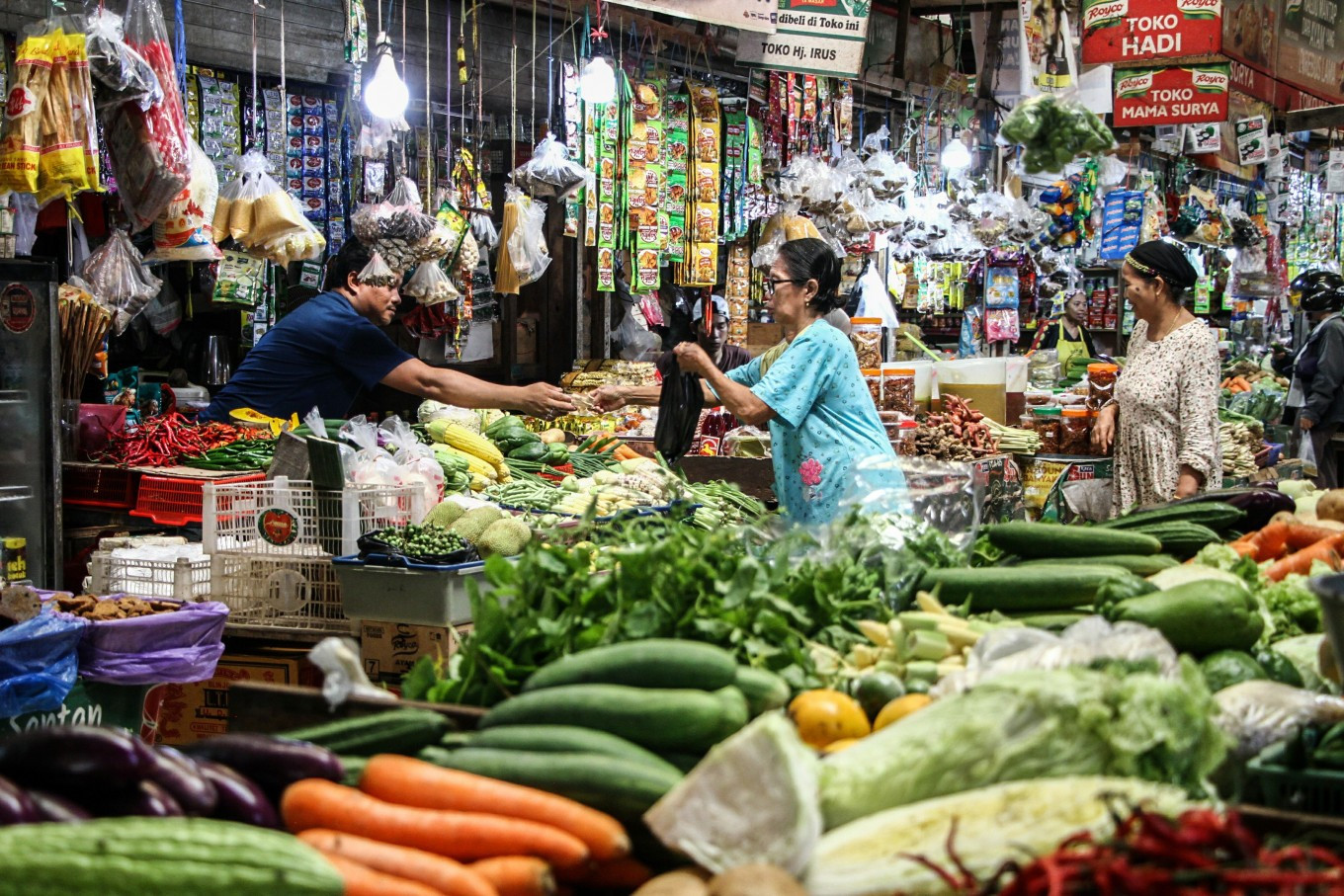 A vendor serves customers shopping for staple foods on June 11 at Kahayan Market in Palangka Raya, Central Kalimantan. (Antara/ Auliya Rahman)
Indonesian consumers are increasingly feeling the pinch from the combined effects of external and domestic pressures on the economy, with the impact extending beyond the country's productive sectors into household finances.
The Consumer Confidence Index (CCI) fell 3.1 points from 120.9 in May to 117.8 in June, the lowest reading since the index stood at 115 in September 2025, driven by weaker assessments of both current economic conditions and future expectations.
The Current Economic Condition Index (CECI) fell 3.0 points from 112.2 in May to 109.2 in June. All three of its components weakened: the Current Income Index (IPSI) stood at 119.8, the Job Availability Index (IKLK) at 101.8 and the Durable Goods Purchase Index (IPDG) at 105.9. The largest decline was in the ISPSI, which dropped 3.4 points, indicating that households felt their income conditions had deteriorated.
Similarly, the Consumer Expectation Index (CEI) fell 3.3 points from 129.7 to 126.4, with all three components recording lower readings. The Income Expectations Index (IEP) stood at 133.6, the Job Availability Expectations Index (IEKLK) at 124.4 and the Business Activity Expectations Index (IEKU) at 121.2. The largest decline was recorded in the IEKLK at 3.7 points, suggesting growing concerns about future employment prospects.
Across expenditure groups, respondents spending more than Rp 5 million (US$278.29) per month remained the most optimistic, recording the highest CCI and CECI at 121.4 and 129.7, respectively. Meanwhile, the highest CEI of 108.8 was recorded among respondents spending between Rp 3.1 million and Rp 4 million. This was also the only expenditure group to record an increase in the CEI between May and June.
By age, consumers between 20 and 30 remained the most optimistic, posting a CCI of 124.3 as well the highest scores across all CECI and CEI components. In contrast, the IKLK and the IPDG fell into pessimistic territory for respondents aged 41 and above, suggesting that older consumers saw job opportunities as limited and were delaying durable goods purchases.
A similar pattern emerged across education groups. Respondents with only a senior high school education recorded an IKLK of 98.3, below the optimistic threshold, while their IPDG also slipped into pessimistic territory. Postgraduate degree holders were even more pessimistic about job availability, with an IKLK of 92.7.
These findings suggest that both high school graduates and postgraduate degree holders are facing difficulties in the labor market, although likely for different reasons. High school graduates may perceive fewer employment opportunities overall, while postgraduate degree holders may be finding it harder to secure jobs that match their qualifications.
Household financial indicators also point to rising pressure. The average propensity to consume (APC) increased from 72.3 percent in May to 73.0 percent in June, while the debt-to-income ratio remained relatively stable at around 10 percent. However, the savings ratio declined from 17.5 percent to 17.0 percent.
Increase in consumption was concentrated among households spending Rp 2.1-3 million, Rp 4.1-5 million and above Rp 5 million per month. Meanwhile, the sharpest savings declines were recorded in the Rp 2.1-3 million and Rp 4.1-5 million expenditure groups, suggesting these households were increasingly relying on their savings to maintain consumption.
The banking sector is also showing signs of rising household financial stress. Consumer loan non-performing loans (NPLs) increased 16.6 percent year-on-year to Rp 55.2 trillion, pushing the overall consumer loan NPL ratio to 2.4 percent in April 2026. Mortgages recorded the highest NPL ratio at 3.3 percent, compared with 2.6 percent for motor vehicle loans and 1.9 percent for other household loans. In the mortgage segment, apartment loans were of particular concern, with the NPL ratio rising from 3.3 percent to 4.2 percent over the past year.
The increase in mortgage NPLs may reflect mounting repayment pressures among middle-income households. In response, banks have tightened lending standards, contributing to a slowdown in mortgage growth from 8.5 percent to 4.8 percent as of April 2026.
Analysts attribute much of the slowdown to the cumulative 100-basis point increase in the BI-Rate over the past six months to 5.75 percent. Further rate hikes could intensify these pressures by raising floating mortgage rates.
Despite these challenges, some analysts continue to view the mortgage market as relatively resilient. Major developers such as Summarecon Agung and Bumi Serpong Damai (BSD) have shifted their focus toward premium residential projects, while developers with strong liquidity have expanded nonbank financing schemes that allow buyers to pay directly in installments. These strategies could help sustain property demand if bank mortgage rates remain elevated.
Property developers with recurring income from shopping malls, hospitals and commercial assets are also considered better positioned than those relying primarily on property sales. Nevertheless, banks could face slower profit growth if higher interest rates continue to suppress loan demand while increasing credit risks.
According to the Federation of Private Domestic Banks (Perbanas), the recent decline in consumer confidence has not yet affected consumer loan disbursement. Perbanas argues that movements in the CCI tend to be volatile and that any impact on lending will likely emerge over the next few months. Instead, it believes the recent slowdown in loan growth has been driven primarily by higher funding costs following the BI-Rate increase to 5.75 percent. The federation also expects the full impact of the latest rate hikes on loan disbursement to materialize over the next two to three months.
The broad-based decline in the CCI, together with weaker readings in both the CECI and the CEI, highlights growing vulnerability among Indonesian households. Consumer optimism remains strongest among higher-spending households, while lower savings and higher consumption suggest that many families are increasingly relying on financial buffers to maintain their living standards. Rising consumer loan NPLs further indicate that higher interest rates are beginning to weigh on household balance sheets.
If these pressures persist, they could undermine both household resilience and the effectiveness of Bank Indonesia (BI)’s efforts to stabilize the economy.