
News
Nickel giants under pressure
Tenggara Strategics December 29, 2025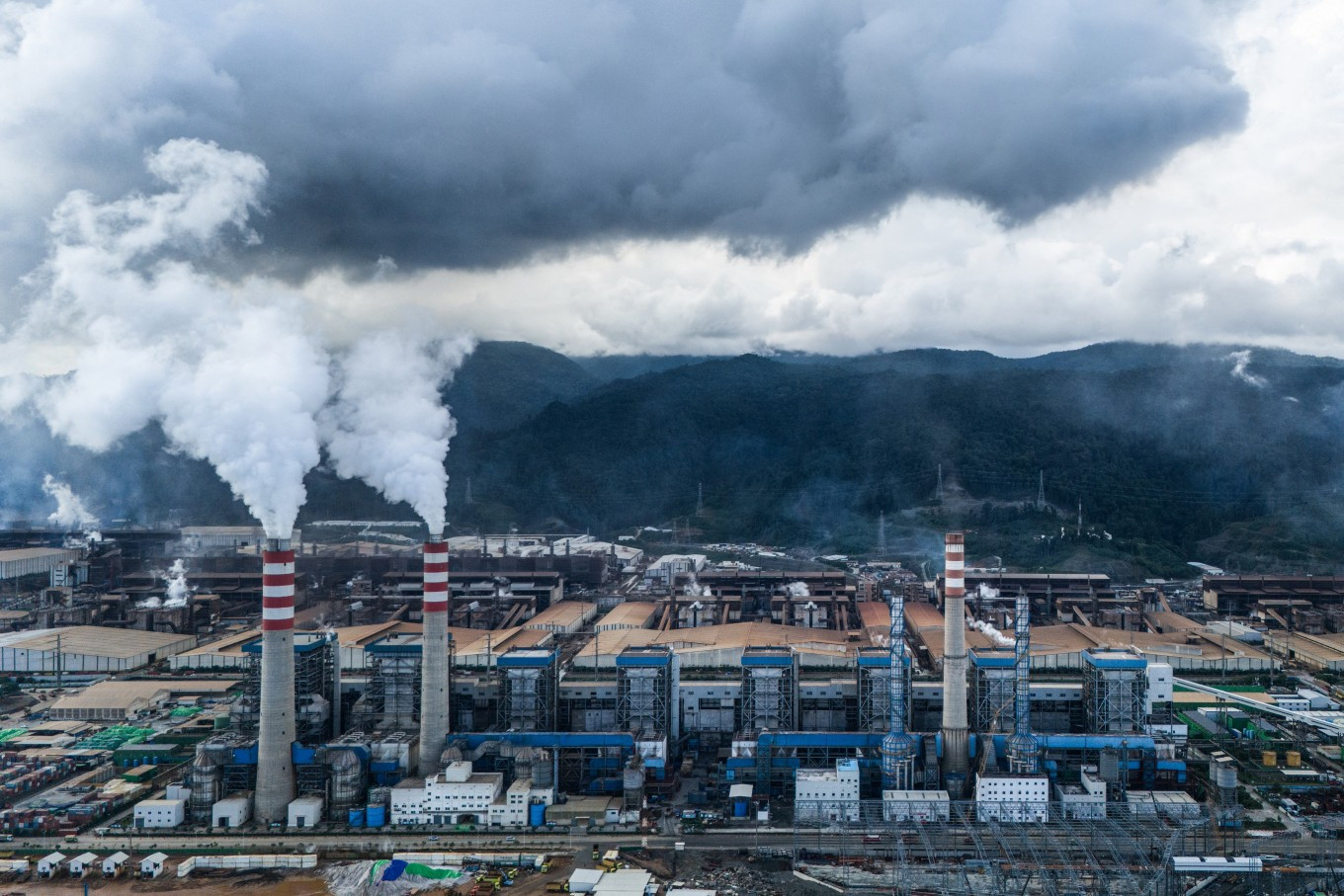 Chimneys spew emissions into the air on July 7, 2024, at the Indonesia Weda Bay Industrial Park in Lelilef, North Maluku. (AFP/Azzam Risqullah)
Indonesia's nickel smelter boom, long promoted as the centerpiece of its downstream industrialization agenda, is entering a new phase. Through Government Regulation No. 28/2025, the government has moved to restrict new smelter permits, prompting questions over whether this signals a response to overcapacity, a recalibration of its downstream strategy or the start of a more measured and deliberate industrial policy.
After banning nickel raw ore exports in 2020, Indonesia cemented its status as the world's top nickel producer by rapidly expanding smelter capacity. The policy compelled major nickel-consuming countries, particularly China, to relocate their processing activities to Indonesia, triggering a swift build-out of refining facilities. By 2024, Indonesia produced 2.2 million metric tonnes of nickel, commanding more than 63 percent of global supply and strengthening its position as the industry's dominant player.
The new regulation targets smelters producing intermediate nickel products using RKEF or HPAL technology. At present, Indonesia has 54 operating smelters, 38 under construction and another 45 in the planning stage. This rapid expansion, however, has carried consequences. Relentless investment and surging output have created a structural oversupply, driving global inventories higher and nickel prices lower.
Nickel futures prices have become increasingly volatile, trending downward. Data from Trading Economics show nickel futures in London falling to US$14,550 in November, one of the lowest levels since early 2021.
To address these imbalances, the government cut nickel mining quotas by 120 million tonnes this year, reducing global quotas by around 35 percent. Yet despite the significant adjustment, prices remain weak, suggesting that oversupply persists. Supporting this view, nickel inventories at London Metal Exchange warehouses have risen by 90,000 tonnes this year to more than 250,000 tonnes, indicating the global market remains saturated.
On the demand side, global stainless-steel purchases, the primary consumer of nickel, remain sluggish. Although higher nickel use in electric vehicle batteries has provided some support, its usage is very small as the majority of EVs sold in Indonesia, and in the world, are using iron-based lithium ferro phosphate (LFP) batteries, and thus, it has not been enough to absorb the industry's excess output.
The government's latest move appears intended to stabilize the market. By slowing unchecked capacity expansion, the policy could tighten supply, enhance competitiveness and support a potential price rebound.
A meaningful nickel price recovery, however, will require not only slowing smelter growth but also imposing a moratorium on nickel concession permits to limit producing mining areas. According to the Indonesian Nickel Miners Association (APNI), nickel mining concessions cover more than 592,000 hectares, about 65 percent of which are in Central Sulawesi and North Maluku.
Yet rebalancing supply is only part of the challenge. Indonesia's downstream model has become deeply intertwined with Chinese capital, technology and industrial networks. Research by Transparency International Indonesia (TII) shows that roughly 75 percent of nickel smelting capacity is controlled by Chinese investors, particularly at the Morowali Industrial Park (IMIP) in Central Sulawesi and the Indonesia Weda Bay Industrial Park (IWIP) in North Maluku.
This concentration of foreign ownership means Indonesia's production dynamics remain strongly shaped by China's demand cycles and investment decisions. While Chinese investment has accelerated Indonesia's downstream ambitions, it has also consolidated market power in a single foreign partner, limiting Indonesia's ability to fully steer its own nickel industry.
Such dependence carries significant risks. When production, financing and technological infrastructure are dominated by one foreign actor, Indonesia becomes exposed to external shocks that undermine its policy flexibility and weaken its bargaining position.
Indonesia's nickel miracle is beginning to show its strain. The new moratorium may serve as a brake, but without deeper reforms in mining licensing, oversight, ownership structures and environmental governance, the sector risks heading toward a future it cannot fully control. Downstream policy was meant to strengthen Indonesia's strategic leverage, not dilute it. The next steps will determine whether the country reclaims control of the narrative or watches its most critical industry slip further from its grasp.