
News
Chasing growth: Can Indonesia break through 5 percent in 2026?
Tenggara Strategics January 31, 2026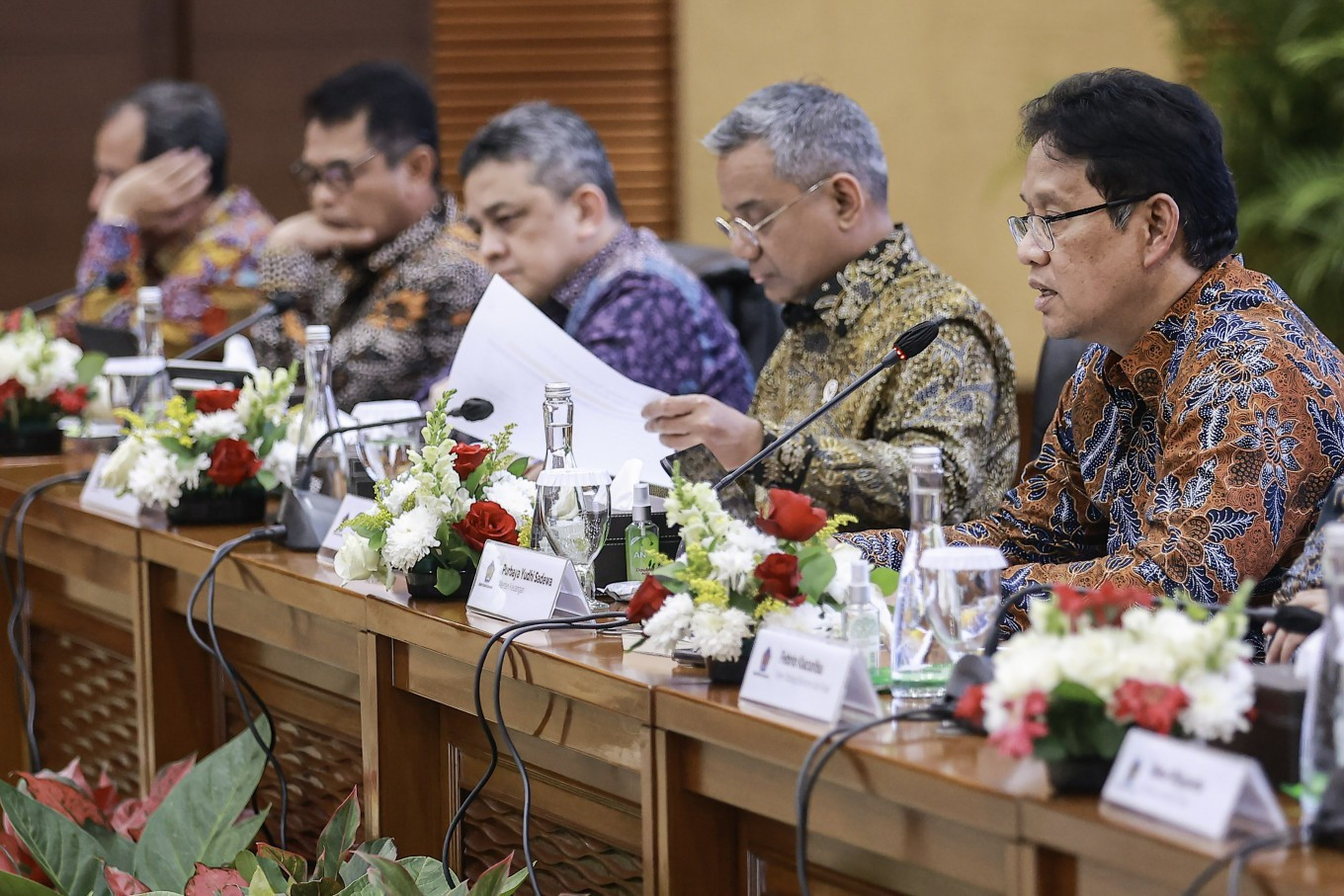 Finance Minister Purbaya Yudhi Sadewa (right) delivers a presentation on Oct. 14, 2025, during a monthly press briefing on the state budget at the Finance Ministry in Central Jakarta. (Antara/Dhemas Reviyanto)
The government has set a 6 percent growth target for 2026, banking on accelerated public spending and tighter fiscal-monetary coordination to generate momentum, in line with President Prabowo Subianto ’s ambition to lift economic expansion to 8 percent by the end of his term in 2029. The challenge, however, lies less in ambition than in execution: whether these policy tools can deliver real growth in an economy where household demand remains fragile and investment responses uneven.
Household consumption, historically the backbone of Indonesia’s growth, showed clear signs of fatigue throughout 2025. In the third quarter, consumption growth slowed to 4.89 percent year-on-year, slipping below the 5 percent benchmark that policymakers often view as a minimum for healthy expansion. The slowdown reflects sustained pressure on purchasing power, driven by elevated living costs, slower real wage growth and lingering uncertainty among households.
This weakness carries significant implications. Household consumption accounts for more than half of Indonesia’s gross domestic product, making it a critical anchor for overall growth. When consumption softens, the effectiveness of fiscal stimulus and investment-led expansion is diminished. Without a clearer recovery in household demand, sustaining growth above 5 percent becomes increasingly difficult, raising questions about the feasibility of reaching the 6 percent targeted for 2026.
Despite these headwinds, Finance Minister Purbaya Yudhi Sadewa has expressed confidence that the target remains achievable. Beyond increased government spending, he has pointed to the role of the De-bottlenecking Task Force in accelerating investment realization and addressing long-standing structural constraints. The minister says improved coordination across ministries and agencies, combined with more decisive policy alignment, should begin to produce tangible economic gains from early 2026.
A critical test of this optimism lies in budget execution. Indonesia has long struggled with slow and uneven budget absorption, particularly in the early months of a fiscal year. Delays in translating allocations into actual spending have frequently blunted the impact of fiscal stimulus. Whether ministries and agencies can disburse funds more quickly and effectively will determine whether public spending generates real economic momentum or merely postpones growth to later quarters.
Toward the end of 2025, the government injected a substantial fiscal stimulus of around Rp 200 trillion (US$12 billion) into the economy to shore up growth ahead of 2026. While expansionary measures can provide short-term support, they also involve trade-offs. A rapid increase in liquidity risks fueling inflationary pressures, potentially eroding purchasing power before demand has time to recover.
Such dynamics underscore a key policy dilemma. Stimulus aimed at accelerating growth may inadvertently undermine household consumption if price increases outpace income gains. Higher inflation would also constrain Bank Indonesia’s room to maneuver, limiting the scope for monetary easing at a time when the economy remains vulnerable and increasing the risk of further rupiah depreciation.
Throughout 2025, the rupiah depreciated to an average of Rp 16,475 per United States dollar and continued to weaken, reaching a rate of around Rp 16,981 by Jan. 21, 2026.
The depreciation reflects a combination of domestic and global factors that have weighed on emerging market currencies. In the US, resilient labor markets and persistent inflation have delayed expectations of aggressive monetary easing, reinforcing dollar strength. At the same time, escalating geopolitical tensions in the Middle East, Venezuela and the Black Sea region have driven oil prices higher due to supply disruptions. For oil-importing economies such as Indonesia, higher energy prices translate into rising import costs, inflationary pressure and a narrower policy buffer.
Indonesia’s growth outlook could improve meaningfully if external and internal conditions align more favorably. A stabilizing rupiah, the absence of major oil price shocks and a smooth policy transition would help reduce uncertainty and restore investor confidence. Under such circumstances, the economy could sustain above 5 percent growth per quarter in 2026, providing a stronger base for medium-term expansion.
However, this outcome is conditional. It requires not only supportive global conditions but also consistent implementation of structural reforms at home. Efforts to lower investment costs, streamline bureaucracy, improve regulatory certainty and strengthen policy transmission to the real economy are critical. Without progress on these fronts, positive external tailwinds may help preserve stability but fall short of propelling Indonesia onto a higher growth trajectory.
Ultimately, the challenge facing Indonesia in 2026 is not a lack of ambition but the ability to bridge aspiration with economic capacity. Fiscal stimulus and closer policy coordination may help cushion short-term risks, but sustainable acceleration beyond the 5 percent range will depend on restoring household purchasing power, anchoring price and exchange rate stability and ensuring that public spending catalyzes productive private sector activity.
Whether 2026 becomes a genuine launchpad toward higher growth or another year of resilient but constrained expansion will hinge on how effectively these policy trade-offs are managed in an increasingly uncertain global environment.