
News
Food estate dream in South Papua grows bigger, more destructive
Tenggara Strategics February 11, 2026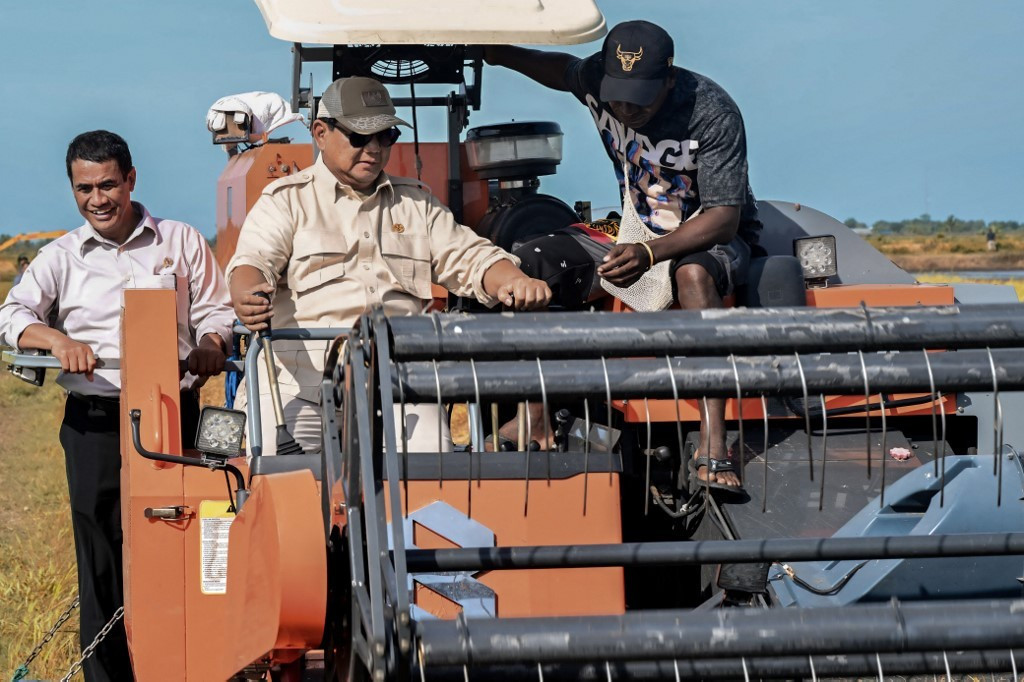 President Prabowo Subianto (center) operates a rice plowing machine at a field cultivated as part of a national scheme to achieve food self-sufficiency, during his visit to Telaga Sari village, Merauke, South Papua, on Nov. 3, 2024. (AFP/Handout/Indonesian Presidential Palace)
The country’s long-running food estate ambition is entering a new and larger phase with the conversion of vast forest areas in South Papua into non-forest zones, or areas for other uses (APL). Initially framed as a strategy to achieve rice self-sufficiency, the program has now expanded under President Prabowo Subianto to also pursue energy security, with palm oil positioned as a key commodity to serve both goals.
The food estate initiative was launched in 2020 under President Joko “Jokowi” Widodo, following warnings from the Food and Agriculture Organization that the COVID-19 pandemic could trigger global food shortages. Framed as a matter of national defense, the program was assigned to then-defense minister Prabowo.
At the time, the Defense Ministry proposed Merauke Regency as the project site, citing abundant available land. The Merauke administration said it had at least 2.5 million hectares suitable for development, half of which had previously been allocated to the Merauke Integrated Food and Energy Estate (MIFEE) project under the administration of Susilo Bambang Yudhoyono. The project ultimately failed, largely because wetlands in the area proved unsuitable for rice cultivation.
Political considerations played a role in Jokowi’s decision not to revive the MIFEE, as a successful revival could have bolstered Yudhoyono’s legacy at a time when his Democratic Party sat in opposition. Jokowi opted instead to develop food estates in Central Kalimantan but that effort also faltered, in part because peatland is similarly ill-suited for farming rice.
Yet Merauke never fully disappeared from the policy agenda. On Apr. 19, 2024, after Prabowo had been declared president-elect, Jokowi issued Presidential Decree No. 15/2024 on establishing a sugar and bioethanol self-sufficiency task force. He then appointed his investment minister Bahlil Lahadalia to lead the task force, which was assigned to implement its program in Merauke, the original location proposed by the Defense Ministry.
Prabowo immediately followed suit, moving to redirect the food estate program back to Merauke. To get an early start, he brought in Jhonlin Group owner Andi “Isam” Syamsuddin, facilitated by Isam’s cousin Amran Sulaiman, who was agriculture minister at the time. Jhonlin began clearing land and building infrastructure for rice paddies, deploying 2,000 excavators imported from China worth Rp 4 trillion (US$236.94 million). When Prabowo took office in October 2024, Amran was retained as agriculture minister.
The sugar and bioethanol self-sufficiency project soon ran into institutional hurdles. A budget deadlock and the absence of a regional spatial plan (RTRW) for South Papua, newly established in 2022, prompted the formation of a high-level coordination team led by Coordinating Food Minister Zulkifli Hasan via Presidential Decree No. 19/2025, issued on Aug. 5. The team designated the food estate as a national strategic project (PSN) and declared Merauke, Mappi, Asmat and Boven Digoel as national food, energy and water self-sufficiency areas under Coordinating Economy Minister Regulation No. 16/2025.
To support the food estate PSN, 489,940 ha of forests in Merauke, Boven Digoel and Mappi were reassigned non-forest area (APL) status on Sept. 18 through Forestry Minister Regulation No. 591/2025. Oil palm development plans include 143,000 ha of these newly converted forests and 326,000 ha of illegal plantations seized by the forest area enforcement task force (Satgas PKH).
The National Procurement Agency (LKPP) issued Regulation No. 3/2025 on Sept. 22, to accelerate state funds disbursement by eliminating electronic bidding and feasibility study requirements for vendors of self-sufficiency areas.
This regulatory change enabled Jhonlin to bill the 2025 state budget for work done in 2024 to a tune of Rp 7 trillion, Rp 1 trillion of which has been paid.
Further cementing the program’s footprint, the Agrarian and Spatial Planning Ministry issued decrees on Jan. 11, 2026, granting right to build (HGB) and right to cultivate (HGU) for 328,000 ha of land redesignated as APL. This includes customary forests for which indigenous Papuan communities have long sought formal recognition.
What we've heard
Several government sources have confirmed that the expansion of the food estate in Boven Digoel is being specifically designated for oil palm plantations to support the B50 biodiesel program. Forestry Minister Decree No. 591/2025, issued by incumbent Raja Juli Antoni, forms the legal basis for the release of forest areas to accelerate the food and energy self-sufficiency agenda through oil palm plantations.