
News
Desperately seeking funds for Red and White cooperatives
Tenggara Strategics March 4, 2026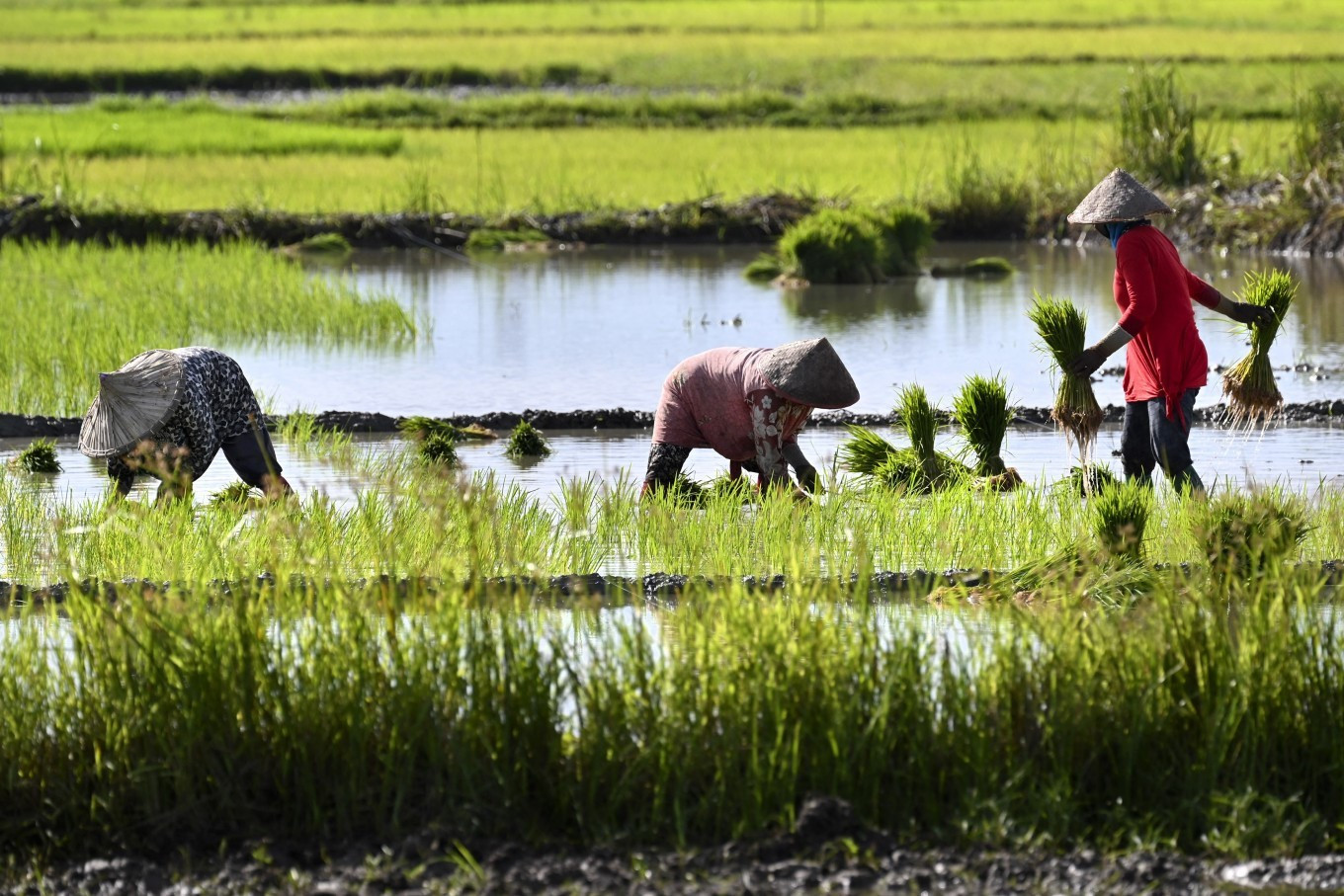 Farmers plant rice in a paddy field on June 28, 2025, at Lambaro in Aceh. (AFP/Chaideer Mahyuddin)
The Red and White Cooperative (KDMP) initiative is rapidly transforming from a flagship economic program into a mandate that must succeed at any cost. In its wake, the program is now cannibalizing the Village Fund, the very backbone of rural development and a decade-long symbol of local empowerment.
Earlier this month, Finance Ministry Regulation No. 7/2026 on Village Fund Management issued a startling directive requiring that 58 percent of all Village Funds be diverted to the KDMP. This mandate drastically strangles the budgetary autonomy of local leaders across the archipelago.
With the 2026 Village Fund ceiling set at Rp 60.6 trillion (US$3.6 billion) for distribution to 75,260 villages, each community receives an average of Rp 805 million. Under these new provisions, villages are left with a meager Rp 332 million to address locally determined needs.
For the nearly 60 percent of Indonesian villages that generate zero internal revenue, the Village Fund is not a supplementary "bonus", it is their entire lifeline for survival and growth.
Since 2015, fiscal decentralization has allowed villages to evolve from passive recipients of aid into autonomous planners. The results were measurable, as the number of self-sufficient villages skyrocketed from a mere 173 in 2015 to over 20,500 by 2025. This progress was built on the principle that local people know their needs better than the central government.
By mandating how over half of these funds are spent, the government risks reverting villages into mere branch offices of a central bureaucracy. The friction is already visible in regions like Kediri and Lamongan, both in East Java, where public outcry erupted over plans to pave over village soccer fields to make room for cooperative offices. These local landmarks have become symbols of a top-down approach that prioritizes national quotas over social cohesion.
This shift creates a glaring political contradiction. During the 2024 campaign, the Prabowo-Gibran ticket pledged to quintuple the Village Fund to Rp 5 billion per village. Instead, the current reallocation feels like a "policy paradox" to critics who supported that vision.
The financial logistics further complicate the narrative. While the KDMP was initially framed as a low-impact Rp 40 trillion loan scheme backed by state-owned banks, recent contracts to import 105,000 pickup trucks from India—valued at approximately Rp 24.66 trillion—have raised eyebrows in the House of Representatives. Critics question how a program built on the narrative of "national sovereignty" justifies such a massive reliance on foreign industrial imports.
Perhaps the most concerning dimension is the expanding role of the Indonesian Military (TNI) in the KDMP’s rollout. While the military is legally permitted to assist in operations other than war, the construction of cooperatives is neither a humanitarian crisis nor an emergency response.
While proponents cite the military’s territorial efficiency, the normalization of military involvement in civilian economic projects blurs a vital line. In a healthy democracy, civilian authorities—not the military—should manage the wheels of commerce and rural development. This encroachment risks creating a "command and control" economy in the countryside, which is often at odds with the collaborative spirit of traditional cooperatives.
The broader question is not whether cooperatives are a valid tool for rural growth; they certainly can be. The question is whether the state is willing to dismantle a decade of successful decentralization to build them.
By diverting local funds and expanding military participation in grassroots economics, the government risks sacrificing the very principles of local empowerment that have underpinned Indonesia’s rural transformation for the past decade.
If the KDMP is to succeed, it should be an addition to the village's strength, not a replacement for its autonomy.
What we've heard
President Prabowo Subianto has launched an ambitious initiative to establish 80,000 Red and White Cooperatives (KMP) throughout Indonesia, aiming to create a more equitable distribution of national welfare. Despite this vision, the program has faced a slow start. As of early February 2026, only 800 units have been completed, while approximately 20,000 others remain in various stages of construction.