
News
SHIMIZU Premium Interview #5 - A Dialogue with the Budiman Family
Aqraa Sagir (The Jakarta Post) July 22, 2024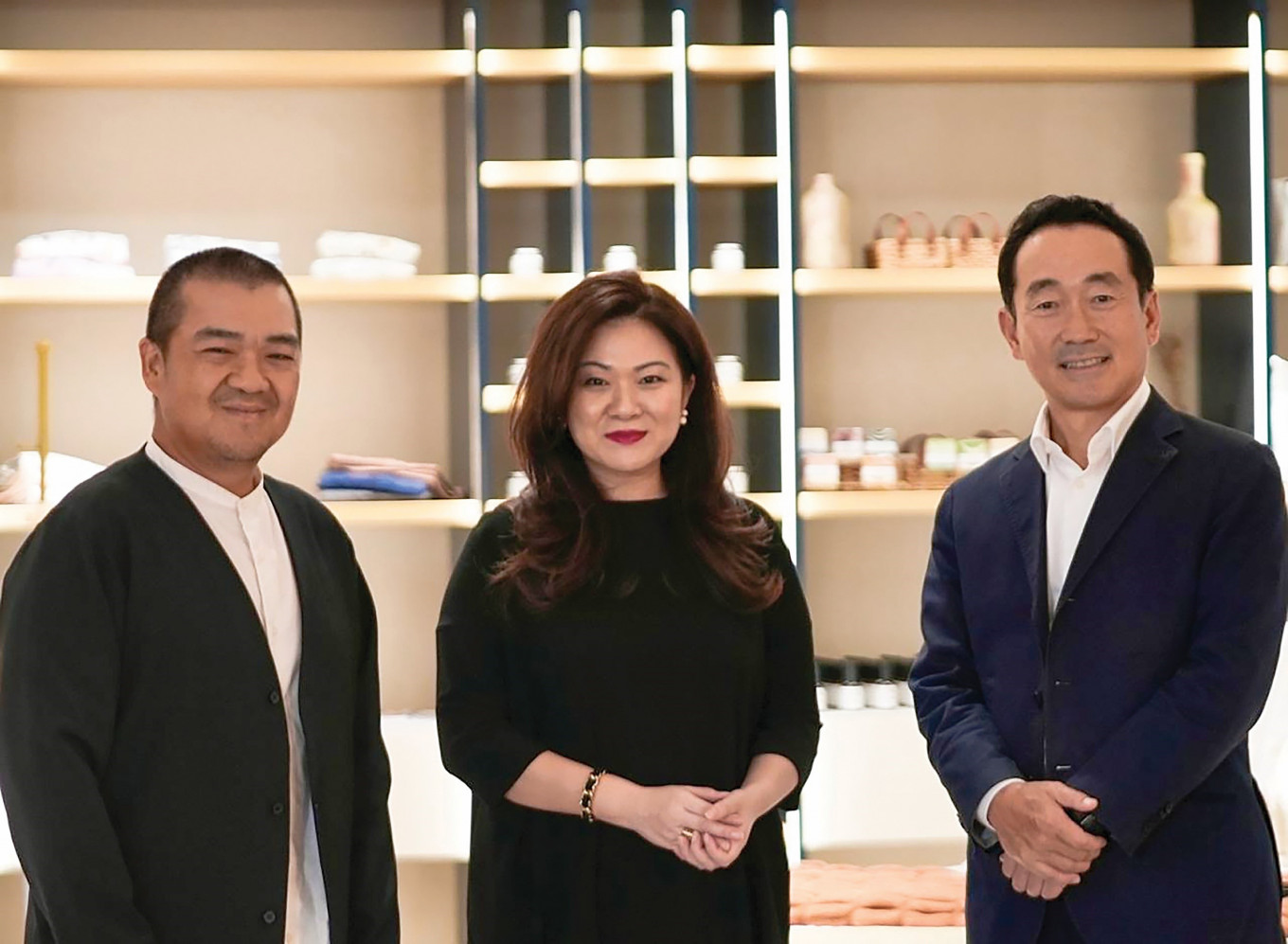 Mulia Colliman International President Director Agung Budiman, Budiman Sejahtera Development Director Novianna Budiman, and Shimizu Corporation Jakarta Office Chief Representative Kohei Akiyama. (Shimizu Corporation).
Great partnership between foreign investors and local developers not only create synergy for success, but also add colors to our world.
“Foreign investors bring in new ideas, dynamics, and a global perspective. However, they need local partners because, in my experience, success cannot be achieved alone. It depends on who you partner with. This is the lesson my family and I have learned through our experience in various aspects of our family business.” Mulia Colliman International President Director Agung Budiman stated.
“Our grandfather started trading business in 1950s and it has expanded into manufacturing, automotive, electronics, textiles, and more over the decades,” Agung explained. “We partner with Japanese companies, for example, TORAY and Honda, and have great experience working with them. Currently, property sector including office buildings, golf resorts, hotels, residential, and industrial estates consist one of the major pillars of our business, but we are trying to expand our group business portfolio into different sectors.”
In the 5th iteration of SHIMIZU Premium Interview, Agung, together with his sister Novianna Budiman, Budiman Sejahtera's Development Director, and Shimizu Corporation Jakarta Office Chief Representative Kohei Akiyama discussed - with a particular focus in property and construction sectors - how international partnership and collaborative approach drive sustainable economic growth and mutual prosperity.
The dialogue started with sharing their insights regarding current investment climate in Indonesia.
“In my opinion, investing in Indonesia’s property market has a lot of upsides and opportunities compared to other countries, because there are various options like real estate, tourism, healthcare and more,” Agung said .
Novianna added, “Indonesia presents a robust opportunity due to its huge population and the rising middle class with increasing consumption power. The Indonesian government is actively supporting foreign investment through initiatives like the Omnibus Law on job creation, providing incentives for foreign entities to partner with local developers.”
As Indonesia undergoes a transition to the new government, the Budiman Family expresses optimism for sustained economic growth and foreign investment incentives. They commend the current government’s strides in infrastructure development, GDP growth, and digital technology while expressing hope for a seamless transition and continued support for foreign investors under the new leadership. This is important for Indonesia to be more competitive in Asia, and jump start the economy to another level.
From a construction perspective, Akiyama shared a few examples how a foreign company can contribute to enhancing living environments in Indonesia.
“The best example would be the Jakarta MRT. It provides a new option for people to travel around this megacity without worrying about traffic and can arrive at destination on time. Besides, it is a healthy transportation because people have a chance to walk and go up and down the stairs at stations. Second, it reduces travel time and costs, and third, it reduces greenhouse gas emissions if more and more people use MRT instead of cars.”
“Another example is Green Building Projects. As Green Buildings are energy-efficient, eco-friendly, and enhance the quality of life for tenants, they are becoming increasingly popular. We can help not only constructing Green Buildings, but also [in the] application process to receive certifications.”
Transit Oriented Development (TOD) is another area where Shimizu can contribute by bringing their rich experience and deep knowledge from Japan. TOD is designed to maximize access to public transport in a residential, commercial and recreational area. If done right, it discourages an individual’s auto-dependency and promote transit ridership, thereby alleviating traffic congestion, improving air quality, and limiting carbon emissions.
The beginning of the business relationship between Budiman Family and Shimizu Corporation was construction of ATRIA Sudirman building in 1993. Novianna praised that it was worth the investment because it is still in a remarkable condition after 30 years.
“I hope we can collaborate with Shimizu again to continue what we started back in 1993 with the construction of ATRIA Sudirman,” Agung said . “It would be a full circle moment and a perfect scenario.”
Akiyama echoed these sentiments, “Likewise, I hope to have a chance to work together with the Budiman Family again, utilizing Shimizu’s high expertise, knowledge, and technology for making optimized “plan and build” to contribute to their development projects.”
As a conclusion, Novianna added, “On a larger scale, I wish to see more collaboration not only in a private sector, but also between the Indonesian and Japanese governments. Whether in construction, medical, or education sectors, we can transfer knowledge and learn a lot from each other in all areas of life. It will lead to enhancing economies and cultures in both Indonesia and Japan.”