
News
Acid attack puts spotlight on Prabowo’s human rights commitment
Tenggara Strategics April 6, 2026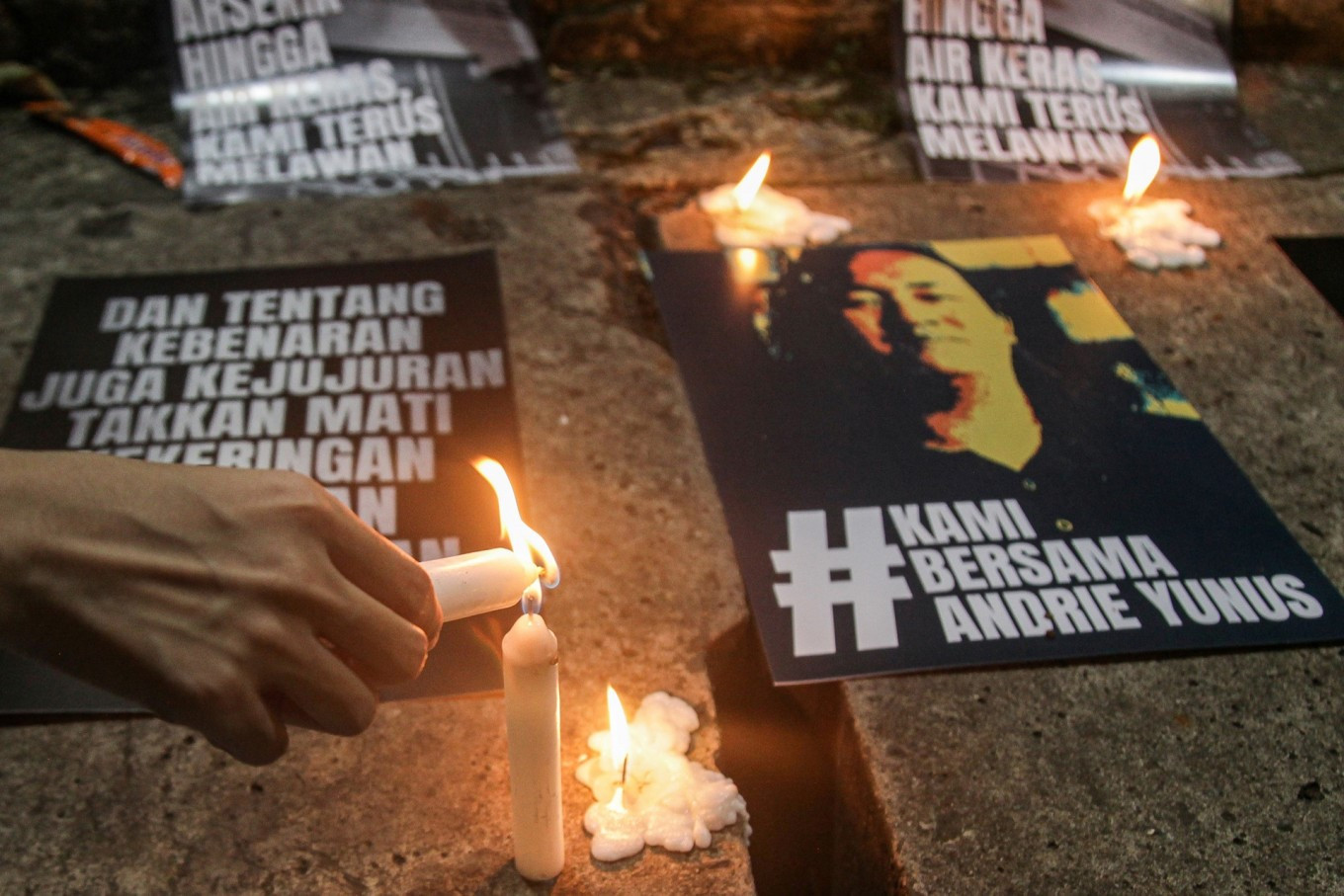 An activist lights up a candle during a prayer gathering on March 17 for Andrie Yunus, a Commission for Missing Persons and Victims of Violence (Kontras) activist targeted in an acid attack, in front of the National Commission on Human Rights (Komnas HAM) in Jakarta. (Antara/Darryl Ramadhan)
President Prabowo Subianto is hardly known for his commitment to human rights, not since taking up the presidency in October 2024 and certainly not during his Army years. He rarely addresses the issue in public, delegating it instead to his Human Rights Minister Natalius Pigai to answer questions on the topic.
But with the March 6 acid attack against a human rights defender, Prabowo can no longer avoid the issue, especially since the Indonesian Military (TNI) has announced that four members of the TNI’s Strategic Intelligence Agency (BAIS) are under investigation.
The attack against Andrie Yunus, deputy coordinator for external affairs for the Commission for Missing Persons and Victims of Violence (Kontras), has drawn condemnations from hundreds of international and national nongovernmental organizations who have question Indonesia’s commitment to human rights and protection of human rights defenders.
It is all the more disturbing since Indonesia this year takes the rotating presidency of the United Nations Human Rights Council in Geneva, Switzerland.
Mary Lawlor, the UN Special Rapporteur on the Situation of Human Rights Defenders, called on the Indonesian authorities to carry out thorough investigations. ”Impunity for violence against human rights defenders is unacceptable,” she wrote on her social media, according to Tempo.
During a meeting with a small group of journalists and critics early this month, Prabowo was asked to comment on the attack. He described it as an “act of terrorism”, but refused to commit himself to the establishment of an independent team, which many view as necessary for the investigation to have any credibility.
The way the TNI literally wrestled the case from police has already raised doubts that the investigation will be anything but credible.
Andrie, who led Kontras and other civil society organizations in opposition to the revision of the TNI bill last year, was riding home on his motorcycle after recording a podcast on the military’s role in politics, when two men, also on a motorcycle, ambushed and sprayed him with an acid liquid, in Central Jakarta
Videos of Andrie screaming in pain have gone viral on social media. He is said to be in stable condition in the intensive care unit at Cipto Mangunkusumo hospital, and has suffered severe burns to his face, right eye, hands and chest.
Police on March 16 announced that they were able to identify two of the four perpetrators, based on images collected from 86 CCTVs tracking Andrie’s movement that night. Police said the four were seen stalking Andrie, and that they belong to a security agency but without naming the unit.
Around the same time, the Indonesian Military Police (Puspom) held their own press briefing, identifying four perpetrators by their initials, two from the Navy and two from the Air Force, and confirming that they worked for BAIS. There was also further confusion since these initials did not match with those provided by the police.
Puspom had not provided a motive for the attack or upon whose order, calling for patience while the investigation continued. Then in the latest twist, on March 25, BAIS chief Lt. Gen. Yudi Abrimantyo tendered his resignation, ostensibly due to the attack.
Civil society organizations are calling for the immediate release of the identities of the four suspects and their photos, for the sake of transparency.
They have also called for the case to be tried in a civilian criminal court rather than a military tribunal, which in the past, has given lighter sentences to soldiers accused of human rights abuses under pretences of line of duty.
Andrie’s case has also revived other unresolved human rights attacks that have haunted Indonesia, some going back to the New Order regime under former president Soeharto.
One striking cases was the killing of Munir Said Thalib, director and founder of Kontras and staunch critic of the TNI, in 2004. Munir was poisoned by arson while on a flight to Amsterdam. The Supreme Court acquitted all four who were found guilty in a lower court, including a senior military intelligence officer, the chief director of Garuda Indonesia, the pilot and air hostess involved.
Prabowo’s name has also been linked to human rights abuses. During his Army years, this included the kidnapping and disappearances of students and activists critical of Soeharto in the 1990s by the Army’s Special Forces which he commanded at the time. He was never tried in a court of law, but was dismissed from the TNI in 1998 for insubordination.
How the Andrie case is investigated and whether it is resolved will inevitably reflect on Prabowo’s commitment to human rights.
What we've heard
The police and the TNI have presented differing accounts regarding the perpetrators behind the acid attack on Kontras activist Andrie Yunus. Several sources familiar with the investigation stated that only one individual overlaps, identified by the initials BHC (also known as BHW).